


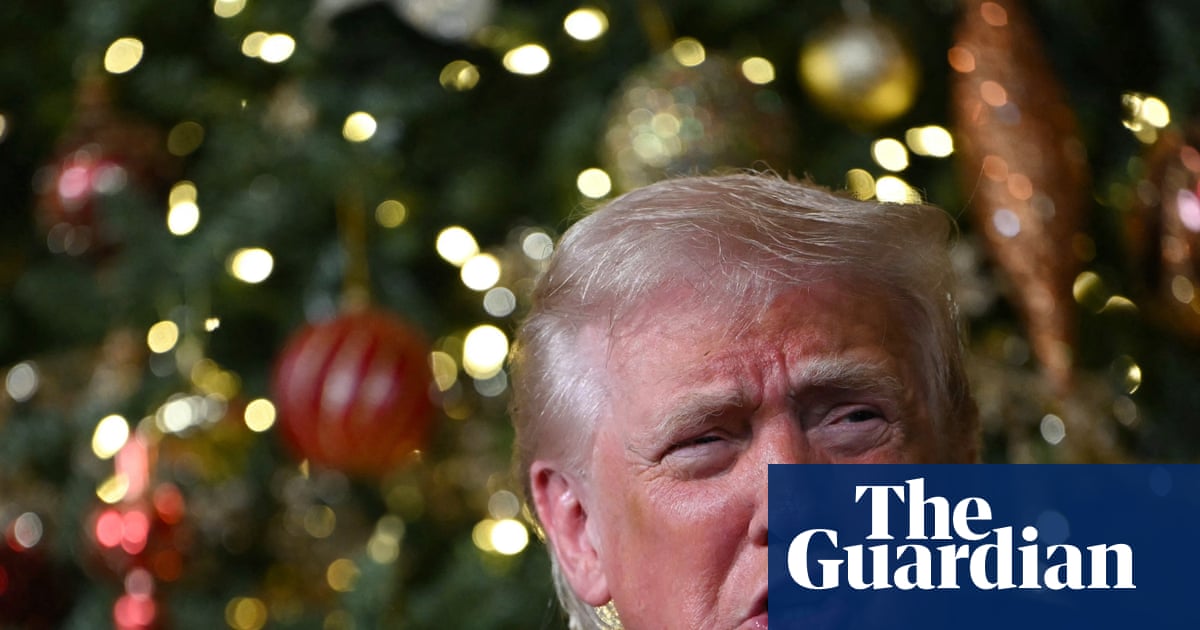
President Donald Trump said the United States carried out airstrikes against Islamic State militants in northwestern Nigeria on Thursday, after weeks of accusing the group of targeting Christians.
The president said in a post on the Truth social platform: “Tonight, at my direction as Commander-in-Chief, the United States launched a powerful and deadly attack against the ISIS terrorist scum in northwestern Nigeria. They have primarily targeted innocent Christians, committing brutal killings at levels not seen in years, or even centuries!”
“I previously warned these terrorists that if they did not stop their slaughter of Christians, there would be a punishment in hell, and tonight that happened. The Department of the Army carried out many of the perfect attacks that only the United States could do.”
The U.S. military’s Africa Command said the airstrike was carried out in Sokoto state in coordination with Nigerian authorities. An earlier statement from the command published in X said the attack was carried out at the request of Nigerian authorities, but the statement was later deleted. “We appreciate the support and cooperation of the Nigerian government,” said Secretary of Defense Pete Hegseth.
Sokoto’s forests, which border Niger to the north, are used as a base for armed bandit groups and members of the Islamic State in the Sahel Province (ISSP), known locally as Laklawa. Some analysts argue that the latter cells in the state began as groups of pastoralists who banded together to fight bandit incursions in the absence of state support.
Nigeria’s Ministry of Foreign Affairs said the airstrike was carried out as part of continued security cooperation with the United States, which includes intelligence sharing and strategic coordination to target insurgents. “This led to precision strikes on terrorist targets in Nigeria with airstrikes in the northwest,” the ministry said in a post to X.
Earlier this month, US military aircraft conducted surveillance missions over the area. It is believed that the aircraft was using an airport in neighboring Ghana as a launch pad.
President Trump had previously said he would launch a “firefight” US military intervention in Nigeria, saying the country’s government was not doing enough to stop Islamist groups from attacking Christians.
Although Nigeria is officially a secular country, the population is split almost evenly between Muslims (53%) and Christians (45%). Violence against Christians has received significant international attention, particularly among the American religious right, and has often been treated as religious persecution.
However, the Nigerian government has refused to frame the country’s violence in terms of religious persecution, saying armed groups have targeted both Muslims and Christians in the past, and the United States argues that the persecution faced by Christians does not represent a complex security situation and ignores efforts to protect religious freedom. But the government had previously agreed to work with the United States to strengthen military forces against the insurgents.
Many analysts say the situation in Nigeria is complex and has long roots in the region’s history. In some parts of the country, conflicts between Muslim nomads and Christian-majority rural areas are rooted in competition over land and water, but are exacerbated by ethnicity and religion.
Priests and pastors are increasingly being kidnapped for ransom, but some experts say this may be a trend driven by criminal motives rather than religious discrimination.
The airstrike came a day after a Christmas Eve bombing at a mosque in northeastern Nigeria killed at least five people and seriously injured more than 30 others. Nigeria’s military blamed Boko Haram for the suicide bombings in Borno, which has been the center of a jihadist insurgency for nearly two decades.
Trump, who has positioned himself as a “peace candidate” in 2024, campaigned on a promise to liberate the United States from decades of “endless wars.” But his first year back in the White House was notable for a number of military interventions overseas, including attacks on Yemen, Iran and Syria, and a major military buildup in the Caribbean targeting Venezuela.
