


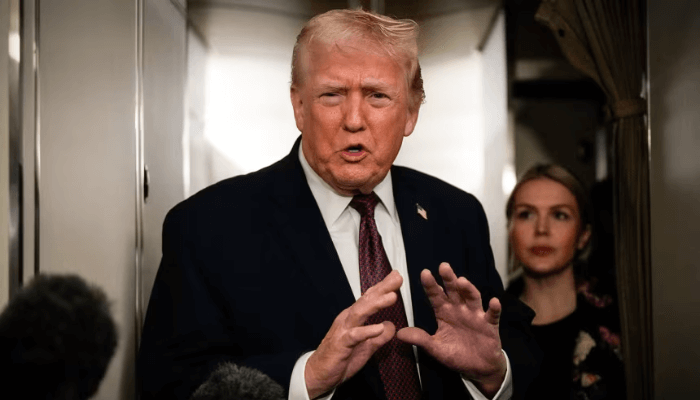
President Donald Trump speaks to reporters aboard Air Force One on his way to Joint Base Andrews, Maryland, on January 11. Julia Demaree Nickinson/AP
Joe Keshi, Nigeria’s former permanent secretary and foreign minister, warned that the US is specifically targeting global remittance flows, with the latest crackdown barring 75 countries, including Nigeria, from obtaining immigrant visas.
In an interview with Channels TV, he warned that Nigeria needed to develop a systematic strategy to engage with Washington and called on Nigeria’s federal government to urgently “reflect and understand” the motives behind the crackdown.
The veteran diplomat emphasized the possibility of a domestic economic crisis if these financial pipelines are narrowed.
“We receive more than $24 billion a year from overseas Nigerians and that is a tremendous amount of money Nigeria stands to lose if the remittances are targeted,” Keshi said.
He further warned that if new US policies disrupt the flow of capital, many Nigerian families dependent on these funds could be pushed “below the poverty line.”
According to him, proper coordination is needed to find out what President Trump thinks about Nigeria. “A few days ago, he said that 30 percent of Nigerians earn their living from the state, which is not true. Many Nigerians living in the United States are hard-working and have two to three jobs,” he said.
The move is expected to impact travel, immigration and international relations.
Crackdown on “public charges”
The ambassador’s warning came after the U.S. State Department announced it would indefinitely suspend processing immigrant visas for nationals of 75 countries, including Nigeria.
The move marks a significant escalation in efforts to restrict legal routes into the United States since President Donald Trump returned to office.
The State Department justified the move Wednesday, calling it a necessary step to “end abuse” of the U.S. system.
Officials claimed the restrictions were aimed at preventing foreigners from using welfare and public benefits to “exploit wealth.”
Scope of new restrictions
The order is scheduled to take effect on January 21, although the complete list of 75 affected countries remains classified. Key details of the policy include:
Public charge rule: Potential immigrants who are deemed to be a “public charge” are judged ineligible.
Related article: Nigeria accounts for over 60% of Africa’s FID – Lokpobiri
Reassessment of procedures: Secretary of State Marco Rubio has ordered a moratorium on the review of vetting procedures to prevent “exploitation” of America’s social safety net.
Selective Suspension: The freeze applies specifically to immigrant visas. Non-immigrant categories such as temporary tourist visas and business visas are not affected at this time.
Existing Bans: This new measure builds on previous restrictions already in place for nationals of Brazil, Iran, Russia, Somalia, and Afghanistan.
National security and economic impact
The administration moved to a more aggressive review following a security incident involving an Afghan national in Washington, D.C., in November. In the aftermath, the White House banned or restricted entry to nationals of 19 countries, but the list has since been expanded to include 24 countries and holders of Palestinian Authority documents.
The impact on these countries is severe. Not only are new visas on hold in the original target countries, but asylum applications, citizenship processing, and green card applications are also frozen.
For Nigeria, concerns remain primarily economic. The resulting friction could significantly reduce the billions of dollars in private capital sent each year as the Trump administration moves to “protect the generosity of the American people.”

