


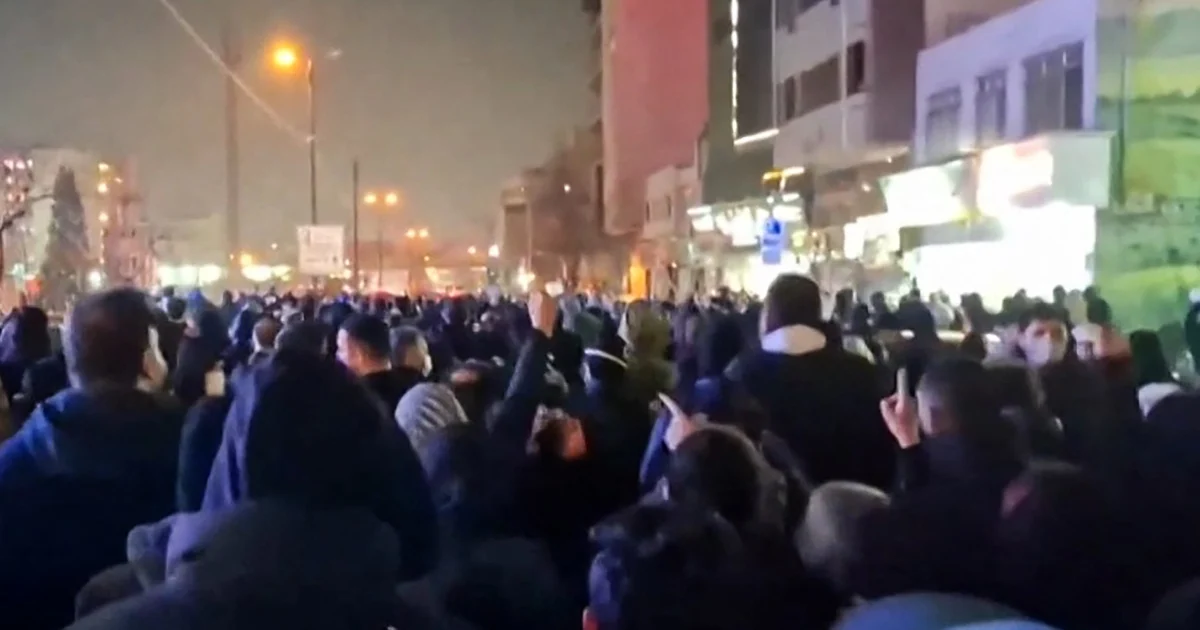
Protesters poured onto the streets of cities across the country late Friday, ignoring threats of harsh punishment from Iranian leaders and warnings from human rights groups about unlawful killings.
The fresh protests came after President Donald Trump renewed his warning to the Islamic regime that he would intervene if protesters were killed. “I say to the Iranian leaders: You better not start shooting because we will start shooting too,” he told a meeting with oil executives.
Iranian Prosecutor General Mohammad Movahedi Azad said Saturday in remarks carried by Iran’s semi-official Tasnim news agency that the protesters would be considered “enemies of God” in Iran, punishable by the death penalty.
The news agency also reported that 100 people were arrested for “disturbing public order” and leading riots in Tehran province.
The demonstrations, which began nearly two weeks ago amid economic discontent caused by last week’s currency collapse and soaring inflation, have now turned into one of the biggest challenges the Islamic republic has faced in its 47-year history, with thousands taking to the streets in cities large and small across the country to demand the ouster of the ruling cleric.
The country’s supreme leader, Ayatollah Ali Khamenei, took a hard line in a fiery speech on Friday, saying the Islamic Republic would not back down in the face of domestic protests or external pressure, a position analysts say is likely to lead to more violence by security forces against demonstrators.
“At this point, we’re very concerned that there will be an increase in atrocities after the internet shutdown,” Mahmoud Amily Moghaddam, director of the Norway-based group Iran Human Rights, told NBC News in a phone interview.
The organization said in a report released Friday that at least 51 people, including eight children, were killed during two weeks of protests that spread to 11 states across the country.
Amnesty International issued a similarly stern warning in a post about X on Friday.
“Iranian authorities have once again deliberately blocked internet access within Iran in order to hide the true extent of grave human rights violations and crimes under international law that they are committing to suppress nationwide protests,” the group said.
Video trickling out on Friday and located by NBC News showed large crowds in Mashhad and Tehran shouting slogans against Khamenei.
An X post showing protesters in Tehran’s Saadat Abad district states that the video clip was sent via Starlink, Elon Musk’s satellite internet service, which could be one way for protesters to circumvent internet blackouts. Starlink terminals are known to have been smuggled into Iran during the last major protests in 2022 and 2023.
Videos posted on social media since Thursday show security forces likely waging an intense and bloody crackdown across the country, with some protesters also attacking government buildings.
Amily Moghaddam said he had heard that his organization was carrying out “massive acts of violence” in the city of Qarazi, west of Tehran.
One video posted online, said to be from Fardis, a city between Karaj and Tehran, circulated on Friday and shows several bodies strewn on a bloodstained floor as a man filming says: “They shot with war bullets and killed people!”
NBC News did not independently verify the content of the video.
Another video geolocated by NBC News shows a municipal building in Karaj on fire.
Violence also broke out in the city of Zahedan in southeastern Iran after Friday prayers. Security forces opened fire on the crowd of protesters, according to the Norwegian-registered Kurdish monitoring group Hengo Human Rights Organization, which monitors rights violations across Iran.
Zahedan, home to a large community of Iran’s ethnic Baluchi minority, has also been a hotbed of 2022 protests, with several protesters shot dead by security forces after Friday prayers in what later became known as “Bloody Friday.”
Reza Pahlavi, the son of Iran’s late exiled Shah, called on protesters on X Post early Saturday to prepare to take over urban centers across Iran.
He also called for a “national strike” targeting the transport, oil, gas and energy industries to destabilize the regime.
The violence in Iran comes as President Trump on Friday once again warned the country’s leaders not to kill protesters.
“We have made it very clear that if they start killing people like they have in the past, we will get involved,” he said at a meeting with oil company executives attended by journalists. “You hit it hard where it hurts. That doesn’t mean putting your boots on the ground, it means hitting it really hard where it hurts.”
Trump later added, “I say to the leaders of Iran: You better not start shooting because we’re going to start shooting too.”
“The United States stands with the brave Iranian people,” Secretary of State Marco Rubio said in a post to X late Friday.
British Prime Minister Keir Starmer, French President Emmanuel Macron and German Chancellor Friedrich Merz issued a joint statement Friday calling on Iranian authorities to “exercise restraint”.
“We are deeply concerned by reports of violence by Iranian security forces and strongly condemn the killing of protesters,” the statement said. “Iranian authorities have a responsibility to protect their citizens and must allow freedom of expression and peaceful assembly without fear of reprisal.”
Analysts say the protests are unlikely to stop anytime soon as the Iranian government steps up violence.
“In every protest movement over the past decade, the initial trigger is embedded in broader discontent with the regime,” Ali Baez, Iran project director at the International Crisis Group, said in a text message in response to questions. “This is one of the key challenges facing the nation. Governments can suppress dissatisfaction but fail to address the underlying political, social and economic grievances.”
