


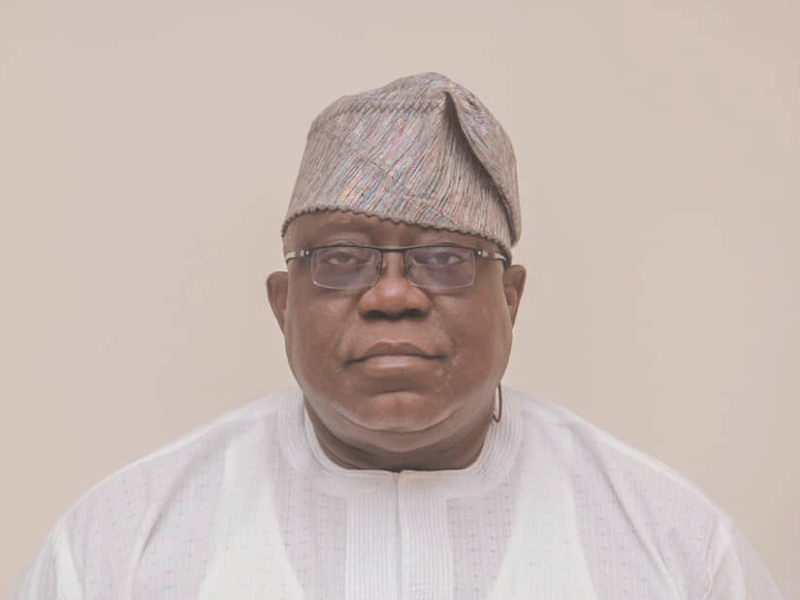
Written by Tunji Olaopa
Exploring the Relationship Between Politicians and Political Scientists
In introductory political science or political philosophy courses, a common exercise involves comparing the roles of politicians and political scientists. Educators often prompt students to explore how these different commitments shape our understanding of political life. What contributions do political scientists and politicians make to the field, and how do they inform our perception of politics as both an art and a science? Is one more impactful than the other—a practitioner versus a theorist? Furthermore, can political scientists transition effectively into political roles? These inquiries extend beyond academic exercises and resonate on a personal level. When I chose to study political science at the University of Ibadan, my mother questioned whether I’d need to wait for a return to civilian rule before finding a job. My later role as a research assistant to the late Chief Obafemi Awolowo led my parents to assume I was destined for a political career. Their assumptions illustrate a common tendency to conflate the study of political science with a direct path to political practice.
Understanding the Distinct Yet Interconnected Roles
Politicians are driven by a calling to engage in politics, seeking to gain political power to make consequential decisions that shape society. In contrast, political scientists bear the responsibility to develop a theoretical understanding of political missions and analyze the behavior of politicians under various circumstances. Despite this inherent difference, the possibility of overlapping roles cannot be dismissed. Global examples abound, particularly in Nigeria, demonstrating that the lines between these two spheres can indeed blur.
Global Examples of Political Scientists in Power
Historically, figures like Woodrow Wilson exemplify this intersection. The 28th President of the United States was not only a key political actor but also a significant theorist in public administration, surpassing even Max Weber in articulating its foundational theories. With a PhD in history and political science, Wilson was instrumental in establishing the League of Nations post-World War I. Similarly, Henry Kissinger transitioned from a political science background to serve as the 56th Secretary of State from 1973 to 1977, advocating realpolitik in his geopolitical approach. In Europe, Pablo Iglesias Turrion transitioned from a political science educator to a member of the European Parliament. In Nigeria, notable examples include Professor Humphrey Nwosu and Professor Attahiru Jega, both of whom occupied significant roles in shaping the country’s electoral processes as chairpersons of the Independent National Electoral Commission.
Evaluating the Legacies of Political Figures
The success or failure of these figures will ultimately depend on the judgments passed by future generations, who will evaluate historical actors within specific contexts and the complex decisions they faced. For instance, how will future assessments regard Woodrow Wilson, a key figure in public administration who also upheld racial discrimination within the federal bureaucracy? Similarly, what legacy will Nigerians ascribe to electoral reform advocates like Professor Attahiru Jega and Professor Humphrey Nwosu?
The Debate on Theoretical Knowledge and Political Practice
A thought-provoking question is whether political scientists, equipped with theoretical insights, make better politicians. Did Wilson’s grounding in public administration prepare him for the tumultuous landscape of 19th-century American politics? How did Nwosu navigate the military regime’s annulment of the June 12 presidential election, drawing from his political science background? The chasm between academic theories and the often irrational nature of politics raises this critical debate. In a postcolonial context like Nigeria, political dynamics frequently defy the logical models that political scientists attempt to employ.
Philosophical Underpinnings of Governance
In Plato’s Republic, Socrates posited that a political community cannot know peace until philosophers transform into kings or kings into philosophers. This assertion underscores the necessity of political wisdom for effective governance. According to Socrates, governance hinges on knowledge rather than mere popularity—a notion that challenges the democratic process, especially in modern states like Nigeria. His warning about democracy devolving into tyranny through demagoguery raises important concerns that resonate in today’s global political ecosystem.
The Shared Responsibility of Governance
Ultimately, both political scientists and politicians share an obligation to govern responsibly, fostering a framework that promotes the common good. Achieving this necessitates an inclusive approach to decision-making, one that does not solely rely on politicians but engages all who possess the skill and passion to improve society. The evident anti-intellectualism in the Nigerian political landscape illustrates the need for greater collaboration between politicians and scholars. Mobilizing intellectual resources can significantly enhance governance, ensuring that policies reflect thorough analysis rather than partisan agendas. In doing so, we can eliminate the barriers separating political scientists from politicians, recognizing the vital roles they both play in nurturing good governance.
*Professor Tunji Olaopa is the Chairman of the Federal Civil Service Commission, Abuja
