


The NFL draft kicked off with its first round on Thursday night, with multiple teams making critical selections across a multi-day event.
The Las Vegas Raiders initiated the festivities by choosing Indiana quarterback Fernando Mendoza as the overall first pick. While the decision to select Mendoza seemed straightforward, the subsequent choices created unexpected twists and turns.
Here are the key highlights from the evening of the draft.
Notable Surprise: QB Ty Simpson, Los Angeles Rams
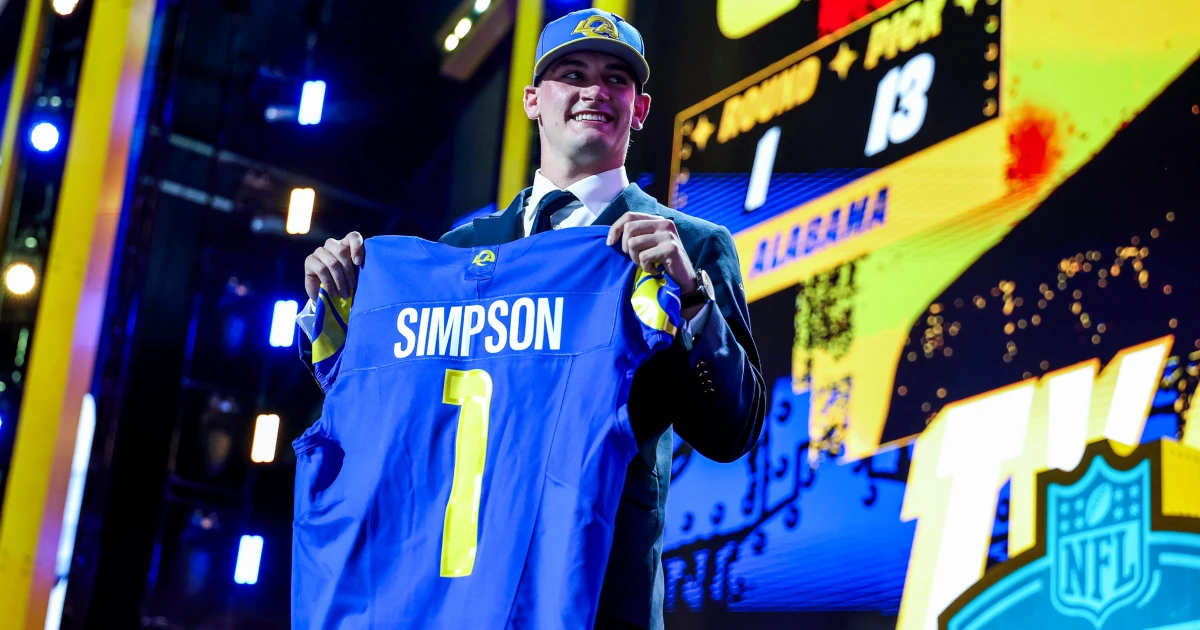
The Los Angeles Rams made headlines by taking Alabama quarterback Ty Simpson as the 13th overall pick. This choice raised eyebrows given that NBC Sports’ Connor Rogers had Simpson ranked 42nd among draft prospects.
But why did they select Simpson? If there’s anyone capable of harnessing his potential, it’s Rams head coach Sean McVay. Recognized for his ability to guide quarterbacks, McVay could be the catalyst for Simpson as he adapts to a play-action heavy offense. Before Jared Goff flourished under McVay, he faced challenges as the Rams quarterback—his transformation serves as a testament to McVay’s coaching prowess.
Simpson is undeniably a developmental project. He only started for one season at Alabama, and in his last five games, he struggled significantly, failing to complete 20 passes in any outing while throwing three interceptions against just six touchdowns. His final game saw him record a mere 67 yards in a playoff loss to Indiana.
Fortunately for Los Angeles, they may have the luxury of time. With Matthew Stafford poised to remain a top quarterback for at least another season, Simpson can learn without the immediate pressure of starting.
Expected Drop: DE Reuben Bain Jr., Tampa Bay Buccaneers
Miami edge rusher Reuben Bain Jr. was anticipated to secure a top-10 pick, with analysts like NBC Sports’ Connor Rogers placing him at 8th and NFL Network’s Daniel Jeremiah ranking him 7th. Instead, Bain Jr. fell to the Tampa Bay Buccaneers at 15th overall.
The primary reason for this surprising slide was Bain Jr.’s arm length, which measured at 30 7/8 inches. Since 2003, no pass rusher with arms shorter than 31 inches has been chosen in the first round, shedding light on his unexpected draft position.
Despite his physical measurements, Bain Jr. excelled in performance during his time with the Hurricanes, racking up 20.5 sacks over three years, including 9.5 in his final season. His ability to pressure opponents off the edge played a crucial role in Miami’s advancement to the National Championship Game. If Bain Jr. can maintain that intensity in Tampa Bay, the Buccaneers may have secured a significant steal in this draft.
High-Stakes Gamble: RB Jeremiah Love, Arizona Cardinals
Typically, teams hesitate to use a top-five pick on a running back, as historical precedents show mixed outcomes. Comparisons are often drawn with Trent Richardson, chosen No. 3 in 2012, who had a brief career, or Saquon Barkley, picked at No. 2 in 2018 but who struggled in a less-than-stellar 2024 season. Even last year’s sixth overall pick, Ashton Giunty, faced challenges behind a struggling offensive line.
Despite these reservations, the Arizona Cardinals boldly selected Notre Dame’s Jeremiah Love as the third overall pick during the draft, challenging the prevailing notion that effective running backs can be found later on. Many analysts regard Love as the top pure talent in the 2026 draft class, yet a running back’s success heavily relies on the strength of his supporting cast, and the Cardinals faced significant struggles last season. Without a dynamic quarterback to alleviate pressure in the run game, defenses may be able to focus on thwarting Love’s efforts.
Future Implications: WR Makai Lemon, Philadelphia Eagles
Philadelphia Eagles general manager Howie Roseman stated earlier this month, “AJ Brown is an eagle.” However, the uncertainty surrounding Brown’s future intensified following Thursday night’s draft. To bolster their offense—ranked seventh-lowest in drive scoring last season—the Eagles traded up to select USC receiver Makai Lemon with the 20th pick.
This decision does not imply that Philadelphia viewed Lemon merely as a potential prospect. According to NFL Network, the Eagles were prepared to select Lemon ahead of the Pittsburgh Steelers, who were also in discussions for the receiver. This development could indicate that the Eagles are preparing for a life beyond Brown, whose earlier reports of frustration with his role and declining productivity last season have only fueled speculation about his future in Philadelphia.
Ultimately, the selection of Lemon signals a strategic shift, reflecting Philadelphia’s preparations for a post-Brown era, especially when considering that they have recently added three other receivers to the roster.
