


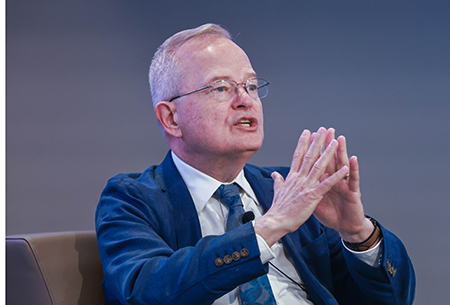
The second Dialogue in Times of Turmoil event featured speakers Diego N. Sanchez and Jim Robb, with Dean John Gould serving as moderator.
Discussion on Immigration Amidst Political Division
In a notable gathering at the University of California, Irvine, two prominent immigration advocates from opposing sides of a deeply contentious issue came together on Tuesday to convey a unified message: collaboration is essential for solving the immigration crisis. “Both sides are failing, and only by working together can we address the problem,” they asserted.
Jim Robb, vice president of alliances at Numbers USA, and Diego N. Sanchez, vice president of policy and strategy at the President’s Alliance on Higher Education and Immigration, joined a full audience as part of the Department of Social Ecology’s “Conversations in Times of Turbulence” series. Over a 90-minute discussion, they sought common ground rather than engaging in adversarial debate.
“We’ve been at odds for so long that we haven’t truly addressed these important issues,” said Sanchez, who once faced immigration challenges himself. “I’m ready to set aside the fighting and focus on shared goals.”
Robb, whose organization has dedicated three decades to opposing certain immigration laws, expressed the gravity of the current legislative stalemate: “We’re in a situation of mutually assured destruction. If anyone here is aiming to pass a bill in Congress, I can block it, and in turn, you can block anything we want to pass. Consequently, nothing is getting done.”
This event was held in partnership with Braver Angels, an organization committed to bridging America’s political divide, and received support from various local business and community organizations, including the Greater Irvine Chamber of Commerce and the Orange County Business Council.
John B. Gould, the dean of the School of Social Ecology and the moderator of the event, emphasized the importance of breaking out of ideological silos. “When we confine ourselves to echo chambers and only discuss topics with like-minded individuals, we miss opportunities for genuine dialogue,” he stated. “As a result, critical issues facing our country remain unresolved.”
Both Robb and Sanchez are members of the Braver Angels Citizens Committee on Immigration, which pioneers national discussions among diverse advocacy leaders. Their approach includes conducting common ground workshops, resulting in nearly 1,000 agreements between participants from both major political parties—an impressive feat given the polarized nature of the immigration debate.
During the discussion, both speakers identified a significant immigration crisis. Sanchez highlighted the absence of substantive immigration reform for over three decades, mentioning a backlog of more than 2 million asylum cases alongside Congress’ ongoing inaction. “We have let down not just Congress, but also the advocates, as we’ve been too busy fighting each other,” he asserted.
Robb further illustrated the depth of the dysfunction in American politics, likening the atmosphere to a battlefield, where the risks of approaching contentious issues feel insurmountable. He argued that the adoption of a confrontational European-style political discourse has stifled the bipartisan collaboration that the American system requires.
While both speakers concurred on the necessity for more judges and resources within the asylum system, they differed significantly on how to manage the legal status of undocumented immigrants. Sanchez advocated for citizenship for long-term residents, especially those who have lived in the country for over a decade, while acknowledging the political inadequacies of a strictly “citizenship or nothing” stance. Robb expressed a more cautious approach, arguing against the “mass detention” of migrants during times of border surges. “It’s unwise to reward those who circumvent the legal process en masse; history has shown that this approach doesn’t conclude well,” he remarked, referencing the failures of 1986 reforms.
Speaking to the need for a transformative reevaluation of the immigration system, both speakers underscored the necessity for flexibility to respond to evolving economic contexts. Dean Gould concluded the event by urging attendees to engage in challenging discussions with individuals who hold differing perspectives, suggesting that true progress is made only when diverse voices are included.
Jessica Stern, dean of the College of Humanities and Social Sciences at California State University Fullerton, who attended the event, praised it as a model for engaging in these complex dialogues with an emphasis on curiosity and mutual respect. She noted that although Robb and Sanchez held starkly differing views on critical topics, they navigated these contentious issues with a focus on respect and trust.
This discussion marked the second installment of the Dialogue in Times of Turmoil series, following last year’s edition focused on America’s identity crisis.
