


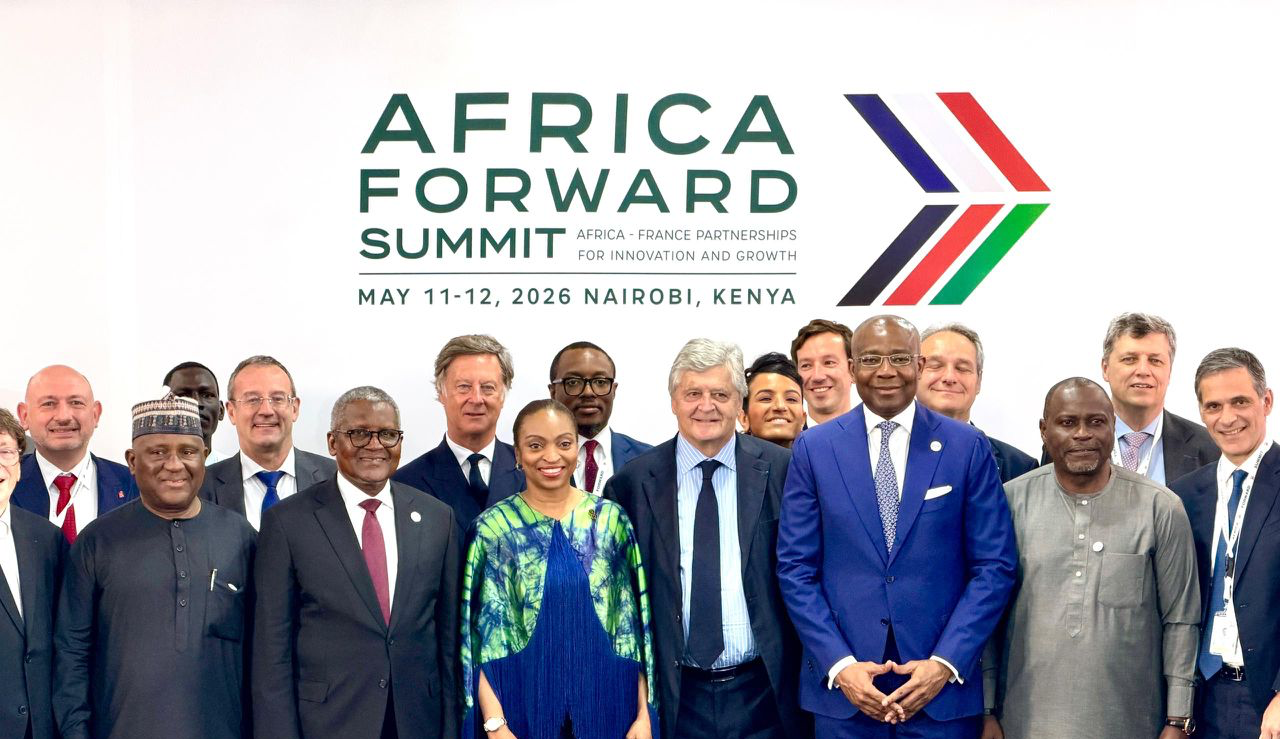
Nigeria Advocates for Economic Integration at Africa Forward Summit
President Bola Tinubu recently led a delegation representing Nigeria’s government, diplomatic corps, and business sector to the Africa Forward Summit at the Kenyatta Convention Center in Nairobi, Kenya. The summit emphasized the importance of enhanced economic integration to foster growth and prosperity across Africa.
Co-hosted by French President Emmanuel Macron and Kenyan President William Ruto, the Africa-France Summit attracted more than 30 leaders and officials from various African nations. Notable figures, including UN Secretary-General António Guterres and African Union Commission President Mahmoud Youssouf, opened the event with remarks highlighting the summit’s objectives.
On the sidelines of the summit, President Tinubu engaged in bilateral discussions with Madagascar’s President Michael Landrianilina. Additionally, he met with Confederation of African Football President Patrice Motsepe, who expressed Nigeria’s willingness to host the 2026 CAF Awards.
The French government advocated for a restructuring of economic and political relations based on principles of equality and fairness. In turn, African leaders underscored the urgent need to enhance access to credit, aiming to finance substantial investments and galvanize economic growth across the continent.
During the summit, President Tinubu spotlighted Nigeria’s potential in the blue economy as crucial to Africa’s development. He lamented that this opportunity has often been overlooked due to apprehension and uncertainty. “Today, I commit to strengthening regional collaboration through the maritime information infrastructure of the Deep Blue Project, ensuring interoperability, harmonized legislation, and effective enforcement become practical realities,” he stated.
He continued, clarifying that “maritime sovereignty attracts investment rather than repels it. Safe shipping routes, predictable regulations, and functional courts are essential for unlocking private capital.” Tinubu emphasized that Nigeria is dedicated to institutionalizing maritime sovereignty and ocean governance as non-negotiable pillars for the continent’s blue economy transformation.
The President also addressed the pressing need for reforms in the international financial structure. He highlighted Nigeria’s stance expressed at the recent UN General Assembly, warning that the existing system must evolve or risk obsolescence. Despite decades of autonomy, Africa’s share of global manufacturing value remains below two percent, a situation exacerbated by a global financial framework that depletes capital and imposes constraints on African industries.
“Even reformed nations like Nigeria face deindustrialization due to a financial system stacked against us,” he declared, citing expected debt servicing costs that could reach approximately $11.6 billion in 2026, consuming nearly half of projected revenue.
Tinubu urged for a financial system that supports Africa’s industrialization capabilities, enabling the continent to process its resources and compete fairly in global markets. He articulated a vision for migration management tied closely to economic prosperity, emphasizing cooperation in addressing root causes in countries of origin while calling for substantial international investment in sectors that create jobs and opportunities.
Collaboration for a Sustainable Future
Highlighting the need for a cooperative approach to migration, President Tinubu advocated for the establishment of a global governance structure. He noted that while initiatives like the Global Compact for Safe, Orderly and Regular Migration are steps forward, they require robust funding and coordination with regional efforts like the African Union Migration Policy Framework.
Accompanying President Tinubu were key ministers, including the Minister of Foreign Affairs Bianca Odumegwu Ojukwu and the Minister of Finance Taiwo Oedele, who engaged in discussions with counterparts from Kenya, France, and other African nations. The summit also hosted sessions focused on entrepreneurship, demographic dividends, and the impacts of artificial intelligence and digitalization in driving investment and innovation.
Overall, the Africa Forward Summit served as an essential platform for dialogue regarding Africa’s economic integration and growth, bringing together various stakeholders united in their vision for a prosperous future. With strong political will and collaborative efforts, the leaders aim to propel the continent toward modernization and sustainable development.
Bayo Onanuga
Special Advisor to the President
(Information and Strategy)
May 12, 2026
