


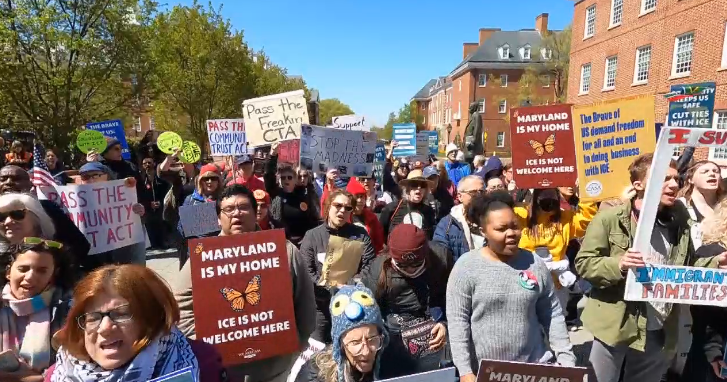
Two contentious immigration bills aimed at limiting local police collaboration with Immigration and Customs Enforcement (ICE) are set to take effect in Maryland, following Governor Wes Moore’s decision not to veto the legislation.
On Friday, Governor Moore expressed his intention to allow the bills to become law while acknowledging the need to address several concerns related to the Community Trust Act in the upcoming legislative session.
Understanding the Community Trust Act
The Community Trust Act prevents Maryland law enforcement from detaining individuals in ICE custody without a warrant, except in cases involving felonies and sex offenses. Additionally, authorities are barred from inquiring about the immigration status of individuals held in local jails.
This emergency legislation is scheduled to go into effect in early June, granting law enforcement and state agencies a brief period to adjust to the new law. Advocates for the Community Trust Act, motivated by frustration with the strict immigration policies of the Trump administration, pushed for this bill, which swiftly passed through the General Assembly in its final session.
Senator Clarence Lamb, a key sponsor of the bill, expressed his relief at its passage. He emphasized the need for due process, stating, “We don’t want individuals who may be in minor legal trouble turned over to ICE and face the threat of deportation.” Lamb highlighted how the Act closes loopholes exploited by some sheriffs who maintained informal communication with ICE, despite previous attempts to sever such ties.
Governor Moore’s Position
Governor Moore confirmed in a statement to WJZ that he will not veto the bill, thereby allowing it to become law. He stated his opposition to allowing untrained ICE agents to enforce immigration policies on behalf of local law enforcement while acknowledging the practical implementation challenges the legislation poses. Moore indicated that these issues will need to be addressed through executive action in the next session.
Opposition to the bill is growing, particularly from Harford County Sheriff Jeff Gaylor. Following a conversation with Governor Moore, Gaylor expressed concern that the governor recognized the bill’s shortcomings, arguing that legislative issues should not fall under the purview of the attorney general’s office. He hinted at potential legal action, stating that many sheriffs in Maryland may unite to challenge the law in court.
“We will comply with Maryland law, but we are also prepared to file a lawsuit,” Gaylor remarked. “Most sheriffs in Maryland are likely to come together to contest this legislation, which undermines our responsibilities as elected officials.”
Amid this pushback, Senator Lamb remains optimistic that community trust laws can withstand legal scrutiny, asserting that the state has the authority to set protections for individuals arrested and processed by local law enforcement. Supporting organizations like We Are CASA have urged Governor Moore to uphold the Community Trust Act as a necessary safeguard for immigrant communities.
Legislation on Data Privacy
Alongside the Community Trust Act, a data privacy measure is also expected to pass without the governor’s signature. This law aims to block federal immigration officials from accessing state records, including those from the Bureau of Motor Vehicles, as well as records about taxes, healthcare, and unemployment benefits. It is slated to go into effect on July 1.
Senator Lamb, a supporter of this bill as well, commented on its significance, emphasizing the importance of protecting state databases from unnecessary federal intrusion.
Expanded Statement from Governor Moore
In a comprehensive statement, Governor Moore reaffirmed his commitment to ensuring public safety while safeguarding the rights of Maryland residents. He stressed that cooperation with the federal government is crucial, but not at the cost of allowing unaccountable ICE agents to perform law enforcement duties. Moore underscored the importance of maintaining community trust during a time when immigrant communities are facing heightened fears and potential disruptions due to federal policies.
“We must work collaboratively to address potential challenges in enforcement and ensure that local law enforcement can operate effectively within the legal framework,” he stated. “I am committed to working alongside law enforcement officials, legislators, and advocates to ensure Maryland is able to balance public safety with upholding civil rights.”
