


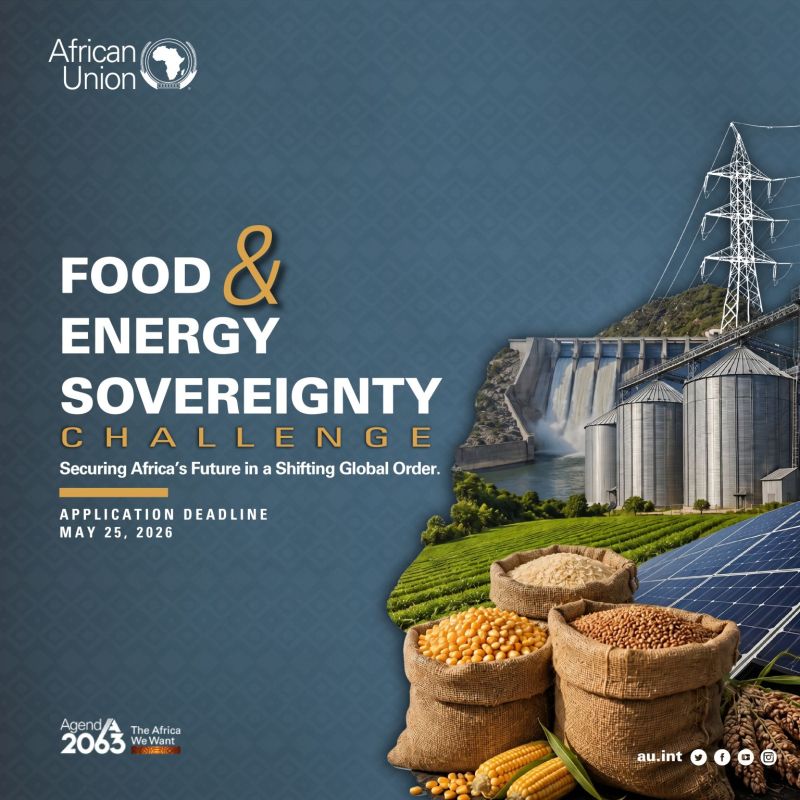
African Union Launches Food and Energy Sovereignty Challenge 2026
The African Union Commission’s Department of Economic Development, Trade, Tourism, Industry and Mines (ETTIM) has officially introduced the Food and Energy Sovereignty Challenge 2026. This initiative carries the theme “Rooted and Empowered in Resilience: Securing Africa’s Future in a Changing World Order.”
The challenge aims to encourage transformative innovations that overhaul Africa’s food and energy systems. By harnessing industrial-scale, technology-driven solutions, the initiative seeks to bolster self-sufficiency, enhance resilience, and promote sustainable economic growth across the continent.
Applications for the program will be accepted from May 11 to May 25, 2026.
Context Behind the Initiative
The Food and Energy Sovereignty Challenge emerges in response to escalating global geopolitical tensions and supply chain disruptions that threaten Africa’s food and energy security. The African Union underscored that reliance on imported food, fuel, and industrial inputs makes African economies vulnerable to external shocks, particularly those associated with vital trade routes like the Strait of Hormuz.
This challenge aligns with the objectives outlined in Agenda 2063, focusing on crucial areas such as:
- Industrial transformation
- Economic resilience
- Technological innovation
- Regional integration
- Sustainable development
The program aims to shift Africa from a reactive approach to crisis management towards achieving long-term sovereignty in its food and energy frameworks.
Core Objectives of the Challenge
The primary goal of this initiative is to identify and scale innovations led by Africans that can resolve persistent issues in the agriculture and energy sectors. Specifically, the challenge seeks to:
- Support innovative solutions for food and energy autonomy
- Scale industrializable African technologies
- Encourage partnerships among innovators, governments, and investors
- Ensure policy alignment with AfCFTA and Agenda 2063 priorities
- Facilitate the integration of emerging technologies like AI and robotics
The program targets startups, small businesses, and deep tech companies that demonstrate credible technology capabilities and scalable business models.
Strategic Focus Areas for 2026 Applications
The challenge is organized along two strategic tracks aimed at fostering innovation.
Track A: Innovations for Food Sovereignty
This track emphasizes enhancing food security, agricultural resilience, and local production capabilities through technology and innovative systems. Key innovation areas include:
- Production of industrial biofertilizers and organic pesticides
- Preservation of indigenous climate-resilient seeds
- Circular bioeconomy and waste-to-value systems
- Solar-powered cold chain and storage solutions
- Precision agriculture tools utilizing AI and IoT
The African Union is particularly interested in solutions that can reduce reliance on imports and create sustainable food systems.
Track B: Innovations for Energy Sovereignty
This track aims to foster energy independence and nurture the development of renewable industries. Focus areas include:
- Decentralized renewable energy systems
- Battery technology leveraging African minerals
- Green hydrogen solutions
- Electric mobility and resilient transport systems
- Smart grids and peer-to-peer energy platforms
- Renewable thermal energy for manufacturing and agro-processing
Track B is designed to support technologies that promote industrial growth and enhance resilience against climate change.
Eligibility and Selection Criteria
The challenge invites applications from organizations based in African Union member states, provided they meet specific criteria. Key requirements stipulate that:
- Companies must be at least 51% African-owned
- Organizations must be legally registered
- Innovation Technology Readiness Level (TRL) must be at least 6
- Solutions must align directly with the Food Sovereignty or Energy Sovereignty tracks
Participation is encouraged from innovators within Africa and the broader African diaspora.
Evaluation and Submission Guidelines
Applications will undergo a technical review by a joint selection committee using a weighted scorecard. Evaluation criteria will focus on:
- Innovation and uniqueness – 30%
- Economic viability and scalability – 20%
- Socio-economic impact and climate resilience – 20%
- Intellectual property and patent protection – 20%
- Team expertise and ability to execute – 10%
The review process will occur over seven weeks and will involve multiple stages, including automated eligibility screening and a final institutional review.
Applicants are required to submit a comprehensive proposal package, including: a problem statement, an innovation and implementation plan, an impact report, a pitch deck, a video demonstration, and all pertinent legal documentation.
Opportunities for Selected Innovators
Innovators who successfully navigate the selection process will gain access to significant growth and market expansion opportunities. Benefits include:
- Support for industrial scalability
- Access to public procurement opportunities
- Networking opportunities with venture capital firms and institutional investors
- Participation in African Union trade missions
- Visibility in the African Food and Energy Sovereignty Catalog 2026
The initiative aspires to elevate selected companies into continental leaders capable of driving substantial industrial transformation throughout Africa.
The Importance of Addressing These Challenges
The challenges related to food and energy sovereignty underscore a growing commitment to self-reliance, innovation, and sustainable industrial growth across the continent. By investing in Africa’s innovation ecosystem, the challenge aims to:
- Reduce dependency on imports
- Strengthen local supply chains
- Accelerate renewable energy adoption
- Enhance resilience in food systems
- Promote climate-smart industrialization
This program emphasizes the critical role of African-led technological solutions in shaping the continent’s economic future.
