


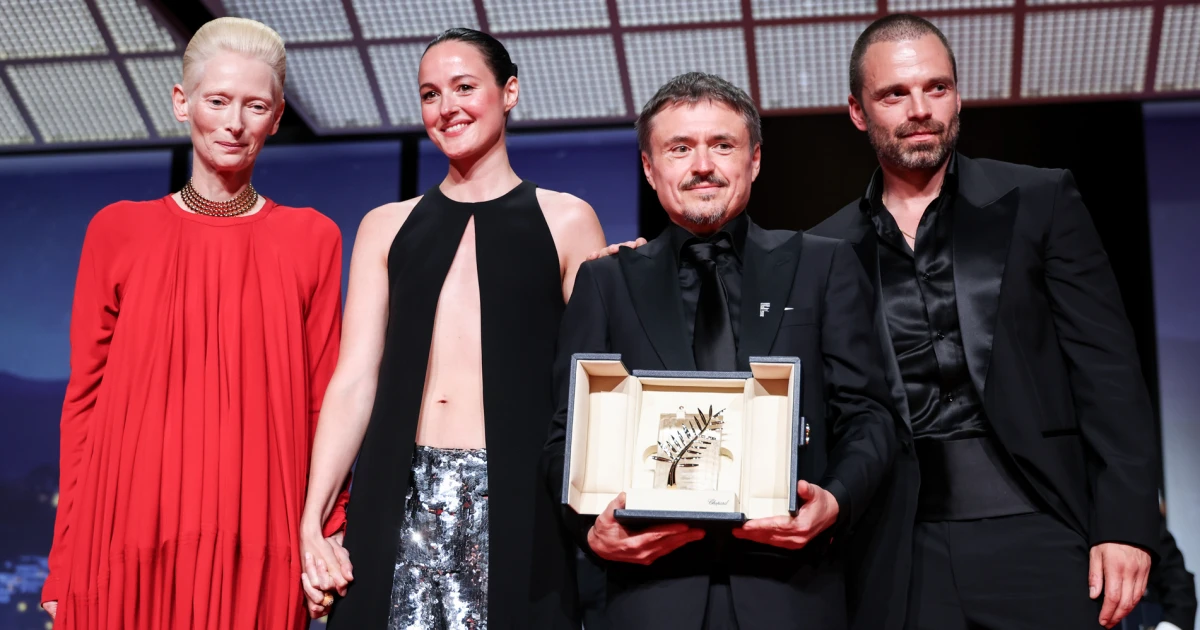
Cristian Mungiu’s Fjord Wins Palme d’Or at Cannes
Romanian director Cristian Mungiu has received the prestigious Palme d’Or for his politically charged film, Fjord, at the Cannes Film Festival. This marks Mungiu’s second time receiving Cannes’ highest honor, following his win for 4 Months, 3 Weeks, and 2 Days in 2007.
At the 79th Cannes Film Festival, Fjord was lauded for its compelling narrative, which Mungiu describes as a commentary on “left-wing fundamentalism.” The film features actors Sebastian Stan and Renate Rijnsve portraying Romanian evangelicals who relocate to Norway, only to find themselves under scrutiny from child services due to their strict disciplinary methods.
Mungiu highlighted the contemporary societal divisions, stating, “Today, society is divided and radicalized.” He emphasized that the film serves as a critique of various forms of fundamentalism and calls for a more profound application of concepts like empathy and inclusion, which are frequently referenced yet inadequately practiced.
In achieving this accolade, Mungiu becomes the tenth filmmaker to win the Palme d’Or twice, underlining his significant contributions to cinema. The film’s triumph bolsters Neon’s exceptional record, with Fjord becoming the seventh consecutive Palme d’Or winner for the specialty brand. It follows in the footsteps of previous winners, such as Jafar Panahi’s It Was an Accident and the 2024 Best Picture Oscar winner, Anora.
Minotaur Secures Grand Prix
The Grand Prix, awarded to the runner-up, was presented to director Andrei Zvyagintsev for his domestic thriller, Minotaur. Set against the backdrop of the ongoing conflict between Russia and Ukraine, the film centers on a businessman who begins to suspect his wife’s fidelity while facing the moral burden of enlisting workers for Vladimir Putin’s war efforts.
During the award ceremony, Zvyagintsev made a powerful statement, urging, “Only you, President of the Russian Federation, can stop this butcher. Please end this genocide. The whole world is waiting for this.” His remarks encapsulated the gravity of the themes presented in his film.
This year’s Cannes Festival saw a relative lack of controversial films. Hollywood’s presence was minimal, and many entries struggled to resonate with critics. Overall, the festival’s global impact felt somewhat muted compared to previous years.
Acknowledgments for Direction and Performance
The accolades continued with the Best Director award, shared between Polish filmmaker Pawel Pawlikowski for his postwar drama Fatherland and Spanish duo Javier Ambrossi and Javier Calvo for the cross-generational queer narrative, Blackball. This marks Pawlikowski’s second Cannes win, following his success with Cold War in 2018, while Ambrossi and Calvo achieved a remarkable debut at the festival.
The Best Actress award was jointly awarded to Virginie Efira and Tao Okamoto for their roles in Ryusuke Hamaguchi’s All of a Sudden, a poignant exploration of friendship born from shared hardship. In a similar vein, the Best Actor honor was equally shared by Emmanuel Macchia and Valentin Campagne for their compelling performances in Lucas Don’s war drama, Coward.
Emmanuel Mare received the award for Best Original Screenplay for his impactful French film A Man of the Age, which revisits the lives of Nazi collaborators in Vichy France, drawing from his family’s historical experiences. The jury’s prize went to Valeska Grisebach’s crime drama, Dreams, set in a Bulgarian border town, highlighting the festival’s diverse storytelling.
This year’s ceremony lacked any memorial tributes, as Barbra Streisand, set to receive an honorary Palme d’Or, was unable to attend due to an injury. However, she expressed her gratitude through a recorded video message, acknowledged warmly by Isabelle Huppert during the event.
Finally, the Camera d’Or, honoring the best first feature presented at Cannes, was awarded to Marie-Clémentine Dusabejimbo for her post-genocide drama Ben Imana, marking a significant milestone as the first Rwandan film selected for the festival.
