


Nigeria’s Stock Market Sees Remarkable Growth Over Three Years
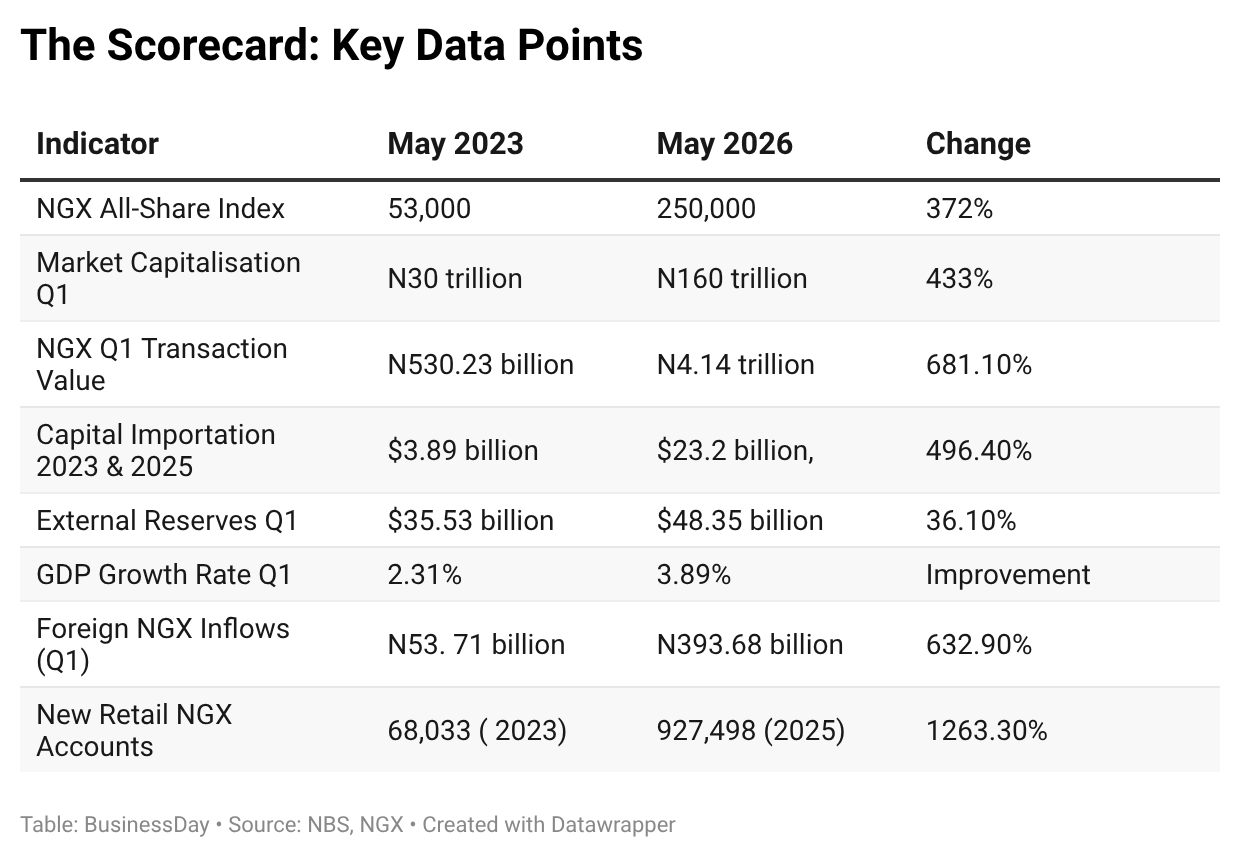
Three years ago, the Nigerian Exchange (NGX) boasted a market capitalization of 30 trillion naira. As of May 2026, this figure has surged to 160 trillion naira, marking an impressive five-fold increase.
Recognized as one of Africa’s largest and best-performing stock markets, NGX typically ranks third on the continent in both market capitalization and the number of listed companies, following South Africa’s Johannesburg Stock Exchange (JSE) and the Egyptian Exchange (EGX).
In parallel, the All-Share Index experienced a significant rise, climbing from 53,000 points to 250,000 points—a nominal increase of 371 percent. To illustrate this growth, an investor who initially placed 1 million naira in a diversified portfolio of NGX stocks at the start of this period now holds nearly 4.7 million naira.
During his speech commemorating three years in leadership, President Bola Ahmed Tinubu credited this market expansion to heightened investor confidence, improved macroeconomic management, and ongoing economic reforms.
The president highlighted that companies across various sectors are now reporting robust earnings and declaring larger dividends, reflecting a renewed confidence in the economy. He also pointed out that stronger public finances and enhanced fiscal stability have bolstered the state government’s capacity to invest in critical infrastructure and social services.
Structural Reforms Fueling Market Momentum
The reform in the stock market is a consequence of both deliberate policy measures and macroeconomic adjustments facilitated by pivotal interventions from key institutions, including the Presidency, the Central Bank of Nigeria (CBN), and the Securities and Exchange Commission (SEC).
The removal of the petrol subsidy and the CBN’s consolidation of multiple exchange rate windows in May and June 2023 provided a vital signal to foreign investors, many of whom had previously viewed Nigeria’s exchange rate structure as a deterrent to capital investment. Estimates suggest that the elimination of foreign exchange arbitrage, which had cost the economy over 8 trillion naira in three years, has restored a measure of price transparency eagerly sought by institutional investors. As a result, within months, the market began to reassess the value of Nigerian stocks against a more stable macroeconomic backdrop.
Banking sector reforms, specifically the CBN’s directive to raise minimum capital requirements for commercial banks from March 2024 to June 2026, have significantly driven stock market activity. Major financial institutions such as GTB, Zenith Bank, Access Holdings, First Holdco, and UBA returned to capital markets to secure additional funding. This resulted in a surge of public offerings and rights issues, introducing approximately 4.65 trillion naira into the NGX platform.
In 2025 alone, the recapitalization initiatives spurred the registration of over 2.2 million new individual accounts on the NGX, according to data from the CBN. By the end of the first quarter of 2026, more than 500,000 new investors had participated in various bank offerings since 2024, many of whom were new to equity investment.
The Investment and Securities Act of 2025 represented a historical overhaul of Nigeria’s capital markets regulations, as it was the first comprehensive reform in 18 years. This new legislation, signed by President Tinubu in March 2025, addressed the limitations of the pre-digital Investment and Securities Act of 2007. The revised law introduced flexible categories for stock exchanges, accommodating diverse financial instruments, including stocks, bonds, derivatives, and digital assets under a unified framework. It expanded the SEC’s regulatory powers to align with international standards, thereby enhancing Nigeria’s credibility with global institutional investors.
The SEC’s introduction of Private Debt Rules in April 2025 enabled private companies to issue bonds and sukuk publicly for the first time, significantly widening access to capital markets. Transitioning from a T+3 to a T+2 settlement cycle has also reduced counterparty risk while enhancing liquidity, aligning market operations with global best practices.
Market Dynamics and Investor Engagement
As Nigeria’s stock market continues to flourish, it has attracted attention from retail investors and cautiously renewed interest from foreign institutional investors, many of whom divested in prior years. In the first quarter of 2026, the total trading volume on the NGX soared to 4.14 trillion naira, nearly doubling the 2.2 trillion naira recorded during the same period in 2025. For the entirety of 2025, total trading volume reached an unprecedented 12 trillion naira, encompassing both local and international traders.
Current data indicates that domestic investors comprise approximately 78% of market activity; however, foreign participation is trending upward. Year-on-year foreign inflows to the NGX rose by 78% to 393.68 billion naira in the first quarter of 2026, further increasing to 1,803 billion naira in April—an astounding 274% increase from April 2025.
The Office for National Statistics reported that total foreign capital inflows in 2025 reached $23.2 billion, the highest since 2019, up from $12.32 billion in 2024. Notably, foreign portfolio investment constituted the majority of this figure, amounting to $19.4 billion (approximately 85.5% of total capital imports).
Industry leaders attribute this influx of foreign capital to structural reforms and improved market transparency. Charles Fakloga, CEO of ECL Asset Management, noted that the recent market recovery resulted from increased activity by domestic institutional investors capitalizing on attractive valuations, alongside enhanced foreign participation spurred by Nigeria’s removal from the FATF gray list and reclassification by FTSE Russell.
Experts maintain confidence that the ongoing reforms will continue to enhance market dynamics and bolster financial institutions, playing a crucial role in Nigeria’s ambition to establish a $1 trillion economy. With sustained progress, the economy has the potential to create jobs, reduce poverty, attract investment, and fortify overall economic stability.
