


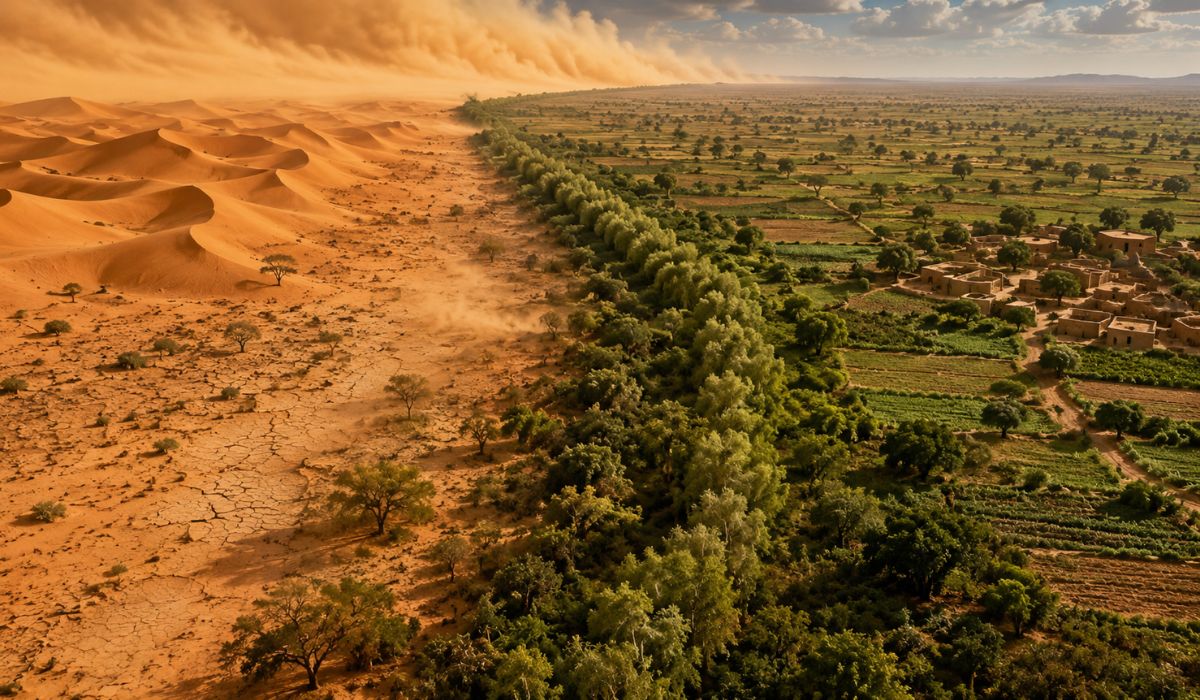
Africa’s Ecological Restoration Initiative Mobilizes Resources to Combat Desertification
The Africa Ecological Restoration Initiative, often referred to as the Great Green Wall, represents a significant environmental restoration endeavor across the Sahel, a semi-arid region located just south of the Sahara Desert.
Launched by the African Union in 2007, this ambitious project seeks to rehabilitate degraded landscapes, fortify rural communities and mitigate the adverse effects of desertification from Senegal on the Atlantic coast to Djibouti in the Horn of Africa.
While initially recognized for its wooden barriers, the initiative has evolved to embrace a comprehensive approach that includes soil rehabilitation, efficient water management, sustainable agricultural practices, and the creation of viable income sources for local communities.
According to the United Nations Convention to Combat Desertification (UNCCD), the overarching objective is to regenerate damaged land and enhance the resilience of rural populations in the face of climate change.
The official Great Green Wall project encompasses eleven countries, including Burkina Faso, Chad, Djibouti, Eritrea, Ethiopia, Mali, Mauritania, Niger, Nigeria, Senegal, and Sudan. Over the years, the initiative has expanded to involve additional African nations and international partners, contributing to variations in reported figures regarding its scale and progress.
The Green Wall Project Across the Sahel
The original vision was to create a green corridor extending approximately 8,000 kilometers across Africa from west to east. The aim was to curb land degradation occurring in the southern fringes of the Sahara Desert, an area plagued by recurrent droughts, pressure on natural resources, and a heavy reliance on agriculture and animal husbandry.
As research progresses in the areas of soil science, climate patterns, and ecosystem restoration, the project has shifted from a mere linear reforestation effort to a more nuanced approach tailored to existing local realities and community requirements.
Today, the Great Green Wall initiative includes a variety of restored ecosystems that incorporate local flora suited to the particular conditions of each area. This involves a combination of indigenous trees, drought-resistant shrubs, grazing lands, agroforestry systems, and methods for conserving soil moisture and revitalizing spring water.
Species such as the Senegalese acacia and Phidohervia albida have been highlighted for their adaptability to arid environments and their contributions to soil fertility, shade provision, livestock feed, and products like gum arabic.
The ambition is to restore a staggering 100 million hectares of degraded land by 2030, with a goal of sequestering 250 million tons of carbon and creating 10 million green jobs in rural communities.
Desertification and Climate Challenges in the Sahel Region
The Sahel acts as a buffer between the Sahara Desert and the African savannah, characterized by unpredictable rainfall, prolonged droughts, and communities heavily dependent on agriculture. As vegetation cover diminishes, rainwater infiltration decreases, leading to increased soil erosion and diminished agricultural viability.
The deterioration of the Sahel is influenced by multiple factors, including changing rainfall patterns, rising temperatures, intense land use, deforestation, and population pressures. Research indicates that the Sahara has expanded by approximately 10% since 1920, impacting the southern boundaries that directly affect the Sahel.
International bodies report that the Sahel is experiencing temperature increases that surpass the global average, intensifying droughts, reducing water availability, and destabilizing local food production systems. The World Bank projects that climate change could displace up to 216 million people internally by 2050, with sub-Saharan Africa facing the greatest vulnerability.
A Holistic Approach to Environmental Recovery in Africa
According to a synthesis report from a leading United Nations agency, between 2007 and 2018, about 18 to 20 million hectares were initiated in the restoration process, underscoring the challenges of meeting ambitious climate goals. Notably, only 4% of the area earmarked as part of the Great Green Wall was restored during this timeframe.
The gap between stated objectives and actual outcomes reveals that progress is not a straightforward journey. Rather, efforts are distributed across diverse landscapes, communities, and various ecological zones, hinging on factors like funding, local engagement, and governance.
To achieve the ambitious target of restoring 100 million hectares by 2030, participating nations will need to rehabilitate an average of 8.2 million hectares annually, with the UNCCD estimating that around $33 billion will be necessary to reach these goals by the decade’s end.
Funding Initiatives for the Great Green Wall
The Great Green Wall secured new international funding during the One Planet Summit in January 2021, where leaders committed a total of $14.3 billion for integrated projects focusing on recovery, climate adaptation, and rural development.
To date, more than $19 billion has been mobilized by multilateral and bilateral organizations towards this initiative. The European Union continues to support the Great Green Wall through its Global Gateways, linked to regional investment strategies.
However, challenges persist related to coordination, monitoring, and on-the-ground enforcement. Many funds must navigate bureaucratic layers before reaching the local communities tasked with implementing restoration projects, complicating efforts to ensure plant survival and sustainable land management amid persistent political instability in the Sahel.
Addressing the Challenges of Desert Expansion
While the Great Green Wall is often framed as an initiative to halt desert encroachment, its technological strategies have evolved. Experts in restoration assert that deserts do not progress as a uniform front; their boundaries fluctuate based on rainfall, temperature, land use practices, and human influences on vegetation.
Consequently, the project has transitioned from a continuous wooden wall concept to a decentralized network of rehabilitated zones. This framework emphasizes natural regeneration, fencing off degraded terrains, managing water resources, utilizing indigenous species, and strengthening local agricultural practices.
Research from the Food and Agriculture Organization (FAO) suggests that investments in the Great Green Wall can yield positive economic returns, although outcomes can vary significantly by country and the level of local participation. Social impacts include enhanced income opportunities, improved food security, and increased resilience among rural families.
Ultimately, while the Great Green Wall initiative is closely tied to larger environmental objectives, its success is dependent on more than just the quantity of trees planted. Factors such as soil fertility restoration, water retention, species survival rates, agricultural productivity, and community stability are critical components to its long-term efficacy.
