


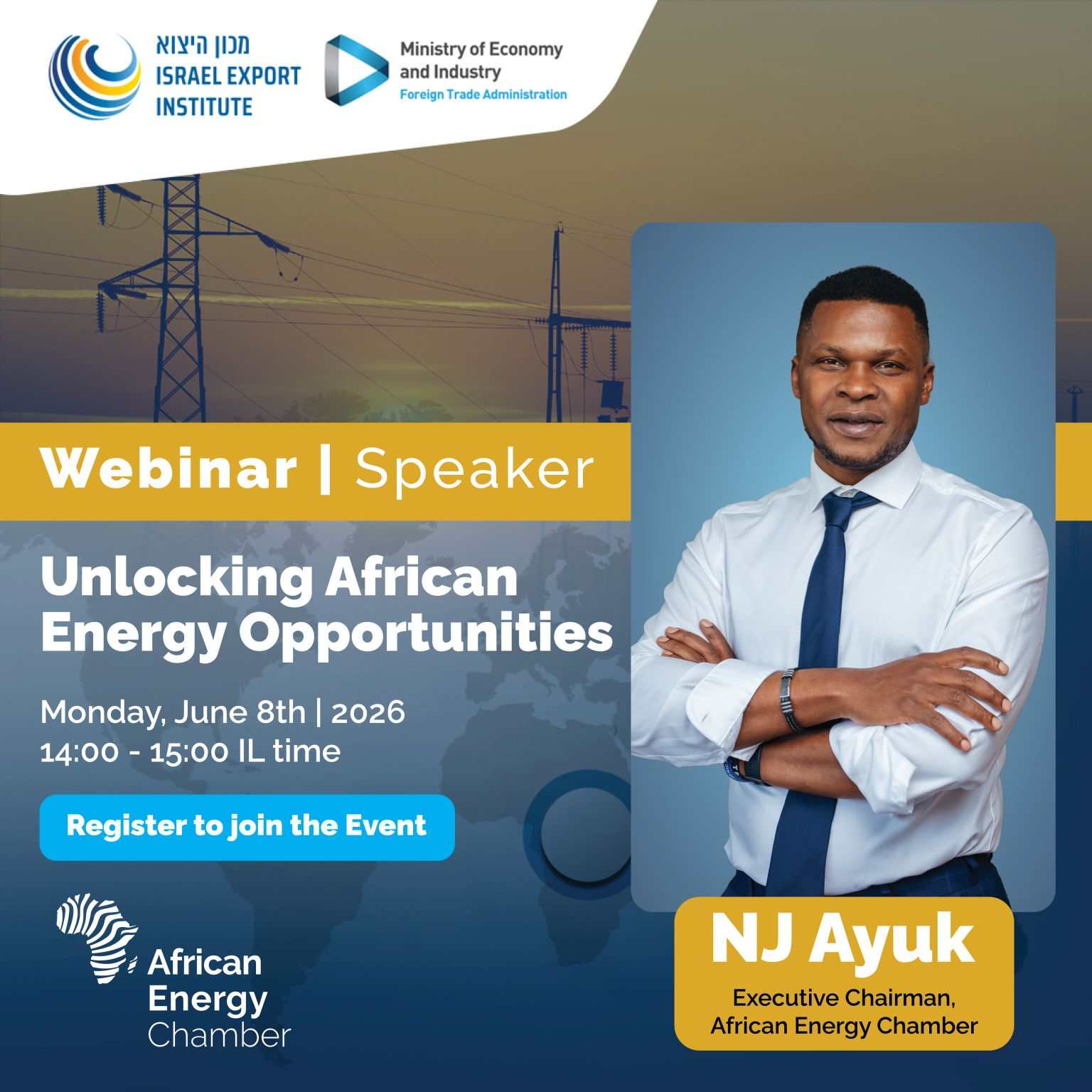
Africa’s Energy Sector Highlighted as Investment Destination in Upcoming Webinar
The African Energy Chamber (AEC) is set to showcase Africa’s energy sector as a prime opportunity for investment by Israeli stakeholders during the “Unlocking Africa’s Energy Opportunities” webinar. This event will be hosted by TradeIL South Africa, the trade facilitation division of the Israel Trade Authority, on June 8 from 2:00 PM to 3:00 PM Israeli time.
Industry Insights from AEC Leadership
Representing the Chamber at the webinar will be AEC Executive Chairman NJ Ayuk, who will collaborate with industry experts to discuss market entry strategies, investment trends, and technological advancements shaping Africa’s dynamic energy landscape.
Upstream Oil and Gas Sector Poised for Growth
Africa’s upstream oil and gas sector is entering a promising investment cycle, with capital expenditures projected to reach approximately $41 billion by 2026, marking the highest levels in over a decade. While production is expected to stabilize at around 11.4 million barrels of oil equivalent per day, new developments could boost this figure to 13.6 million barrels per day by 2030. Established producing nations like Nigeria, Angola, and the Republic of Congo are driving this growth, alongside successful frontier exploration efforts in Namibia and Ivory Coast that are broadening the continent’s resource base.
Addressing Africa’s Power Shortage
Simultaneously, Africa’s persistent energy deficit remains a critical factor influencing opportunities throughout the energy value chain. Roughly 600 million people across the continent currently lack access to electricity, with sub-Saharan Africa accounting for a significant portion of the global energy access gap. This urgent need underscores the rising demand for scalable solutions in grid stability, renewable energy, and gas-to-power, areas where Israeli firms excel and are recognized for their expertise.
Renewable Energy Adoption Gains Momentum
The pace of renewable energy deployment in Africa is accelerating, with installed capacity anticipated to rise by 15.9%, reaching 82GW by 2025. Key markets such as Ethiopia, South Africa, and Egypt are leading this growth. However, Africa still represents only 1.6% of global capacity expansion, revealing a substantial gap between potential and actual implementation. This discrepancy offers significant commercial opportunities in grid management, energy storage, and distributed generation, areas that still face limitations in capital and technological capabilities.
Collaborative Initiatives to Bridge Investment Gaps
In an effort to address these gaps, public and multilateral funds are increasingly collaborating. Initiatives like Mission 300, spearheaded by the World Bank and the African Development Bank, aim to connect 300 million people to electricity by 2030, supported by over $90 billion in funding. At the same time, new offshore gas discoveries in Mozambique, Senegal, and Mauritania are leading to a growing array of gas-to-power projects, creating demand for technology providers, equipment manufacturers, and financing partners.
Webinar Focused on Market Entry Strategies
The upcoming webinars for Israeli companies will concentrate on practical strategies for market entry. Ayuk will discuss opportunities related to licensing rounds, local content frameworks, and potential partnerships with national oil companies and independent power producers. Additionally, this session will introduce African Energy Week 2026, the continent’s most significant energy event, emphasizing opportunities for investment, participation, and strategic alliances. AEC is committed to encouraging first-mover advantages for companies establishing a presence now, positioning them to capture long-term value as Africa’s energy sector evolves.
Strengthening Energy Cooperation Between Israel and Africa
This webinar is part of a broader initiative to enhance energy collaboration between Israeli and African markets, aligning Israeli innovation with Africa’s needs in upstream activities, power generation, and transmission. Companies interested in entering the continent will gain invaluable insights into the policy frameworks, project pipelines, and partnership structures that are set to define the next phase of Africa’s energy development.
