


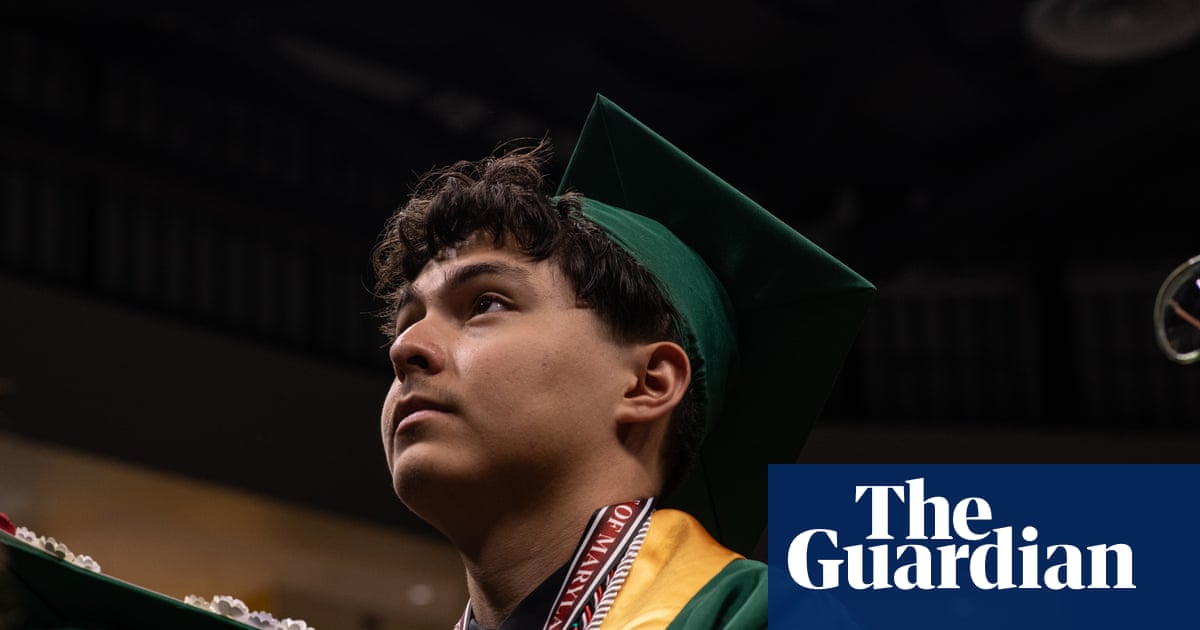
Challenging Circumstances Surround High School Graduation
As Mark prepared for his high school graduation, he found himself reflecting on how his father would have insisted he adjust his slacks. “My slacks were a little tight, so I fixed my tie,” he recalled, realizing his father would have wanted him to look his best.
However, Mark’s father, Marco, was 3,000 miles away, having been arrested by Immigration and Customs Enforcement (ICE) in Maryland just before Christmas and deported to El Salvador in March. The weight of that absence hung heavily over Mark as he approached the graduation ceremony.
When Mark took the podium to receive his diploma, he experienced a profound sense of relief, akin to waking from a nightmare. His mother, Rosie, proudly congratulated him, saying, “Congratulations, you finally made it.”
Mark was passionate about his studies, excelling in advanced placement classes while cherishing a close circle of friends his mother described as “wholesome.” Yet following Marco’s arrest and deportation, his enthusiasm waned. “I almost didn’t want to go to school this semester,” he admitted. “Even after coming to terms with what happened to my father, I never wanted to be there.”
The immigration system made no distinction that Marco had lived in the U.S. for nearly 40 years, owned a contracting business, and had two U.S. citizen children. Mark’s greatest dream was for his father to witness his graduation, but that reality was shattered. Throughout the initial months of the Trump administration, policies led to the arrest of at least 27,000 parents of U.S. citizen children, according to a Guardian investigation.
While Marco watched the graduation ceremony via livestream from Aguascalientes, Mexico, his pride was tinged with sorrow. “I was very happy, but also disappointed that I couldn’t be there,” he expressed. To honor his father’s spirit, Mark and Rosie considered bringing a life-sized cardboard cutout of Marco to the ceremony but ultimately opted for a video call from a Baltimore restaurant after the event.
The life Marco had built in the U.S. crumbled quickly after his arrest. A routine trip to a hardware store for supplies led to ICE agents taking him into custody. Despite his long-standing ties to the community and family, an immigration judge ordered Marco’s deportation shortly thereafter, devasting his family.
During his three months in detention, Marco faced unspeakable hardships, losing 30 pounds as he navigated inadequate living conditions. He desired to remain with his family but felt relief upon leaving custody, despite the traumatic experience. Meanwhile, Mark battled stress and depression, struggling to keep up with schoolwork and ultimately dropping out of advanced classes.
Financially, the family felt the strain as well—Marco had previously contributed to household expenses. With their savings depleted and Rosie’s job at Burger King barely covering costs, they had to rely on community support. Mark took on shifts at Walmart and participated in local mutual aid initiatives to navigate this difficult period.
As part of the family’s ongoing challenges, Mark reconnected with his half-sister after years apart. She expressed commitment to support him if anything happened to Rosie, a silver lining amid the turmoil. Meanwhile, Marco faced his own struggles with post-traumatic stress in El Salvador, yearning to provide for his family from afar.
Despite the overwhelming circumstances, Marco expressed hope for his son, emphasizing the importance of education. Mark, now considering a future in engineering, is also planning to visit his father in Mexico, wishing to capture a moment that reflects the graduation ceremony he missed. “If I go, I’ll pack my cap and gown to take a photo with him,” he said, dreaming of a moment that transcends distance.
