


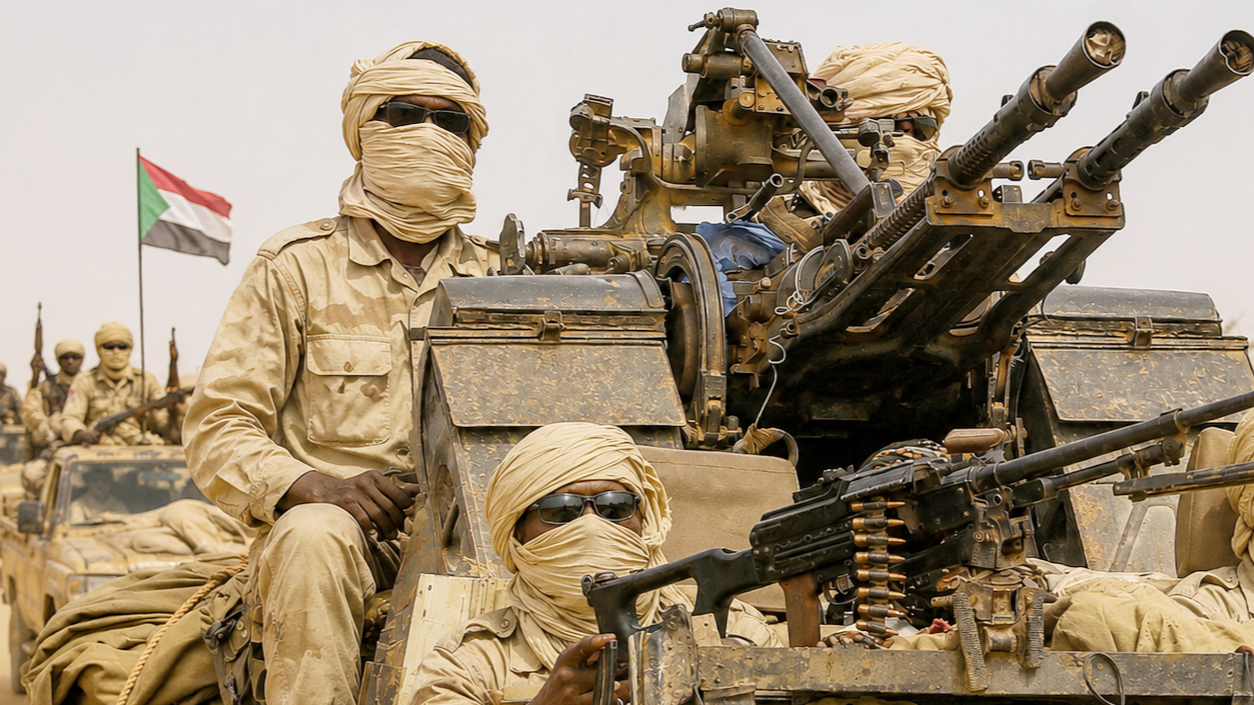
Conflict Escalates in Sudan Amidst Technological Warfare
On April 15, 2023, the Sudanese Armed Forces (SAF) and the Rapid Support Forces (RSF) plunged into a full-scale civil war, resulting in a humanitarian crisis of alarming proportions in Darfur. Over 10 million individuals have been displaced, and numerous atrocities have been reported. This conflict is notable not only for its brutality but also for the significant role of advanced technology. Sudan has become a testing ground for autonomous drone warfare, artificial intelligence (AI)-assisted surveillance, and open-source intelligence (OSINT), all being utilized in real time by both combatants and civil society observers.
AI Technologies: A Dual-Edged Sword
This situation raises a critical contradiction: the same AI technologies capable of potentially saving lives through early conflict detection are now being wielded as instruments of destruction. The proliferation of drones, AI-driven satellite analysis, and social media surveillance throughout Africa’s war-torn regions highlights the inadequacy of the African Union’s (AU) peace architecture, which was established long before the advent of AI technologies and is ill-equipped to manage contemporary conflict dynamics.
Drones and Warfare Dynamics in Africa
Both the SAF and RSF have deployed a range of commercial unmanned aerial vehicles (UAVs), including the Turkish Bayraktar TB2 and the Chinese Wingron II and FH-95. According to the Armed Conflict Location and Event Data Project (ACLED), there were 1,003 recorded attacks using these drones between April 2023 and January 2026. Notably, the introduction of AI-powered swarm drone technology has facilitated autonomous attacks with minimal human oversight. A tragic instance of this was the Karogi hospital attack in December 2024, which resulted in over 114 fatalities and illustrated the speed at which algorithmic targeting can lead to mass casualties, far outpacing accountability measures.
Foreign Influence and Governance Challenges
The involvement of foreign nations such as Iran, Russia, and the United Arab Emirates (UAE) complicates the governance landscape in Sudan. These countries have provided drone technology in exchange for strategic advantages, effectively turning Sudan into a proxy battleground in the broader technological conflict. Therefore, any regulatory framework developed in Africa must account for international supply chains as well as local developments.
The Dual-Use Dilemma of AI
The technologies that fuel these atrocities are also being employed with benevolent intent. For example, UNOSAT utilized AI-enhanced satellite imaging to document destruction in Khartoum and Darfur almost instantaneously. Furthermore, a civil society OSINT project has identified over 1,700 civilian casualties through AI-assisted analysis, with findings now being presented to a United Nations (UN) expert panel. The AU Peace and Security Council (PSC) recognized in June 2024 the urgent need for AI tools that detect hate speech, predict evacuations, and analyze conflict patterns. However, the Continental Early Warning System (CEWS), developed before the operational deployment of machine learning, is inadequately prepared for these challenges.
The AU’s Response: Progress and Shortcomings
The AU has begun to take steps toward addressing these issues. The landmark 1214th PSC Session in June 2024, focused on AI and security, highlighted a concerning regulatory void. At a subsequent ministerial meeting in March 2025, the AU sought a unified African stance on AI governance. A technical workshop in Kigali in November 2025 led to a unified roadmap for integrating AI into CEWS, alongside the formation of an AU AI Advisory Group on Governance, Peace, and Security in Nairobi in December 2025.
Despite these initiatives, substantial gaps remain. There is currently no binding continental framework governing autonomous surveillance technology or lethal autonomous weapons systems (LAWS). The Kigali roadmap lacks mechanisms for enforcement and accountability and does not ensure civilian protections. Additionally, many CEWS regional nodes are not equipped with the necessary technical capacity to operate AI tools, exacerbating the issue of digital sovereignty concerning control over data from Africa’s conflict zones.
Proposed Recommendations for AI Governance
To address these urgent challenges, a three-tiered approach is recommended:
Tier 1: Prohibition—The African Charter on Autonomous Weapons should explicitly ban fully autonomous lethal systems that select targets without meaningful human oversight. The tragic precedent of targeting algorithms used against civilians in hospitals and schools provides a compelling ethical and legal rationale for this prohibition.
Tier 2: Regulation—A continental licensing framework should oversee the importation and deployment of dual-use AI surveillance technologies. This framework should be implemented through the AU’s Commission on Intelligence and Security for Africa (CISSA) and the AI-equipped CEWS Situation Room in Addis Ababa, with interoperability mandated across the Intergovernmental Authority on Development (IGAD), Economic Community of West African States (ECOWAS), and Southern African Development Community (SADC) nodes.
Tier 3: Empowerment—Establishing an Africa AI Fund for Peace would allocate resources to develop effective AI tools for conflict detection and documentation of atrocities, while also formally recognizing civil society OSINT contributors and facilitating data-sharing agreements with AU bodies.
The ongoing crisis in Sudan highlights one of the most pressing governance issues of our time: the absence of a coherent continental framework to regulate AI-powered surveillance and autonomous weapons in conflict zones across Africa. While recent diplomatic efforts by the AU indicate a burgeoning political will, there is an urgent need for binding legislation, enhanced institutional capacity, and adequate funding. For a continent bearing the brunt of unregulated technology, now is the time to lead in governance and set a precedent for the world.
Abraham Enameh Minko is a senior researcher and policy analyst specializing in peace, security, and conflict resolution.
