


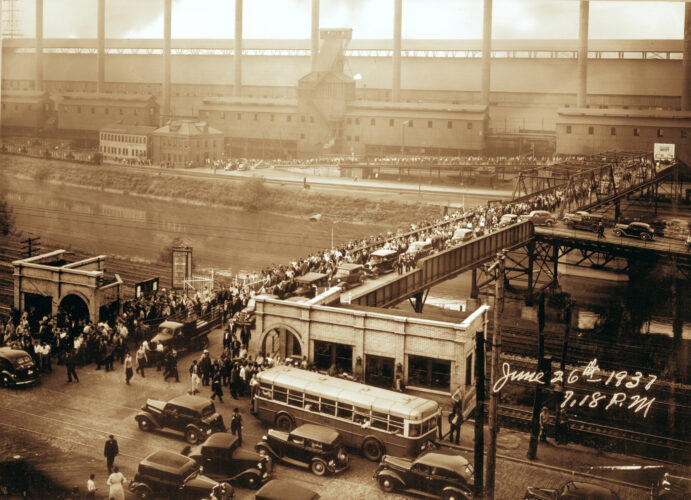
The national Little Steel Strike escalated into violence at Youngstown’s Republic Steel in 1937, marking a pivotal moment in the labor movement in the United States. Provided photo
Youngstown’s Industrial Growth and Labor Movement
In the early 20th century, America witnessed a surge in industrialization fueled by abundant natural resources, which played a crucial role in securing victory in two world wars and establishing the nation as a superpower. Youngstown, Ohio, emerged as a significant player in this transformation, synonymous with steel production and the evolution of labor relations that reshaped work culture across the nation.
The Start of the Little Steel Strike
On June 19, 1937, tensions reached a boiling point outside Republic Steel’s Stop 5 plant on Poland Avenue. Workers had been engaged in a national strike known as the Little Steel Strike, a fierce battle for union recognition that had been ongoing for weeks. Republic Steel, along with Youngstown Sheet & Tube, followed the lead of industry giant U.S. Steel by refusing to acknowledge the Steelworkers Organizing Committee.
Martial Law Declared Amidst Violence
As conflict escalated and production came to a standstill, riots erupted at Republic Steel. In response, then-Ohio Governor Martin Davie declared martial law, deploying the National Guard to restore order. This episode became a significant milestone in Youngstown’s labor history, symbolizing the struggle for workers’ rights.
Historical Context and Demographic Shifts
The roots of the strike extend well beyond 1937, tracing back to the formative years of the steel industry in Youngstown. The city grew from a small community in the Mahoning Valley into one of the world’s leading steel producers, fueled by a mix of immigrant labor, evolving demographics, and cultural identities. Steel production generated considerable wealth and opportunity, but it also led to strife, highlighting power dynamics and social fractures within the community.
Cultural Tapestry of Youngstown
Youngstown’s cultural landscape was shaped by waves of immigrants who brought with them diverse backgrounds and traditions. Bill Lawson, executive director of the Mahoning Valley Historical Society, notes that various communities formed around shared experiences and origins, which solidified their social bonds. These networks significantly influenced labor dynamics, determining who held power within the factories as well as inside their neighborhoods.
Transition from Iron to Steel Production
Although Youngstown was rich in natural resources suitable for iron production, its identity gradually shifted towards steel in the late 19th century. The area began its journey during the post-Civil War era, with iron manufacturing laying the groundwork for economic development. However, the subsequent rise of steel as the backbone of American industry necessitated a strategic pivot that local leaders recognized early on.
Final Stages of the Strike and Labor Progress
Despite the conflicts of 1937, the labor movement did not falter. Activism persisted through a series of legal battles and organizing efforts that eventually led to the establishment of formal representation for steelworkers. Republic Steel signed a contract with the union in 1942, marking a significant victory in the long fight for workers’ rights. The Little Steel Strike thus stands as a defining moment in Youngstown’s history, a testament to the intertwined stories of industrial growth, immigration, economic disparity, and the relentless pursuit of justice.
