


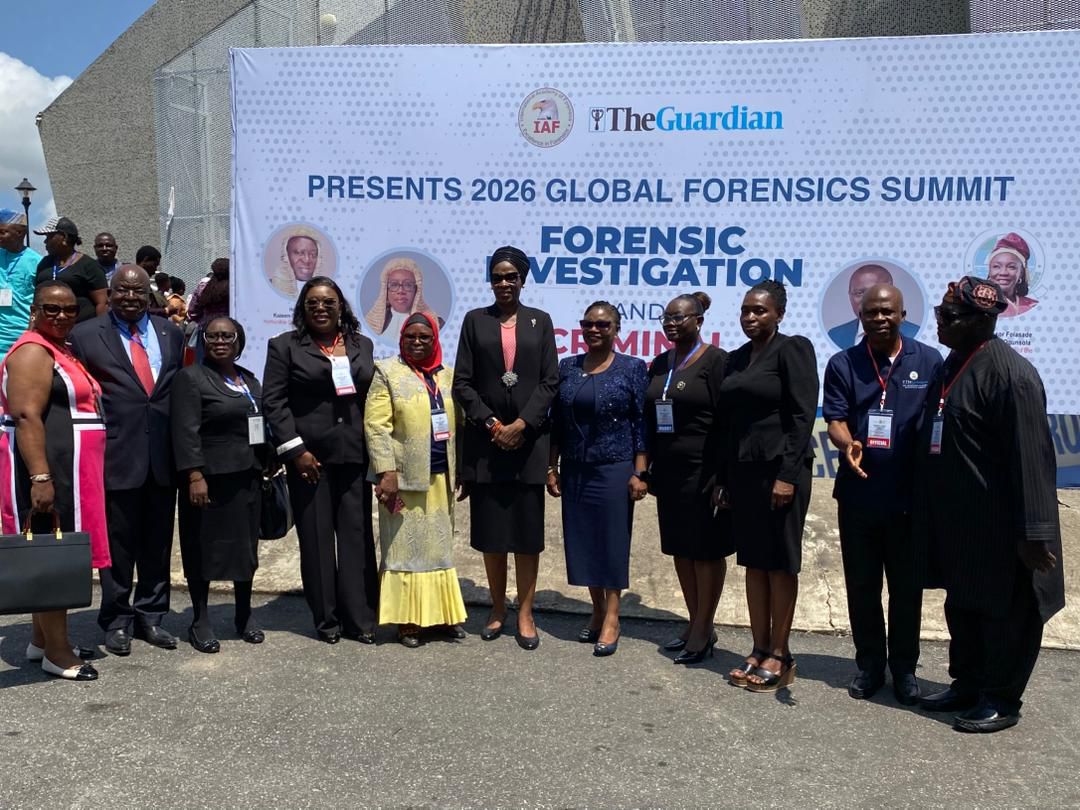
2026 Global Forensic Summit Commences in Lagos
The 2026 Global Forensic Summit kicked off in Lagos, with Justice Kazeem Arogba, Chief Justice of Lagos State, emphasizing the urgent need for Nigeria to bolster its judicial system. A robust judiciary, he asserted, is vital for cultivating a business-friendly environment that attracts investment and stimulates economic growth.
Represented by Olutoyin Ipay, Justice Arogba delivered a keynote address highlighting that a strong judicial system not only boosts investor confidence by safeguarding property rights but also provides a sense of certainty crucial for businesses. He noted that as technology advances, so too does criminal activity, necessitating a scientific approach to law enforcement.
“Modern technology has made criminal acts increasingly sophisticated, requiring investigations to be grounded in forensic science,” Arogba explained. He emphasized the importance of cyber intelligence and data analysis as essential tools in contemporary crime fighting.
Experts in the legal field concurred with Arogba’s assessment, pointing out that investors tend to favor jurisdictions where contracts are enforceable and property rights are secure. A reliable judiciary is indispensable for ensuring timely dispute resolution and sustaining investor trust.
With criminal elements exploiting advanced digital technologies to elude law enforcement, professionals at the summit advocated for Nigeria to adopt digital forensics, artificial intelligence (AI), and data analytics. These innovations are essential for bridging the gap between successful criminal investigations and prosecutions, they argued.
The gathering at the University of Lagos attracted judges, forensic specialists, lawyers, security experts, and policymakers, all aiming to explore how technology can enhance the justice delivery process. Lagos State Governor Babajide Sanwo-Olu, represented by Aderinsola Olanrewaju from the National Mediation Bureau, remarked that numerous criminal cases are stymied due to an inability to gather courtroom-worthy evidence.
“Many criminal proceedings in Nigeria face delays, not from a shortage of witnesses or suspects, but from insufficient, credible evidence,” the governor noted. He attributed this gap in successful investigations to a lack of stringent forensic methodologies. Highlighting Lagos State’s role as a hub for financial institutions and tech companies, Sanwo-Olu called for enhanced digital forensic capabilities to combat increasingly sophisticated crimes effectively.
During the inaugural sessions, Dele Olowokudejo, a Fellow of the International Academy of Forensic Sciences, expressed a desire to foster collaboration between various stakeholders. “Our collective goal is to strengthen the justice system, enhance accountability, combat crime, and discover innovative methods to build public trust,” he stated.
As the summit progresses, justice advocates will delve into themes such as forensic investigation and criminal intelligence, focusing on modern challenges posed by technological advancements. Justice Alaba Omolaye Ajilayi highlighted that evidence from digital investigations, DNA analysis, and cyber evidence increasingly plays a critical role in judicial proceedings. He pointed out significant legislative advancements, such as the Evidence Act of 2011, which clarifies the admissibility of electronic evidence in courts.
Participants will continue to explore emerging technologies, including AI, biometric identification, and advanced investigative tools, as the summit draws to a close. Many attendees reiterated that combating modern crime demands contemporary evidence approaches, underscoring the necessity of integrating science and technology into the future of justice.
