


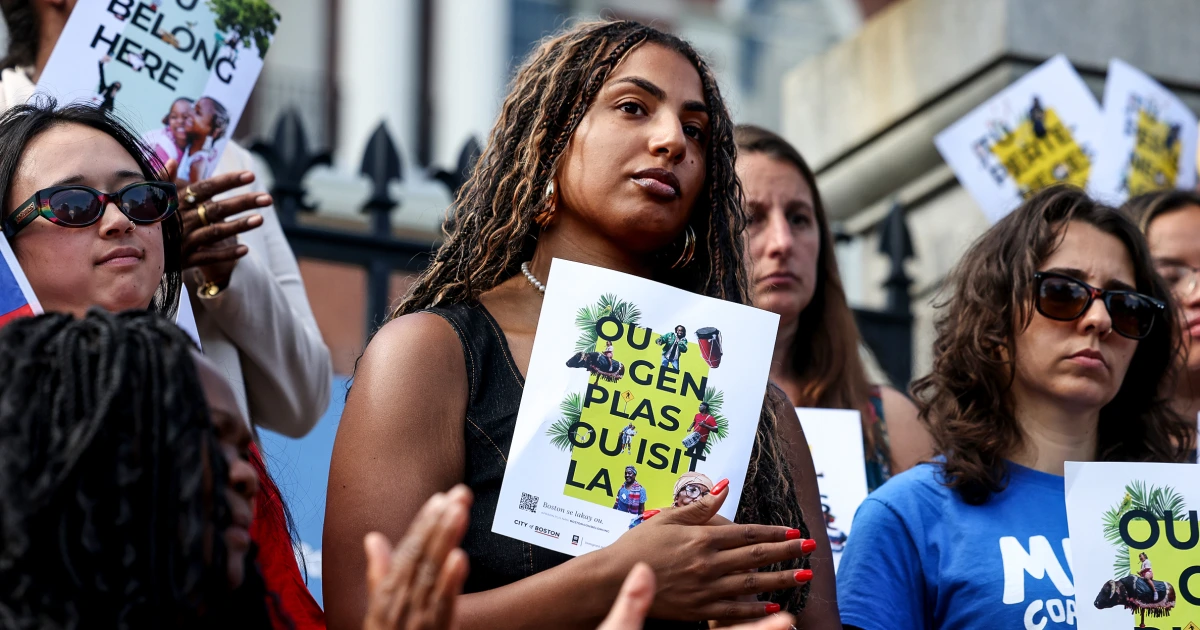
Supreme Court Decision Impacting TPS Holders reverberates through communities
Harlein, an emergency room and travel nurse, felt the weight of a critical decision Thursday morning when the Supreme Court gave the Trump administration the green light to terminate immigration protections for Haitians, impacting individuals like herself.
“I just couldn’t breathe. It felt like a heaviness in my chest,” said Harlein, who has been on parole leave since her mid-30s. The Temporary Protected Status (TPS) program provides crucial humanitarian relief to individuals from countries experiencing conflict or natural disasters, allowing them to work legally and safeguarding them from deportation. Many have resided in the United States for decades.
Harlein expressed her feelings of despair, fearing that the loss of her work permit without TPS status could lead to unemployment for herself and potentially hundreds of thousands of others. As a nurse during the COVID-19 pandemic, she has cared for critically ill patients reliant on ventilators.
“They’re starving us and our friends and family back home who depend on us,” added Harlein, who requested her last name be withheld to avoid potential backlash from immigration authorities.
A series of ongoing lawsuits aim to block attempts by President Trump to eliminate TPS protections for immigrants from 17 countries during his second term. The Supreme Court’s decision has now set a precedent that could also strip protections from around 350,000 Haitians and 6,000 Syrians, raising significant concerns for the 1.3 million individuals from various countries who hold similar protections.
Commenting on the ruling, White House Press Secretary Abigail Jackson declared, “This is a major victory for the Trump administration. The court confirmed what President Trump has always maintained: Temporary Protected Status is, by definition, temporary.”
James Percival, the general counsel for the Department of Homeland Security, reiterated this sentiment, arguing that many TPS designations have effectively become permanent. “This is a victory for the rule of law and common sense,” he stated.
Jessica Bansal, an attorney with the National Network of Day Labor Organizations, remarked that the loss of TPS status represents a tragedy for the 1.3 million individuals facing uncertainty. Legal experts note that the Supreme Court’s order complicates the potential for legal challenges against TPS terminations.
Current holders of TPS voicing their concerns to NBC News expressed trepidation about the implications of this decision, which threatens to strip them of their ability to work and put them at risk of deportation under Trump’s mass removal initiatives. Many remain uncertain about when these potential changes will take effect.
“This is the saddest day of my life in the United States,” lamented Biles Dorsainville, a TPS recipient and the director of the Haitian Community Support Center in Springfield, Ohio. Dorsainville highlighted the dangers faced by the Haitian community, particularly amid escalating violence and instability in Haiti.
Harlein, who has held TPS status since its inception for Haitians after the 2010 earthquake, conveyed her concerns for her 17-month-old son, a U.S. citizen. “I feel trapped because being separated from my son is not an option,” she said.
The Supreme Court majority ruled that they lacked the authority to reconsider the administration’s decision on TPS, dismissing claims that the termination was racially motivated. In a dissenting opinion, Justice Elena Kagan criticized the administration’s rhetoric regarding Haitians, arguing that it had clear racial implications.
Doris Lamberde, a TPS recipient from El Salvador and co-coordinator of the National TPS Alliance, shared her anxieties regarding the looming decisions, emphasizing the impacts beyond the U.S. border. Having lived in the U.S. since 2000, she fears the fate that awaits her and her three U.S. citizen children if her TPS protections are revoked.
Lamberde encapsulated the sentiment of many by stating, “You will see the loss of hope and the despair of the people,” if the Supreme Court sides with the administration in this case.
