


Rwanda’s Graduates Prepare to Tackle Africa’s Challenges with Advanced Skills
Kigali is witnessing a pivotal moment as Africa turns to artificial intelligence, data, and technology to address pressing issues like climate change, food insecurity, and public health. In this transformative landscape, a cadre of young scientists is poised to make significant contributions.
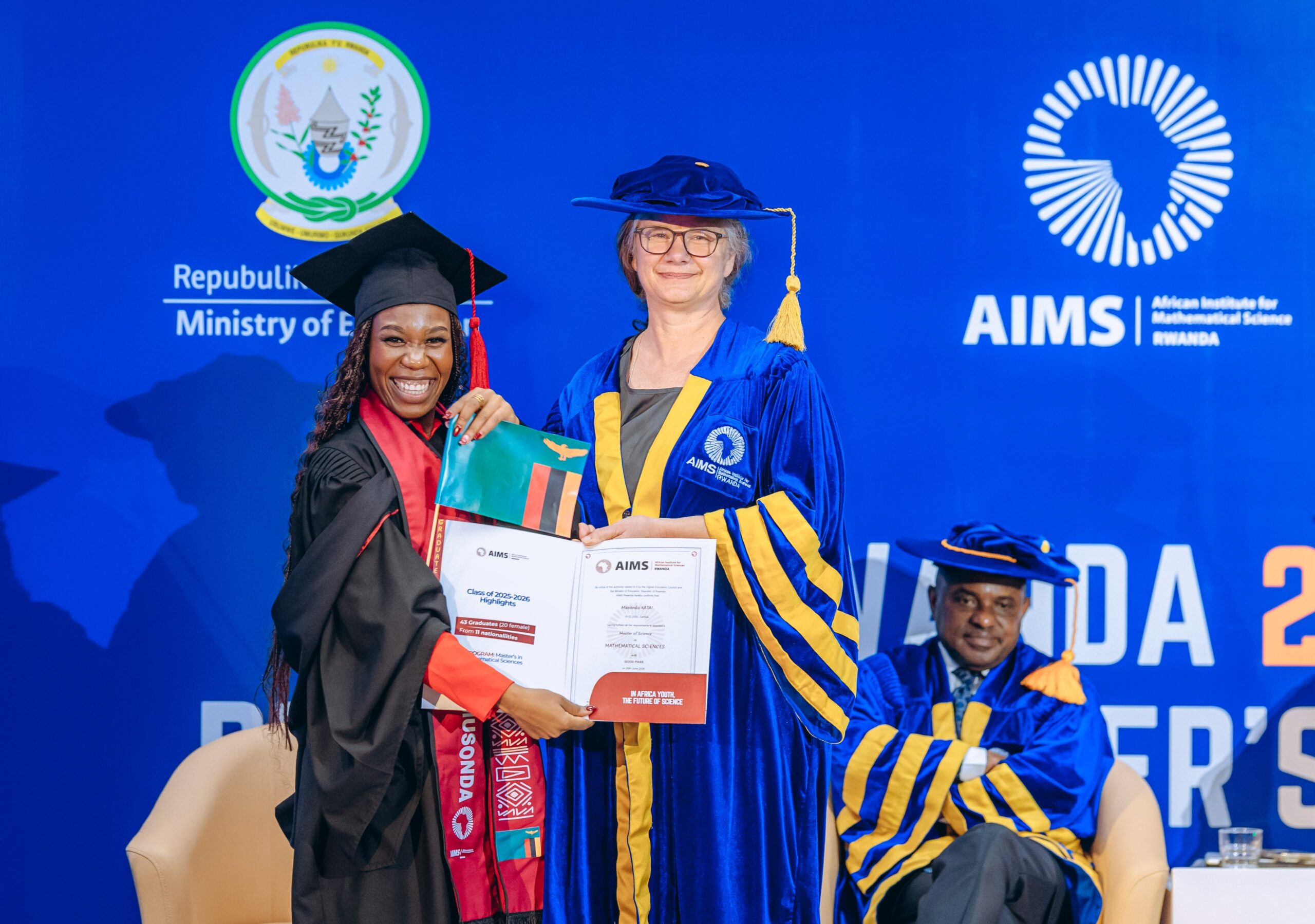
Recently, the African Institute of Mathematical Sciences (AIMS) Rwanda celebrated the graduation of 43 students with master’s degrees in mathematical sciences. These graduates are now part of an expanding network of African experts dedicated to crafting practical solutions for the continent’s most pressing challenges.
The new graduates come from 11 African nations, having received advanced training in mathematics, artificial intelligence, data science, scientific computing, and computer modeling. As reliance on technology and data grows among both governments and businesses, the importance of these skills is paramount.
This graduating cohort includes 19 women and 16 Rwandans, underscoring the increasing participation of women in science and technology education.
According to senior faculty at AIMS, at least half of the graduates had secured job placements even before completing their studies, reflecting a heightened demand for professionals skilled in these fields.
Professor Sam Yara, Chairman of the AIMS Global Network and Director of the AIMS Rwanda Center, highlighted the readiness of graduates to contribute to Africa’s future. He expressed that the ceremony represented not just a graduation, but a celebration of discipline, resilience, and young African talent prepared to make an impact globally.
Yara emphasized that the impressive employment rate among graduates indicates strong employer trust in the quality of training offered by AIMS. With Africa adopting digital solutions, experts note that mathematics is increasingly pivotal across various sectors, including medicine, agriculture, finance, cybersecurity, and scientific research.
The graduates are expected to play crucial roles in areas such as developing artificial intelligence, enhancing weather and climate forecasting, improving disease surveillance, advancing smart agriculture, and fostering financial technology innovations. For a continent significantly affected by climate change, these capabilities will be vital in helping governments predict natural disasters, improve crop yields, and respond effectively to droughts and floods.
Ivan Ntwari, Country Director at Mastercard Foundation Rwanda, remarked that AIMS has evolved beyond a mere academic institution. It now serves as a platform for cultivating African scientists, innovators, problem solvers, and future leaders. He urged the graduates to leverage their education to create new opportunities for their communities, noting that Africa’s future will be shaped by its youth.
Lucas Miliha Razafimanansoa, speaking on behalf of the graduates, encouraged his peers to embrace uncertainty and utilize their newfound knowledge for positive change as they embark on their careers.
Keynote speaker Jodi Meade, a professor at Boise State University, urged graduates to commit to lifelong learning and employ their mathematical skills to address real-world challenges. He drove home the point that mathematics serves as a backbone in today’s data-driven age, conferring a competitive edge on nations that invest in institutions like AIMS.
Pascal Gatabazi, Chief Technical Adviser at Rwanda’s Ministry of Education, echoed this sentiment, stating that mathematics is a cornerstone of the Fourth Industrial Revolution. He celebrated the increasing number of women graduating from these programs, recognizing that mathematics is an accessible field for all.
Founded in 2016 with government backing, AIMS Rwanda has since graduated over 545 students, with women representing 38 percent of its graduates. As a key center in the AIMS Global Network, the institute continues to cultivate the skilled workforce necessary for Rwanda’s vision of becoming a knowledge-based economy, while also contributing to scientific and technological advancements across Africa.
