


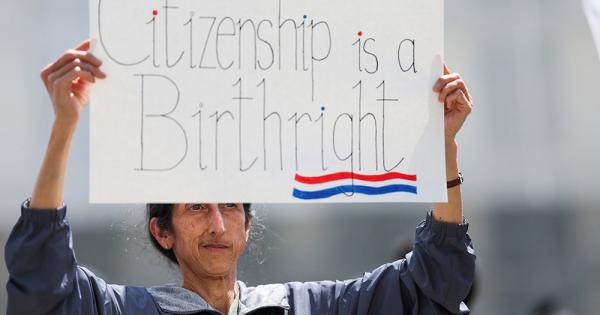
Supreme Court Upholds Birthright Citizenship, Earning Praise from Catholic Advocates
Catholic immigration advocates are celebrating the U.S. Supreme Court’s decision on June 30, which upholds birthright citizenship for all children born on American soil, irrespective of their parents’ immigration status. This ruling reinforces the principle that a child born in the United States is entitled to citizenship.
Norma Pimentel, executive director of Catholic Charities of Texas’ Rio Grande Valley, expressed her relief on social media, stating that the ruling offers peace of mind to families who have been anxious about their children’s futures. Her sentiments resonate deeply within her community, where many families face uncertainty regarding immigration laws.
Kelly Ryan, president of Jesuit Refugee Services of America, explained in a statement that the ruling protects the rights and dignity of countless children in the U.S. It affirms a crucial constitutional principle: that children should not be discriminated against based on their parents’ immigration status. Ryan emphasized the core belief that human dignity must be preserved for all, arguing that the abolition of birthright citizenship could lead to a growing class of stateless individuals deprived of fundamental rights and opportunities.
High Court Rejects Trump’s Executive Order on Birthright Citizenship
The Supreme Court’s ruling overturned an executive order from January 2025 issued by former President Donald Trump, which aimed to limit citizenship rights for children born to undocumented immigrants. Chief Justice John Roberts, speaking for the majority, noted that the executive order was at odds with the 14th Amendment, a foundational element of the U.S. Constitution.
Roberts remarked that citizenship is fundamentally about participation in society and the rights it confers. He reiterated the framers’ intentions when drafting the Fourteenth Amendment, which extends these rights to all persons born on American soil. By upholding this constitutional promise, the Supreme Court has bolstered the rights of all children born in the U.S.
Implications of the Ruling for Children’s Rights
Kevin Appleby, senior director of international immigration policy at the Center for Immigration Studies, called the court’s ruling crucial in preventing a system that would create second-class citizenship for numerous children. He observed that such a ruling would have regressed the U.S. to a time when some individuals had rights while others did not. According to Appleby, the Constitution’s strength lies in its durability and its inability to be altered unilaterally.
Appleby noted that the stance taken by church leaders advocating for birthright citizenship may have influenced the six Catholic justices on the Supreme Court, four of whom sided with the majority. Organizations like the Catholic Legal Immigration Network (CLINIC) and the U.S. Conference of Catholic Bishops submitted amicus briefs supporting this legal principle.
Church Responses to the Supreme Court’s Decision
While the U.S. Bishops’ Conference did not issue a specific statement regarding the ruling, they highlighted in a brief that abolishing birthright citizenship would undermine the church’s teachings and the nation’s moral framework. They characterized both the intended and unintended consequences of the executive order as immoral, challenging core beliefs about human dignity and the treatment of vulnerable populations.
Anna Gallagher, executive director of CLINIC, expressed her gratitude for the court’s decision, emphasizing its importance for national identity and justice aligned with Catholic social teachings. Gallagher noted that this ruling brings relief to immigrant families and represents a significant victory for justice.
Broader Significance of the Ruling
Christopher Kerr, executive director of the Ignatian Solidarity Network, hailed the Supreme Court’s decision as a safeguard against lifelong statelessness for hundreds of thousands of children born in the U.S. Emphasizing Catholic doctrine, Kerr reiterated the right of all children to belong and be protected within society.
Giovana Oaxaca, senior government relations manager at the Catholic Social Justice Network Lobby, critiqued the White House’s prior attempts to portray certain children as undeserving of full citizenship. She argued that denying full rights to all children born in the U.S. contravenes their inherent dignity as individuals created in God’s image.
Criticism from Conservative Catholic Voices
Following the ruling, several conservative Catholic groups expressed discontent. Catholic Vote, a political nonprofit, labeled the decision short-sighted, while Vice President J.D. Vance characterized birthright citizenship as conflicting with the 14th Amendment. Dennis Murphy McGraw, national co-chair of the progressive group Catholic Vote Common Good, praised the court’s ruling for rejecting efforts to alter the Constitution.
McGraw underscored that attempts to separate families and redefine belonging in America violate both constitutional principles and moral values, reaffirming the need for inclusive immigration policies that uphold family unity and dignity.
