


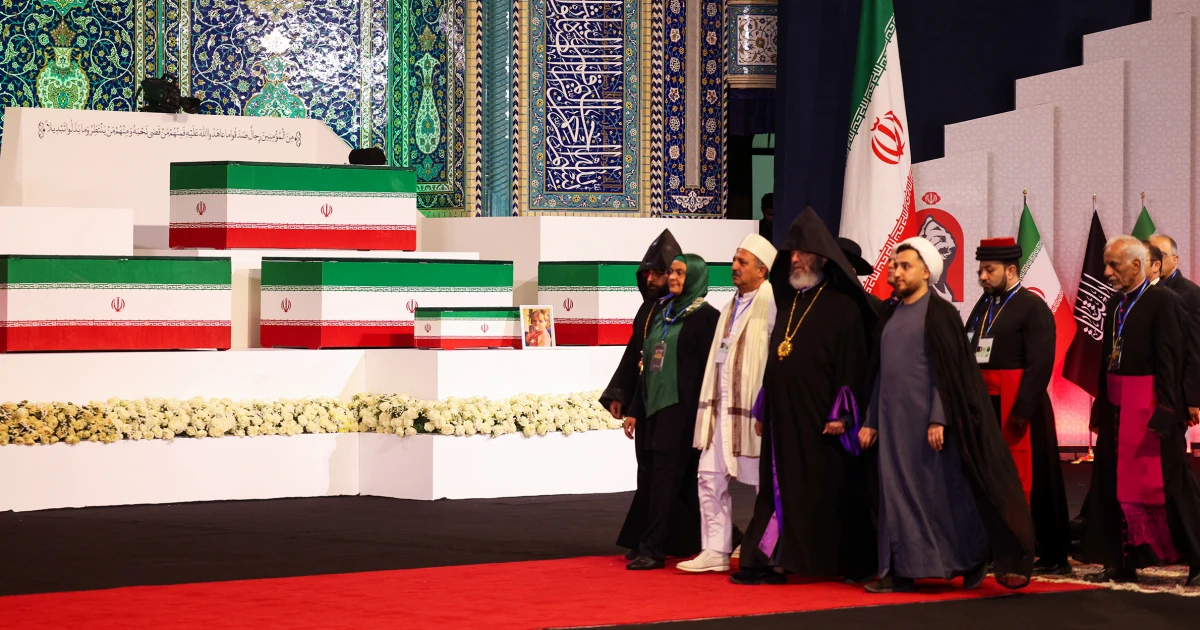
Significance of Khamenei’s Funeral for the Regime
Sheena Azodi, director of the Middle East Studies Program at George Washington University, asserts that the upcoming funeral for former Iranian Supreme Leader Ali Khamenei represents a strategic opportunity for those committed to upholding his legacy. The regime aims to leverage this occasion as a display of strength, resilience, and unwavering loyalty among the Iranian populace.
Funeral Events Scheduled in Tehran
Viewings and prayers for Khamenei’s coffin are set to take place on Saturday and Sunday at the Grand Mosala, a significant mosque and prayer complex in central Tehran. This will be followed by a funeral procession through the streets of the capital on Monday, allowing the regime to showcase its support among the people.
Regional Implications of the Funeral
Additional funeral ceremonies are planned in Qom, Iran’s hub for religious studies, and in Iraq, which hosts important Shiite shrines. Conducting Khamenei’s funeral across the border enables the Islamic Revolutionary Guards Corps—one of Iran’s most influential military, political, and economic entities—to assert its regional influence.
Burial at Iran’s Prominent Shiite Shrine
Khamenei will be laid to rest on Thursday in Mashhad, his hometown, which is renowned for housing one of the most significant Shiite religious shrines in Iran. This burial site is imbued with deep religious and cultural significance, further enhancing the funeral’s prominence.
Delay Raises Concerns in Uncertain Political Climate
Islamic tradition typically dictates that funerals occur immediately following a death. However, Khamenei’s delayed funeral—scheduled for four months after his passing—stands as an unusual occurrence, particularly in light of ongoing tensions with the United States. The date for the ceremony was confirmed just days prior to the signing of a memorandum of understanding between the U.S. and Iran, aimed at formally ending hostilities.
Transition of Power Amidst Turmoil
The political landscape remains precarious following a series of U.S. and Israeli strikes in early wartime stages, resulting in the deaths of several senior political and military figures, thus intensifying uncertainty within the regime. Khamenei’s son, Mojtaba, who was injured in the same attack that claimed his father’s life, was appointed as the new supreme leader in March. However, his absence from public view raises questions about his health and ability to lead effectively during this tumultuous period.
Legacy and Power Dynamics Within the Revolutionary Guards
Despite his passing, Khamenei’s influence endures, especially as his legacy has enabled the Revolutionary Guards to emerge as the dominant force in Iran’s military, political, and economic spheres. Analysts note that efforts by U.S. and Israeli forces to weaken the regime have inadvertently solidified a more hardline faction within the Revolutionary Guards. As Ali Alfone, a senior fellow at the Arab Gulf States Institute, explains, this group now wields significant power over strategic decision-making and national resource allocation, signifying a shift in Iran’s internal dynamics.
Among those who have quickly ascended within this power structure is Mohammad Berger Ghalibaf, the current speaker of parliament and chief negotiator in U.S. dealings. His mockery of U.S. leadership on social media demonstrates the new hardline stance taking shape as the regime recalibrates its strategies moving forward.
In a statement released Thursday, Ghalibaf emphasized the need for Iran to firmly convey its aspirations for justice and retribution, insisting that the nation will not remain silent in the face of perceived aggression from its adversaries.
