


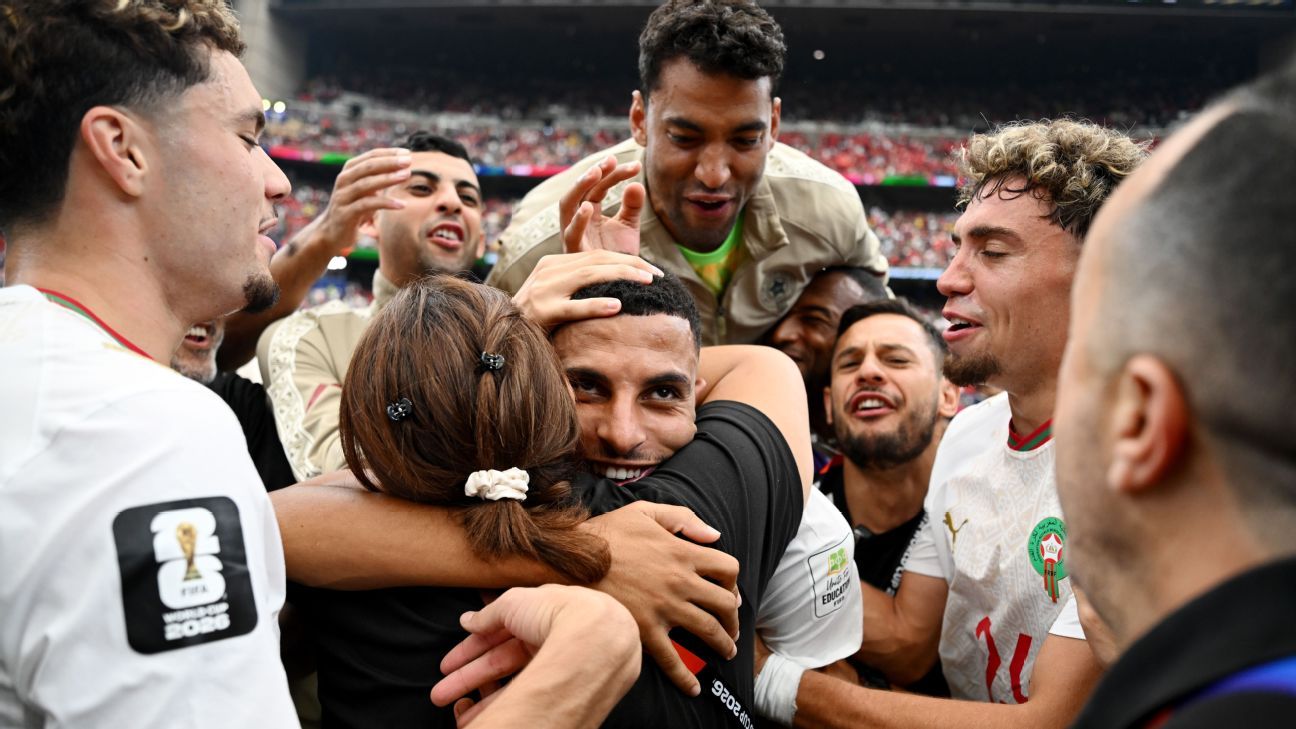
Morocco Celebrates Independence Day with a Resounding Victory
HOUSTON — On July 4, coinciding with the United States’ Independence Day, Morocco made its own statement on the global stage.
Having reached the World Cup semi-finals four years ago, Morocco has firmly distinguished itself as an elite team in international football. In the Round of 16, they faced off against Canada, delivering a commanding 3-0 victory in Houston. Azzedine Ounahi stole the spotlight with two remarkable goals, complemented by Soufian Rahimi’s late score during stoppage time.
The prowess displayed by Ounahi and his teammates proved decisive in crucial moments, marking Morocco as a formidable contender for either France or Paraguay in the quarter-finals.
On the other hand, Canada, which co-hosted the World Cup, was left to ponder its missed opportunities. As the least favored host team, Canada showcased its capabilities for the first 45 minutes but ultimately fell short.
Coach Jesse Marsh expressed his belief that Canada was the better team, albeit with Morocco exhibiting slightly more quality in the final third of the game. He pointed out, “It took just one play to make it 1-0. Otherwise, the game was ours.” His analysis reflected a strong sense of determination despite the loss.
Moroccan coach Mohamed Ouabi, however, offered a different perspective. He acknowledged Canada’s intensity but asserted that Morocco was superior in the second half, contributing to their victory. “We were better than them in the second half,” he concluded.
Ounahi’s opening goal in the 50th minute—set up by Achraf Hakimi—shifted the momentum decisively in Morocco’s favor. Following this, Brahim Diaz’s deft footwork increased their lead, while Rahimi’s goal in the closing minutes cemented Canada’s fate.
Despite dominating the first half, Canada allowed Morocco to seize control after halftime, marking a missed opportunity for the hosts. It became evident that excelling in chances is not enough in the World Cup; Morocco demonstrated a killer instinct that has defined their recent performances.
Ounahi candidly admitted the match wasn’t straightforward, acknowledging that Canada posed significant challenges early on. Moroccan fans have grown accustomed to supporting a team that has evolved to be more than just a surprise contender; they have consistently proven their mettle, having previously defeated Brazil and eliminated the Netherlands in this tournament.
In stark contrast to Morocco’s second half success, their first half was characterized by dominance from Canada, which held 65% possession yet had minimal impact, posting just one shot with an Expected Goals (xG) of 0.02. Goalkeeper Yassine Benou played a crucial role, denying key chances from Jonathan David and Tani Oluwaseyi.
Injuries affected Morocco’s strategy early on, with Ismael Saibari sidelined and key players initially underwhelming. Despite these setbacks, the team changed its approach after halftime. A pivotal moment occurred when Hakimi spotted the unmarked Ounahi, who expertly navigated through defenders to score the opener.
Ounahi’s impressive performance is no longer surprising to fans and analysts alike. Now a standout player for Girona in La Liga, he has proven himself in significant matches and shows potential for a bright future beyond the second division.
Contributing further to Morocco’s success, Ounahi netted a second goal in the 82nd minute and assisted Rahimi’s final strike. His collaborative play with Diaz highlighted the strength of team synergy; Diaz himself now boasts four assists in this World Cup.
Morocco has reached the quarter-finals in consecutive tournaments, while Canada faces reflection on their performance with aspirations for future improvement ahead of the 2030 World Cup. Coach Marsh’s final remarks encapsulated the contest’s unpredictability: “Another day, maybe we’ll get the lead and maybe even win.”
