


Nigeria’s Stock Market Sees Remarkable Growth Amid Economic Recovery
In a promising development for Nigeria’s financial landscape, the total market capitalization of all listed securities on the Nigeria Exchange Limited (NGX) surged by N51.6 trillion during the first half of 2026, fueled by encouraging economic indicators. As of June 30, 2026, the capitalization of tradeable securities rose from N149.74 trillion at the end of 2025 to an impressive N201.3 trillion, marking a notable increase of 34.45%.
The market includes a variety of securities, such as bonds, stocks, and exchange-traded funds (ETFs). Since 2025, several factors have contributed to the stabilization of Nigeria’s economy, including improvements in the foreign exchange market, recovery from previous losses, enhanced liquidity, and a surge in capital inflows. The preference of domestic investors and a boost in portfolio investments have further aided this growth. Key reforms in the banking sector, along with updates in the insurance sector by the Central Bank of Nigeria (CBN), have also significantly contributed to raising overall market capitalization.
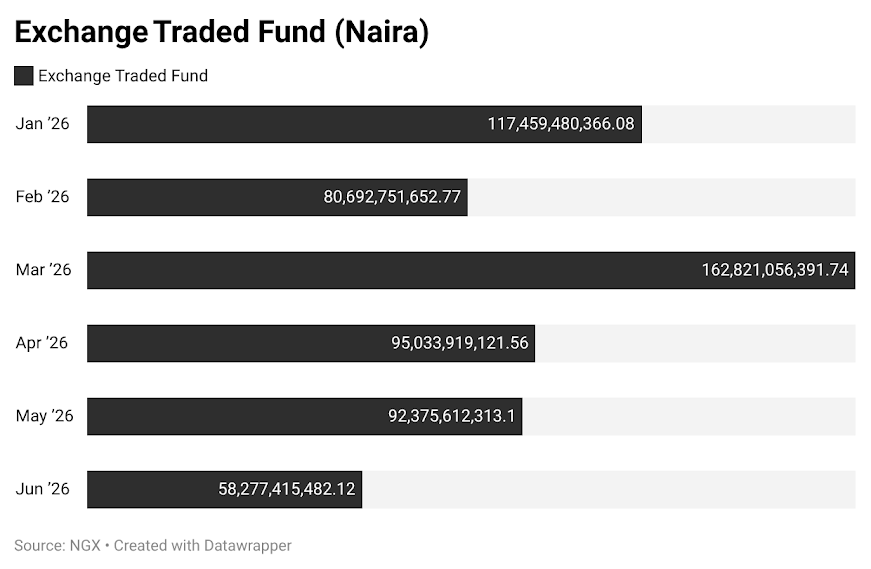
As of June 2026, the stock market accounted for nearly 73% of the total market capitalization at N146.8 trillion, while the bond market comprised roughly 27.03% with a closing figure of N54.4 trillion. Meanwhile, the ETF segment saw modest growth, increasing its contribution to 0.03% at N58.3 billion.
According to trading volume analysis from THISDAY, the stock market experienced robust activity, closing at N146.86 trillion on June 30, 2026, a staggering gain of 48.6% year-on-year from N99.18 trillion in 2025. The bond market showed positive momentum as well, closing at N54.4 trillion, which reflects a year-on-year increase of about 7.72% compared to N50.51 trillion in 2025. The ETF market also experienced growth, rising from N42.85 billion in 2025 to N58.3 billion, an impressive increases of 36.01%.
The stock market sector continues to dominate trading activities on the NGX, as both local and foreign investors respond favorably to CBN’s foreign exchange reforms and initiatives by the National Pension Commission (PenCom). Additionally, the recent upward adjustments to the allocation allowances for common shares in various Retirement Savings Account (RSA) Funds have further encouraged investments.
Confidence among local investors has also been bolstered by solid corporate profits reported by major companies, including MTN Nigeria Communications Limited and Nigerian Breweries Limited. These developments have led to strong price gains for several stocks since the beginning of the month, highlighting the increasing attraction for foreign investment amidst improving macroeconomic indicators.
To sustain this growth trajectory, capital market analysts are urging stakeholders to adhere to stable and reliable economic policies. Aruna Kebira, Managing Director and CEO of Globalview Capital Limited, expressed that despite some volatility and economic challenges, the stock market has demonstrated resilience and promising performance. He identified several key factors driving this success, including banking sector recapitalization, enhanced corporate earnings, subdued inflation, investor optimism, and increased trading volumes.
Looking ahead, Kebira remains cautiously optimistic about the outlook for the Nigerian stock market in the latter half of 2026, citing the ongoing effects of reforms and momentum within the banking sector. David Adonri, Chief Executive Officer of HiCap Securities Limited, echoed this sentiment, predicting a modest recovery in the stock market supported by improved corporate fundamentals and sustained macroeconomic reforms. However, he cautioned that challenges such as high interest rates, political uncertainties surrounding the upcoming 2027 general elections, and ongoing global conflicts may present risks to market performance.
Adonri emphasized that the recent correction observed on the Nigerian Exchange should not be misconstrued as a signal of systemic weakness but rather as a natural phase of portfolio adjustments by financial institutions following significant rallies spurred by economic reforms.
