


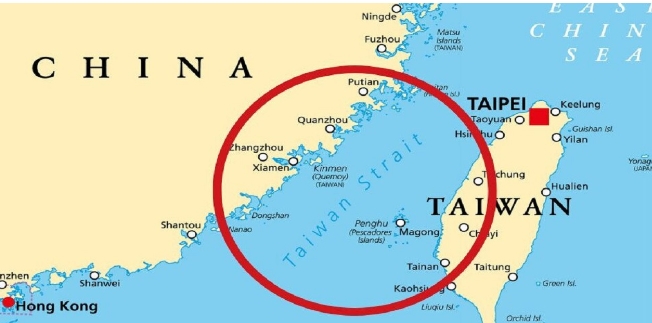
Factors Influencing Tensions in the Taiwan Strait
Experts believe that a combination of strategic restraint, historical experience, diplomatic traditions, and military deterrence has played a critical role in managing tensions in the Taiwan Strait. These elements have prevented the long-standing conflict between China and Taiwan from escalating into a full-scale war.
The Geopolitical Importance of the Taiwan Strait
The Taiwan Strait, a vital 180-kilometer shipping lane that separates mainland China and Taiwan, serves as one of the world’s busiest maritime routes and a significant geopolitical flashpoint. The conflict involves the People’s Republic of China and the self-governing island of Taiwan. Taiwan’s democratic governance and its security alliances with Western powers, notably the United States, contribute to the ongoing friction between the two sides.
Escalating Military Tensions
Military tensions in the region have periodically spiked, particularly as Beijing conducts military drills around Taiwan, framing its actions as necessary responses to perceived external interference and Taipei’s moves towards independence.
The Role of Diplomatic Traditions
Professor Suleiman Bala Mohammed, former Vice Chancellor of Nasarawa State University, stresses that the moderation exhibited by both China and Taiwan can be traced back to a deeper diplomatic tradition. He suggests that underlying cultural norms govern the diplomatic interactions on both sides, promoting a careful approach to conflict management.
Historical Contexts and Philosophical Influences
Professor Ghali Ibrahim, also from Nasarawa State University, echoes this sentiment, arguing that a shared historical and philosophical heritage underlies the cautious behavior of both parties. He asserts that their actions reflect centuries of political conditioning that advocate for prudence in managing conflicts.
The Impact of Military Deterrence
In his 2024 book, “The Struggle for Taiwan: America, China, and the History of the Sandwiched Island,” author Sulman Wasif Khan notes that the absence of a direct military conflict can also be attributed to military deterrence, particularly the strategic balance created by the presence of both Chinese and American forces in the area.
Distinct Nature of the China-Taiwan Conflict
Providing a different perspective, Professor Yusuf Zoaka from the University of Abuja argues that the China-Taiwan conflict differs fundamentally from other international disputes, such as those involving Russia and Ukraine or Israel and Palestine. He posits that the issues between China and Taiwan are rooted in the unresolved legacies of civil wars and competing claims to legitimacy.
The Philosophical Foundation for Conflict Resolution
Analysts also highlight how classical Chinese philosophy influences conflict resolution strategies in the region. Confucian and Laozi teachings emphasize principles of harmony, moderation, and peaceful conflict management. According to Zhao Qiguang’s insights, Confucianism fosters the development of positive relationships through virtues such as benevolence, righteousness, courtesy, knowledge, and faith.
Stability Amid Economic Interdependence
While military tensions have been significant, the conflict has remained largely contained since 1949 when Chiang Kai-shek retreated to Taiwan following defeat in civil war. Subsequent confrontations have been resolved without escalation, allowing the status quo to persist. Beyond security issues, China and Taiwan share robust economic ties, with mainland China serving as Taiwan’s largest trading partner. Taiwanese firms are key investors in China’s manufacturing and technology sectors, highlighting a complex relationship that intertwines strategic rivalry with deep commercial interests.
