


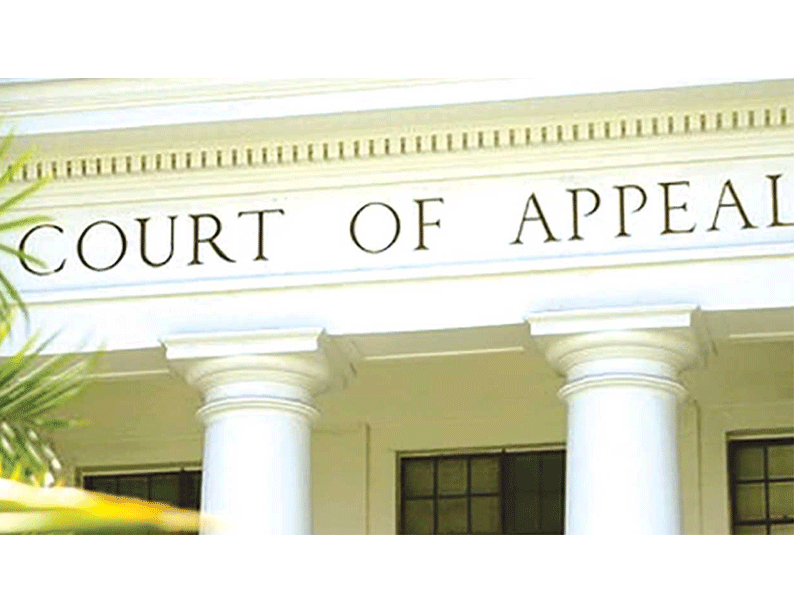
Abuja Court of Appeal Overturns INEC Electoral Guidelines Ruling
The Abuja Court of Appeal has reversed a Federal High Court ruling that had questioned the validity of certain electoral guidelines set forth by the Independent National Electoral Commission (INEC) for the upcoming 2027 general elections. This decision marks a significant shift in the ongoing legal discourse surrounding electoral processes in Nigeria.
A three-member panel reached a unanimous judgment, concluding that the previous court erroneously invalidated INEC’s guidelines, which, according to the appeals court, do not contravene the provisions of the 1991 Constitution or the Electoral Act. This ruling underscores the legal discretion granted to INEC in managing electoral procedures.
Justice Muhammad Umar initially invalidated INEC’s revised timetable for the 2027 elections on May 20, citing concerns that the commission imposed deadlines on political parties for submitting membership registers, conducting primaries, and naming candidates. This was seen as inconsistent with the stipulations of the 2026 Electoral Act.
The lawsuit, identified as case number FHC/ABJ/CS/517/2016, was brought forth by the Youth Party on March 11. The plaintiffs sought multiple declarations, contesting INEC’s authority to manage the timing and procedures for party primaries as defined under Sections 29, 82, and 84(1) of the Electoral Act 2026. They argued that the commission’s actions lacked proper statutory backing.
Displeased with the initial ruling, the appellants sought intervention from the Court of Appeal, asserting that the trial court failed to adequately address jurisdictional questions and infringe upon their right to a fair hearing by ruling on a hypothetical case.
During the ruling, Justice Adebukola Banjoko highlighted the trial court’s misstep in overriding INEC’s administrative discretion. The appeals court noted that while INEC is empowered to conduct elections, no indications were presented that political parties would be hindered from completing their primaries. For the court to intervene, there must be a substantial threat to the electoral process, which was not established in this case.
Justice Okon Abang further articulated that when INEC operates within its statutory powers, judicial intervention is unwarranted. He asserted that the relief granted by the lower court was inappropriate and should therefore be vacated.
INEC, through its counsel Alex Ijinyon, had filed the appeal on May 25, 2026, emphasizing that the trial court’s decision neglected crucial legal considerations. Ijinyon noted the importance of adhering to the procedural stipulations outlined in the Electoral Act, arguing that the trial court’s judgement contradicted substantial evidence submitted during hearings.
The appeals court unanimously concurred with INEC’s position, asserting that the Youth Party did not possess the requisite legal standing to challenge the guidelines, as it failed to demonstrate how these regulations would impact its ability to conduct primaries and nominate candidates for the 2027 elections.
