


Investigation into Fatal Tesla Crash Reveals Driver’s Actions
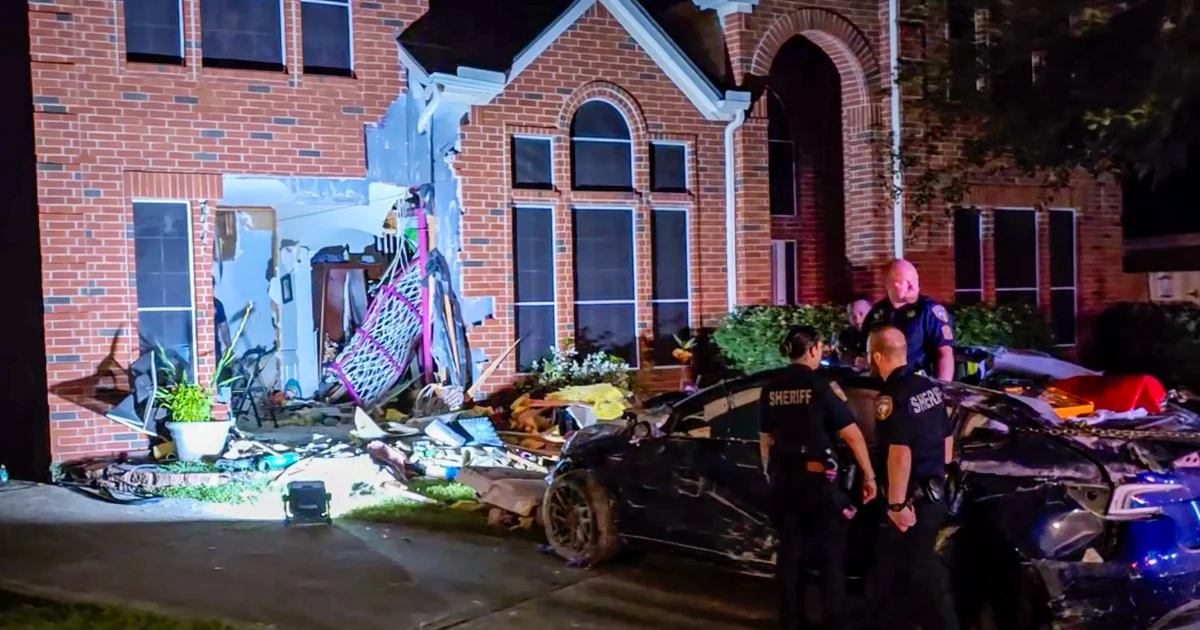
In the wake of a tragic incident involving a Tesla that resulted in the death of a 76-year-old woman in Texas, the National Transportation Safety Board (NTSB) has determined that the vehicle’s driver disabled the car’s driver assistance functions. Michael Butler, 44, was behind the wheel of the Tesla Model 3 when the crash occurred, accelerating into the building at a speed of 110 mph.
Details of the Incident Uncovered
The NTSB’s report, released on Wednesday, detailed how the Tesla struck a residence after “partially entering a driveway.” This alarming event took place on a residential street, where the speed limit is set at 30 mph.
Driver Override of Safety Features
At the time of the accident, Butler was utilizing Tesla’s advanced driver assistance system known as Full Self-Driving (Supervised). However, electronic data retrieved from the vehicle showed that he had taken manual control by pressing the accelerator fully prior to the collision. The vehicle’s speed at impact was markedly excessive, exceeding 110 mph.
Fatal Consequences and Legal Implications
The collision resulted in the death of Martha Avila, while Butler sustained minor injuries. Following the incident, he has been charged with manslaughter in connection with Avila’s death, though prosecutors have yet to clarify whether blame lies with the car’s technology.
Responses from Stakeholders
Butler’s attorney has not commented on the findings, and Tesla has not issued an immediate response. Meanwhile, Ashok Elswamy, Tesla’s vice president of AI software, reiterated that Butler’s actions directly influenced the vehicle’s operation, asserting that he had disabled the autonomous driving feature during the incident.
Expert Opinions on the Findings
Philip Koopman, a professor emeritus at Carnegie Mellon University and an expert in self-driving car safety, expressed concerns that the NTSB’s findings may not capture all factors at play. He emphasized the need to explore possible mechanical, electronic, or software failures that could have contributed to the incident.
The Bigger Picture in Autonomous Driving
Critics of Tesla’s self-driving technology have raised ongoing concerns about its marketing and functionality. Several individuals involved in similar crashes have highlighted the discrepancy between the name “fully autonomous driving” and the actual level of oversight required by drivers. MIT researcher Brian Reimer noted that a clearer naming strategy is essential for informing drivers of their responsibilities while using these advanced systems.
Continued Investigations and Regulatory Oversight
The NTSB continues to investigate the crash to determine a definitive cause, while the National Highway Traffic Safety Administration has launched a special investigation of the accident. Questions remain regarding Tesla’s technology and its implications for driver safety and responsibility in an increasingly automated driving landscape.
