


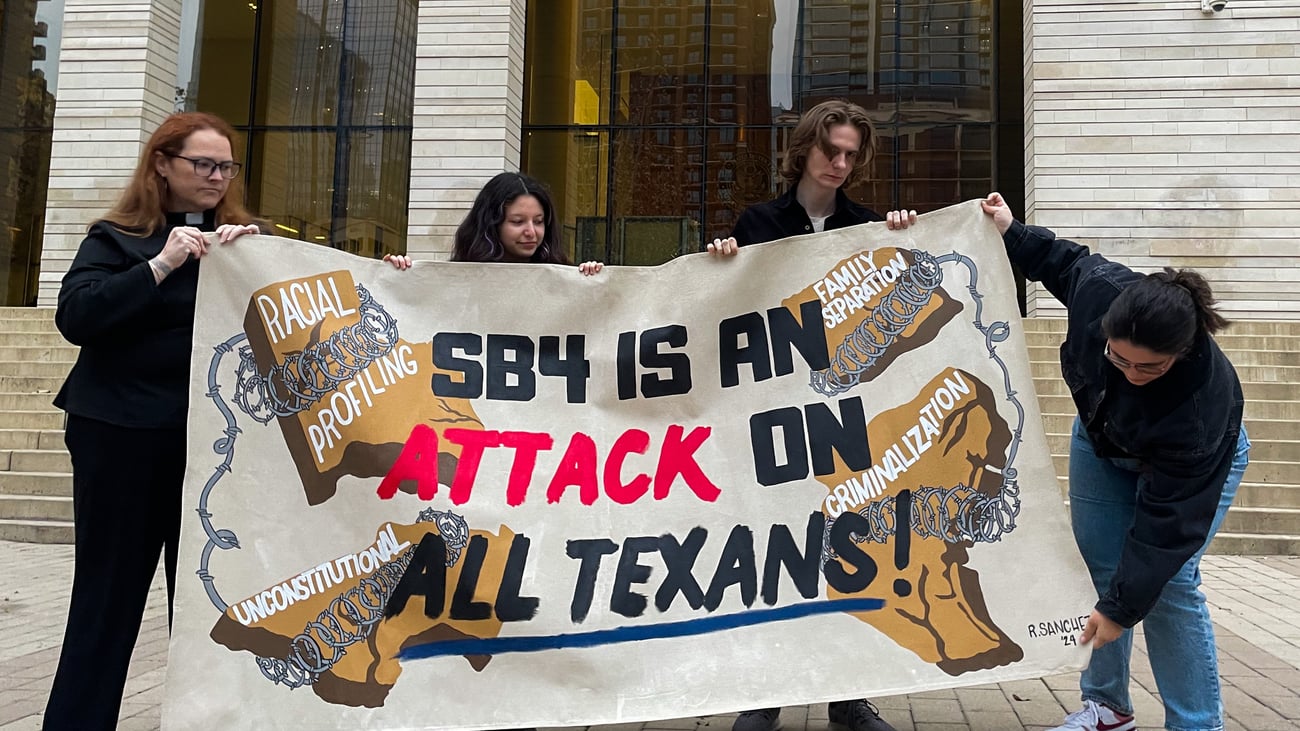
Opponents Challenge Texas Immigration Law
AUSTIN, Texas (CN) – Two anonymous Honduran immigrants are at the forefront of a class action lawsuit against the state of Texas, warning that they face immediate threats of arrest and deportation if a controversial immigration law takes effect as scheduled on Friday.
Civil Rights Groups Argue Against Senate Bill 4
During a recent court hearing, civil rights organizations representing the immigrants contended that various provisions of Senate Bill 4, which designates unauthorized entry into the United States as a state crime, infringe upon the Supremacy Clause of the U.S. Constitution. They requested an injunction to prevent Freeman Martin, director of the Texas Department of Public Safety, from enforcing these provisions.
Judge Questions Constitutionality
“What do we do about a provision that, in my view, is not constitutional?” asked U.S. District Judge David Alan Ezra during the preliminary injunction hearing. He expressed concerns about the “problematic provisions” within SB 4 but indicated he would take his time in reaching a decision, noting that the law could be enacted as planned on Friday.
Immigrants’ Protections at Stake
The plaintiffs, supported by the American Civil Liberties Union (ACLU), the ACLU of Texas, and the Texas Civil Rights Project, are contesting elements of SB 4 that criminalize illegal re-entry, empower magistrate judges to issue removal orders, penalize non-compliance with those orders, and mandate continued removal proceedings regardless of ongoing federal immigration cases. They contend that immigration enforcement should solely fall under federal jurisdiction.
Imminent Risk of Arrest Highlighted
Cody Wofsy, deputy director of the ACLU Immigrant Rights Project, informed the court that the failure to halt enforcement of the law puts the plaintiffs at immediate risk of arrest. Among the plaintiffs is a 59-year-old father with a green card who may be subjected to deportation due to SB 4 after previously re-entering the country without authorization. Although he is a permanent resident entitled to certain federal protections, those rights are not recognized under the new state law.
State’s Defense and Uncertainty About Enforcement
Attorneys for the Texas Department of Public Safety, including Monroe David Bryant, countered that the plaintiffs have not demonstrated any irreparable harm. During the proceedings, Judge Ezra queried Bryant about how the Department would enforce SB 4, especially given a decline in illegal border crossings and ongoing collaboration with federal immigration authorities.
Concerns About State Sovereignty
Ezra expressed concern that SB 4 could create state-specific immigration laws that conflict with federal objectives. He noted, “There is nothing in SB 4 that claims to be subordinate to the federal government,” suggesting that the law asserts a state sovereignty that allows Texas to arrest, prosecute, and deport individuals independently. Previously, Ezra had overseen a case in which the Biden administration and several immigrant advocacy groups argued that SB 4 similarly violated the Supremacy Clause, although an appellate court later ruled that the plaintiffs lacked standing, lifting the injunction against the law.
