


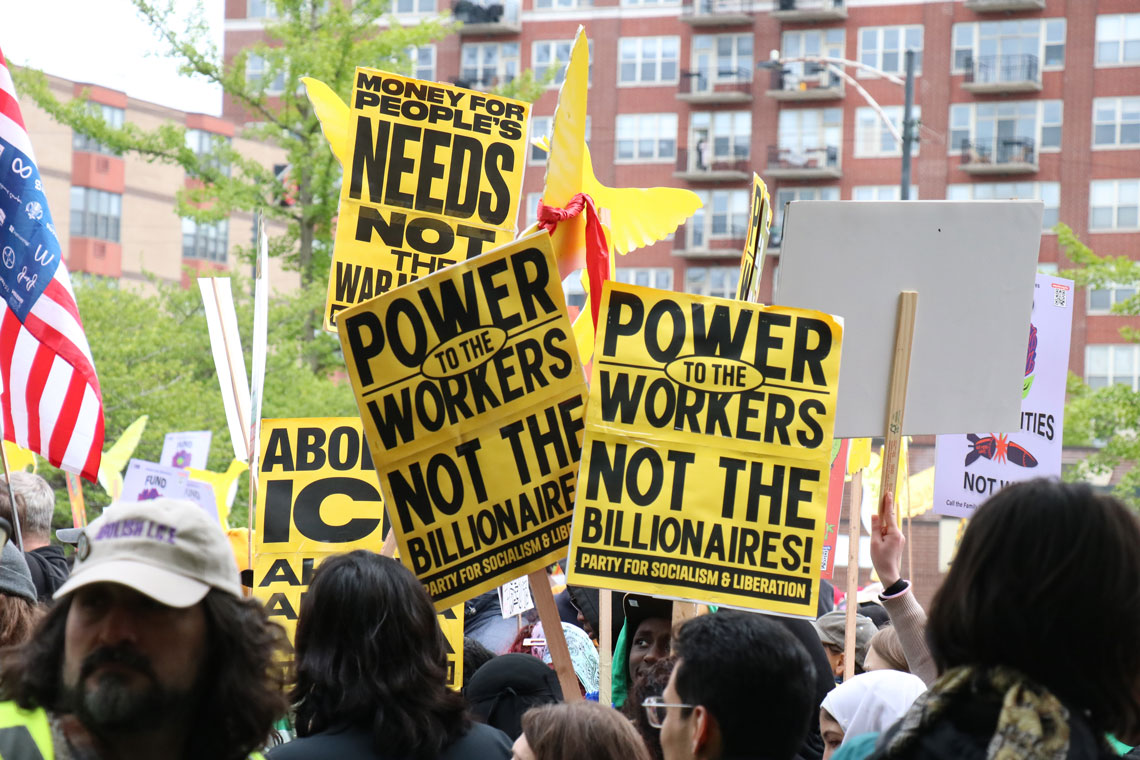
May Day Protests Unite Illinoisans Around Labor and Immigration Rights
On Friday, tens of thousands of individuals across Illinois participated in more than 50 May Day rallies, highlighting the intersection of labor rights, immigration issues, and broader social justice causes. In Chicago, speakers—including Mayor Brandon Johnson—emphasized the importance of supporting workers and immigrant communities. The demonstrations on public university campuses drew attention to ongoing labor disputes and the need for protections amidst tightening immigration enforcement.
Amid the protests, 66-year-old Georgette Foss walked alongside her friend Mary Shapiro, 64. Together, they carried a sign proclaiming, “Workers over Billionaires – Funding Communities, Not Wars.” Foss expressed her concerns about her future, stating, “I’m worried that when I retire at the end of this year, the government will take away my social security, and I’m troubled that my grandchildren won’t have educational opportunities in my neighborhood.”
May Day, recognized globally as International Workers’ Day, has its roots in the 1886 Haymarket Incident in Chicago—a pivotal moment that defined rights for workers. Over the years, the day’s focus has expanded to encompass a variety of social justice endeavors, including immigrant rights and calls to end military conflicts, such as the current situation in Iran.
The largest gathering took place in downtown Chicago, where thousands rallied as Mayor Johnson addressed the needs of city workers, as well as immigrant and refugee communities. Many protesters held placards urging federal agents to refrain from intruding into their neighborhoods, especially in light of the recent Operation Midway Blitz, which intensified immigration enforcement in the area.
This enforcement campaign, which targeted the Chicago region, was in effect for three months before being disbanded last fall. The protests across Illinois varied in focus, particularly on public university campuses where issues of labor and immigration intertwined. At the University of Illinois in Urbana-Champaign, demonstrators united their calls for fair labor practices with concerns about local immigration enforcement.
Keith Pluymers, an assistant professor of history and vice president of the Unified Faculty at Illinois State University, articulated the stark contrast between the visions for higher education advocated by university administrators and labor supporters. “What we are seeing from university authorities is a tragic death spiral for higher education,” Pluymers remarked. He added that the protests demonstrate a collective vision for a more equitable future among workers, students, and community organizations.
In a display of solidarity, activities at various universities highlighted proposals aimed at safeguarding students and employees from immigration and customs enforcement. These initiatives include limiting access to campus buildings by ICE and Customs and Border Protection agents, canceling contracts with companies collaborating with immigration authorities, and providing support to those facing deportation or visa challenges. Students and workers at Illinois State University protested for nearly a month, advocating for fair contracts and better wages, underscoring the importance of unity in addressing these pressing issues.
Chloe Park, a journalism student at Northwestern University’s Medill School of Journalism, Media, Integrated Marketing and Communications, contributed to this report as a Medill Illinois Press Fellow in partnership with Capitol News Illinois, a nonprofit organization delivering nonpartisan state government news coverage to a network of news outlets across the state.
