


Tensions Rise in Minneapolis Following Activist’s Death
Five days after the tragic shooting of activist Renee Good by an Immigration and Customs Enforcement (ICE) officer, the Minneapolis neighborhood where she lost her life was rife with tension. Federal immigration agents surrounded and interrogated a man who had stopped his car, prompting residents to emerge from their homes onto the snowy streets. Many voiced their anger, demanding the agents leave while capturing the incident on their cellphones.
Journalists from FRONTLINE and ProPublica were also present, documenting the escalating situation closely.
The individual being questioned, Christian Molina, a U.S. citizen, recounted to ProPublica reporter AC Thompson that he had been pursued by federal agents, who aggressively rammed his vehicle during the encounter.
Violence Erupts Amid the Chaos
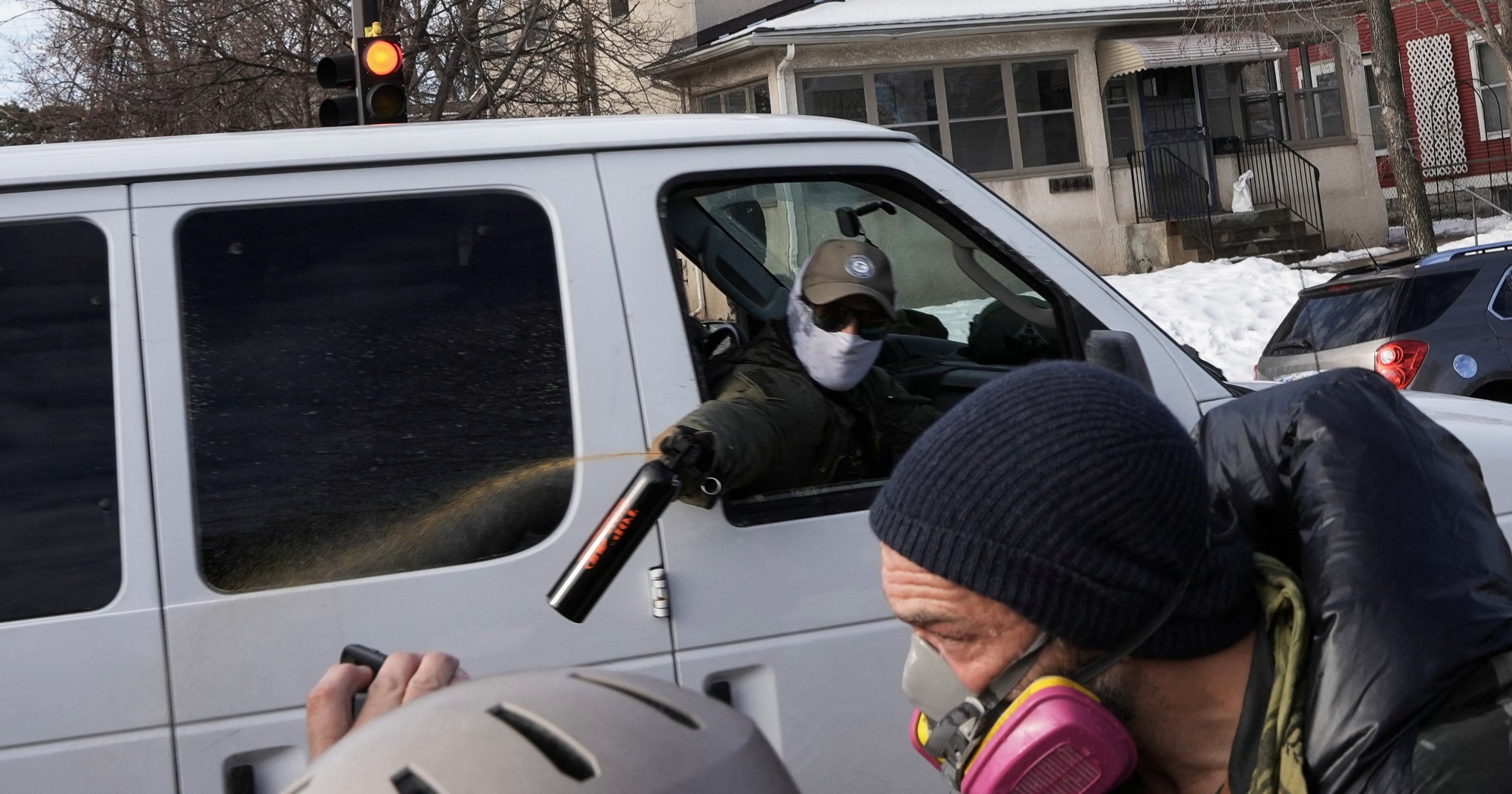
The subsequent events can be seen in footage from the forthcoming documentary, “Caught in the Crackdown,” produced by FRONTLINE and ProPublica. Amidst the turmoil, someone in the crowd threw a snowball at the agents, prompting a drastic response. Federal officials launched tear gas canisters into the crowd, igniting further outrage as demonstrators shouted, “They’re using tear gas in my neighborhood. People live here.”
In a chaotic scene marked by a toxic cloud, agents resorted to using pepper spray against both protesters and news photographers at close range. During this melee, Thompson was struck three times by a pepper ball, with one projectile hitting him above his right eye, a violation of federal use-of-force guidelines that discourage aiming at people’s heads or faces. As the conflict intensified, an agent fired more pepper spray from a moving vehicle, targeting members of the film crew and other onlookers.
Documentary Captures Disturbing Footage of Confrontations
The January 12 incident is one of several chaotic confrontations detailed in “Caught in the Crackdown,” set to premiere on April 14. This joint investigation will delve into how federal officers interacted with protesters and bystanders during the immigration enforcement actions of the Trump administration, across major U.S. cities including Los Angeles, Chicago, and Minneapolis. Experts suggest that many of these tactics not only overstepped the bounds of acceptable law enforcement practice but also violated established police protocols.
The documentary illustrates the Trump administration’s rhetoric that framed immigration enforcement as a necessary measure for public safety, targeting criminals and unauthorized immigrants. Through comprehensive on-the-ground reporting and interviews with officials, experts, and witnesses, “Caught in the Crackdown” reveals how federal agents arrested hundreds of Americans who were merely observing protests, often mischaracterizing them as domestic terrorists while employing aggressive tactics.
Concerns Over Law Enforcement Tactics
Greg Bovino, then Border Patrol commander and architect of the enforcement strategy, displayed no remorse regarding the methods employed by agents. In a local television interview, he asserted, “We’re here to fulfill our Title VIII mission,” dismissing the violent tactics as part of a necessary response to perceived threats.
However, when Thompson shared the footage of the January 12 incident with former law enforcement officials, their reactions were filled with alarm. Christy Lopez, a former investigator for the Justice Department’s Civil Rights Division, stated, “It’s clear that there is a continuation of excessive use of force after use of excessive force,” emphasizing that it is unacceptable to deploy pepper spray against individuals simply leaving the area.
Investigating the Aftermath of Enforcement Actions
Chris Magnus, former head of Customs and Border Protection and a long-time police chief, described the agents’ actions as “egregious,” underscoring the principle of proportionality in law enforcement. He remarked, “You don’t like it, but the experts don’t respond to it,” addressing the troubling nature of the response.
As revealed in the documentary, ProPublica and FRONTLINE discovered that many of the cases against protesters collapsed due to contradictions in the charges, often conflicting with video evidence and witness accounts. Ultimately, Bovino was removed from his position following the shooting of another protester, Alex Preti, in Minneapolis. The Trump administration acknowledged the need for improvements within immigration operations, yet many questions surrounding the enforcement strategies remain unanswered.
“Even if Gregory Bovino is gone, will his footprint remain on every federal agency that continues to be on the streets?” questioned journalist Sergio Olmos in the documentary. “Will anything really change? He was at the forefront of this new wave of immigration enforcement across the country.”
