


Legacy of Colonial Narratives in Africa’s Technological Landscape
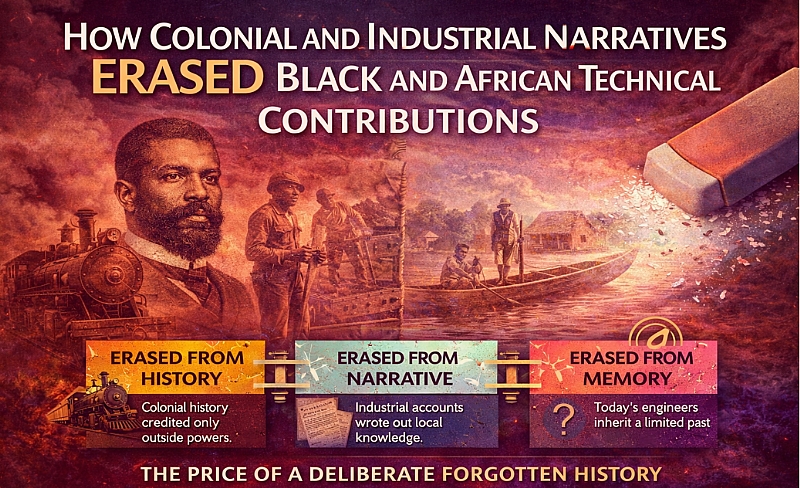
The enduring legacy of colonialism extends beyond physical infrastructure and political boundaries; it profoundly influences the narrative surrounding historical contributions. The way individuals are remembered—whether as inventors or thinkers—affects who gets acknowledged in the annals of history and who remains marginalized. This narrative imbalance, particularly in areas like transportation, engineering, and industrial technology, has enduring repercussions on trust, policy-making, and technological advancement across Africa.
Historical Narratives Serving Colonial Interests
The narratives surrounding colonial and early industrial history were crafted to uphold the empire’s interests. Achievements in systems, machinery, and technological progress are often framed as originating from a singular civilization, while the invaluable contributions of Black and African people remain systematically hidden. In regions built on the labor and ingenuity of Africans, their contributions were rarely acknowledged. Even when African innovation effectively addressed operational challenges, the credit was absorbed by institutions that failed to recognize local input.
The Consequences of Narrative Erasure
This erasure was not incidental; it served to maintain existing power structures. Acknowledging technical contributions lends legitimacy, which challenges established hierarchies. Consequently, the narrative has been simplified to suggest that technology arrived in its complete form from abroad, with Africans merely adapting it. Over the years, this storyline morphed into ‘common knowledge,’ disseminated through educational curricula and professional training, as well as in public discourse.
Impact on Technological Perception and Policy
When a generation learns—both explicitly and implicitly—that innovative capabilities are foreign, they begin to view technology solely as consumers, not as creators. This shift reduces engineering to mere maintenance, sidelining the potential for progress. Policies prioritize procurement over holistic system thinking, causing even well-intentioned leaders to doubt local capabilities, often opting to outsource design, diagnostics, and decision-making.
Trust Erosion in Transportation Infrastructure
The fallout from this misplaced trust is evident in sectors like transportation. Railways are regarded as relics rather than platforms for ongoing improvement. Inland water transport, often dismissed as informal or outdated, fails to garner the attention it deserves. Technical challenges are viewed as barriers rather than opportunities for innovation, leading to a diminishment of ambition as confidence wanes.
Transforming Education and Policy for Future Development
To address these issues, policy must initiate substantive interventions rather than symbolic gestures. Africa’s educational frameworks should actively reclaim the narrative surrounding technological history, integrating it into development strategies. Courses in engineering, technology, and transportation should convey that technology is shaped by the contributions of many, including Africans. This endeavor is not a mere complaint; it aims to bridge past abilities with future aspirations.
Building a Confident and Collaborative Future
When students see their reflections in the narratives of technological progress, their confidence begins to flourish. Innovation becomes attainable when engineers recognize that individuals like them have surmounted complex challenges before. Similarly, when policymakers grasp that local technological capabilities have deep historical roots, they become more inclined to invest in both talent and projects. Redefining the narrative also entails shifting Africa’s global engagements—from fostering dependence to encouraging partnerships based on co-creation.
Embracing Authenticity for Sustainable Development
The pressing challenge is not to fabricate a sense of pride, but to uncover the truth about Africa’s technological history. The future of technology in Africa will not solely rely on new infrastructure, loans, or slogans; it must be anchored in a renewed confidence grounded in a truthful understanding of its past. Until colonial and industrial narratives are critically examined and rewritten, progress will continue to be hampered by unseen barriers. Recovering these technical contributions is not an academic exercise; it is essential for genuine development.
Author: Joseph Husseini
