


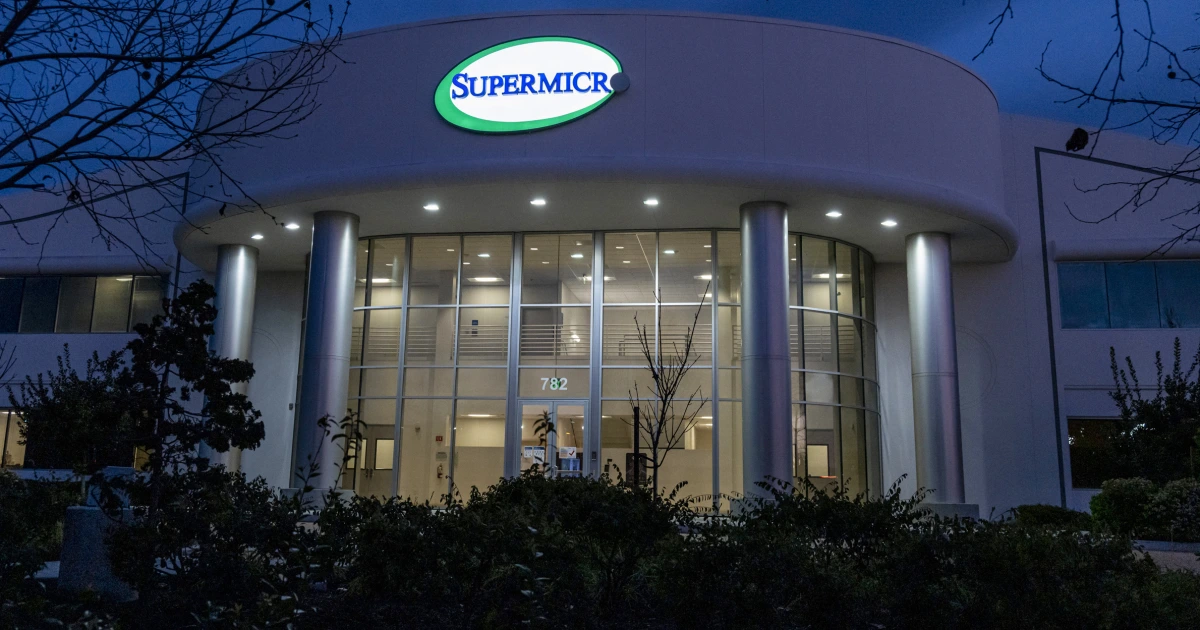
Three Supermicro Associates Indicted for Smuggling NVIDIA Chips to China
Three individuals connected to server manufacturer Supermicro were indicted on Thursday for allegedly conspiring to smuggle advanced NVIDIA chips into China, breaching U.S. export regulations that require licensing for such sales.
The indictment, filed by the U.S. Attorney for the Southern District of New York, outlines how Wally Liau, Stephen Chan, and Willy Sun conspired to sell an impressive $2.5 billion in servers to a Southeast Asian firm. This intermediary then repackaged the equipment, resulting in the shipment of $510 million worth of servers embedded with the restricted chips to China.
The Department of Justice confirmed the arrests of Mr. Liau, a U.S. national, and Mr. Sun, a Taiwanese national and co-founder of Supermicro. Mr. Chan, also a Taiwanese national, remains at large.
All three face serious charges, including conspiracy to violate the Export Control Reform Act, which could result in a maximum sentence of 20 years in prison if convicted. They are additionally charged with conspiracy to smuggle goods and defraud the United States, each of which carries a potential penalty of five years behind bars.
In 2022, the United States tightened its export controls regarding advanced artificial intelligence chips to China, primarily due to national security concerns. This regulatory action specifically targeted NVIDIA’s B200 and H200 graphics processing units, which are among the company’s most advanced AI offerings and can only be sold to China with government approval.
The indictment claims the defendants sold servers containing B200 and H200 GPUs to China without the crucial export licenses.
U.S. Attorney Jay Clayton emphasized the gravity of the situation, stating that the individuals’ actions involved a network of deception designed to maximize profits while undermining U.S. law. Such illegal schemes reportedly generate billions of dollars and pose significant threats to national security.
As of now, Mr. Chan and Mr. Liau have not responded to requests for comment, and no contact information for Mr. Sun is available. It remains unclear if any of the defendants have legal representation.
Wally Liau, 71, co-founded Supermicro in 1993 and currently holds the position of Senior Vice President of Business Development as well as serving on the board of directors. Stephen Chan, 53, works as a sales manager at the company’s Taiwan office, while Willy Sun, 44, is identified in the indictment as a “third-party broker and fixer” collaborating with others.
While Supermicro itself was not named in the indictment, the company confirmed the roles of the three individuals involved. In a statement, Supermicro noted that the two employees have been placed on leave, and their contract with the third party has been terminated.
The company underscored its commitment to compliance, stating that the alleged actions contradict their policies and efforts to adhere to applicable export control laws. Supermicro further clarified that it is fully cooperating with the ongoing government investigation.
NVIDIA, for its part, has declared that strict compliance with regulations is its top priority. The company has reinforced its commitment to work with customers and authorities to ensure adherence to compliance programs.
The indictment aligns with rising concerns about advanced chips finding their way into China through various means, including transshipments via Southeast Asia. A recent Financial Times report estimated that China had secured approximately $1 billion in high-end AI processors within three months of tightened export controls instituted by the Trump administration.
Chris McGuire, a senior fellow at the Council on Foreign Relations specializing in China and emerging technologies, argued that this indictment highlights significant loopholes in export protocols, particularly concerning Southeast Asia. He remarked on the need for closer scrutiny of such operations, asserting that it reinforces the narrative that China is actively seeking to acquire American technology to bolster its AI sector.
Despite the crackdown, the Trump administration has been exploring measures to allow limited sales of chips to China. Recently, the White House approved NVIDIA’s request to sell a limited volume of H20 chips to China, contingent upon sharing a portion of sales revenue with the U.S. government.
