


As America approaches its 250th anniversary, we reflect on significant moments in local history, particularly through the lens of communities served by Ogden Newspapers, the parent company of the Daily News Record. This article marks the tenth installment in our twelve-part series.
Violence Erupts on Poland Avenue
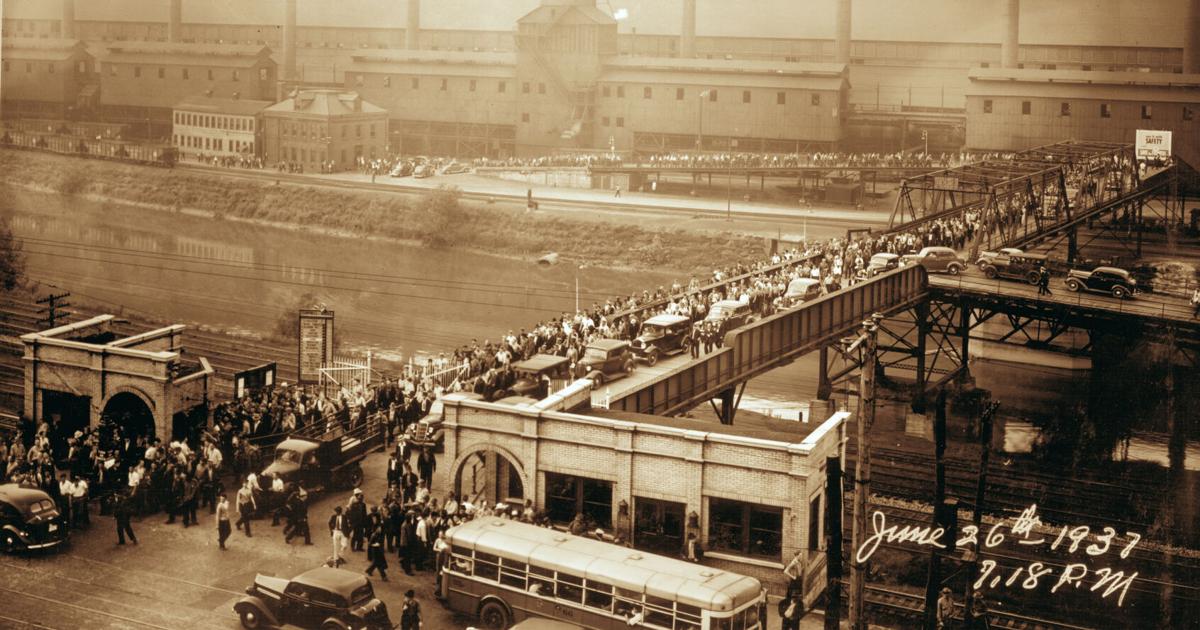
On June 19, 1937, violence erupted outside Republic Steel’s Stop 5 plant on Poland Avenue in Youngstown. Workers had been picketing for weeks as part of the nationwide Little Steel Strike, an intense struggle for union recognition. Republic Steel and Youngstown Sheet & Tube followed the example set by industry leader U.S. Steel, refusing to acknowledge the Steelworkers Organizing Committee.
A Defining Moment in Labor History
As tensions escalated, production ground to a halt, and movement in and out of the plant slowed significantly. When riots broke out, then-Ohio Governor Martin Davie declared martial law and mobilized the National Guard to restore order, marking a pivotal moment in Youngstown’s labor history. However, the roots of the strike extend well beyond 1937, intertwined with the evolution of a community that transformed from a small settlement to one of the world’s foremost steel production centers.
The Impact of Steel on Youngstown
The steel industry created substantial wealth and opportunity for the city and Mahoning County, driving significant population growth while establishing many of the institutions that continue to define the Mahoning Valley today. However, this rapid industrialization also led to labor tensions, power struggles, and social divisions.
The Fabric of Community Identity
Youngstown’s identity has been shaped by the myriad of individuals who came to work in the factories, forming communities rooted in shared language, religion, and heritage. According to Bill Lawson, executive director of the Mahoning Valley Historical Society, these communities resembled tribes, with diverse immigrant groups coming together from various European regions, often encouraged by letters from those who had migrated earlier.
The Transition from Iron to Steel
Although the natural resources surrounding Youngstown made it an ideal locale for industrial production, the area was not initially known for steel. With rich reserves of iron ore, coal, timber, and limestone, iron production became the early focus. The post-Civil War era saw iron furnaces flourish, establishing Youngstown as an important iron-producing region. However, by the late 19th century, local industrialists recognized a critical shift as steel began to dominate American manufacturing, a fact they were slower to fully acknowledge compared to competing cities.
Immigration and the Growth of Industry
In 1892, local entrepreneurs including Henry Wick and H. O. Bohnell founded the Ohio Steel Company, setting the stage for a new industrial future. This initiative led to the arrival of major firms like National Steel and U.S. Steel, ultimately positioning the Mahoning Valley as one of the nation’s leading steel-producing regions. As factories expanded, Youngstown’s population swelled, diversifying culturally and ethnically through successive waves of immigration, especially from Southern and Eastern Europe.
Divisions and Inequality
The rich tapestry of cultural identities brought by immigrants often coalesced around ethnic lines, reinforcing social boundaries within the community. While these divisions were typically rooted in cultural tradition rather than outright hostility, they nonetheless contributed to a hierarchy that favored certain groups over others, particularly in factory employment. In the backdrop of such divisions, the rise of the labor movement emerged as disenfranchised workers sought a voice in a rapidly evolving industrial landscape.
A Transformative Era of Labor Rights
Amidst the Great Depression, the Congress of Industrial Organizations and the Steel Workers Organizing Committee began to mobilize steelworkers for better wages, working conditions, and governance. Resistance from the steel industry lessened in early 1937 when U.S. Steel surprisingly recognized the SWOC, energizing union efforts across the sector. The following months saw the Little Steel Strike unfold, targeting local companies like Youngstown Steel and Republic Steel, as union activists worked to secure representation amidst escalating tensions.
The Legacy of the Little Steel Strike
The culmination of these events on June 19, 1937, resulted in a violent confrontation that ultimately did not yield immediate gains for the strikers. Nonetheless, the strike became a lasting chapter in Youngstown’s labor history, paving the way for future organizational victories, including the eventual formation of the United Steelworkers Union in 1942. The convergence of immigration, industrial growth, and social tensions in 1937 has left an indelible mark on Youngstown, shaping the very fabric of modern America.
