


Challenges Facing Nigeria’s Economic Landscape
Observers note that historically prosperous sectors in Nigeria’s economy have been overlooked. Once a time of quiet confidence reigned, as Nigeria aimed to produce most of its consumption needs. The country’s industrial map was ambitious, encompassing car assembly in Kaduna and Lagos, textile factories in the north, and rubber tire manufacturing in the south.
However, that seemingly prosperous era has given way to a reality characterized by increased imports, currency pressures, and a shrinking manufacturing base. Today, Nigeria grapples with a range of economic challenges, including high unemployment and underemployment, rising poverty levels, weak infrastructure, and pervasive insecurity. These issues persist despite a history of reforms, from the Structural Adjustment Program (SAP) to the latest policy initiatives under President Bola Ahmed Tinubu.
The pressing question is not whether reforms have been attempted, but rather why they have failed to fundamentally change Nigeria’s economic trajectory.
A Historical Perspective on Nigeria’s Industrialization
In the decades following independence, Nigeria adopted a model centered on state-led industrialization and import substitution, designed to reduce reliance on foreign products. Factories sprang up across the nation, manufacturing everything from automobiles to consumer goods like refrigerators and footwear, with agriculture reinforcing both industrial and household needs. Despite its imperfections, the economy showcased a backbone of productivity.
Yet, this industrial foundation was more fragile than it appeared. Much of the manufacturing depended on government protection, oil revenues, and imported components, where efficiency often took a back seat to sheer capacity. As oil prices surged in the 1970s, the sector gradually eclipsed other industries and altered economic incentives. When oil prices plummeted in the early 1980s, these vulnerabilities became glaringly apparent.
Reform Efforts and Their Unintended Consequences
The response to the economic downturn was swift, resulting in the introduction of SAP in 1986, marking a pivotal moment for Nigeria’s economic landscape. This reform aimed to liberalize the economy, devalue the naira, eliminate subsidies, and encourage international competition. While these measures initially addressed fiscal imbalances, they produced unforeseen challenges.
Local industries that had enjoyed protection from external competition struggled to survive in a deregulated framework. Many factories closed their doors, while others had to downsize dramatically, leading to a gradual erosion of the industrial base. Subsequent waves of reforms, including privatization and banking sector restructuring, have failed to alter the core structure of the economy, which remains heavily reliant on oil exports and increasingly dependent on imports.
Critics attribute these ongoing issues to deeper institutional problems. There is a sentiment that the series of reforms have primarily benefited the ruling elite rather than stimulating real developmental progress.
Alternative Perspectives on Economic Progress
Not everyone shares this bleak outlook. Political scientist Obafemi George views the current economic phase as a necessary, albeit painful, reset. He observes that strategic investments in infrastructure since 2023 indicate a governmental effort to pivot from an import-dependent to an export-driven economy.
George cautions against expectations for immediate results, asserting that economic restructuring is inherently gradual. He draws parallels with China’s reform journey under Deng Xiaoping, which began in 1979, illustrating that such transformations typically unfold over decades, not years. The notion that change can happen overnight underestimates the complexity of economic development.
Societal Impact of Reforms
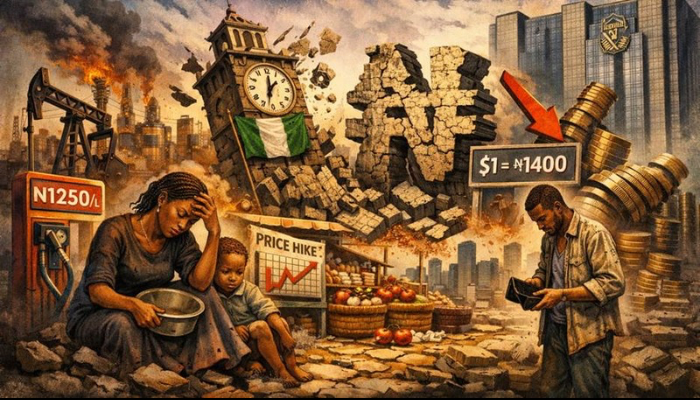
The repercussions of these reforms are acutely felt across various sectors of Nigerian society. Young graduates entering the job market are confronted with limited opportunities, while businesses struggle with escalating operational costs. Households also find themselves battling rising prices and diminishing purchasing power.
Recent reforms initiated by the Tinubu administration, particularly the removal of fuel subsidies and the liberalization of foreign exchange, have exacerbated these challenges in the short term. Although policymakers argue these changes are necessary to rectify long-standing economic distortions, many citizens have yet to experience the anticipated benefits. This disconnect between policy intentions and the lived experiences of Nigerians continues to shape public sentiment.
A Call for Long-Term Economic Strategies
Restoring Nigeria’s economic strength demands more than mere policy announcements; it requires sustained commitment to industrial policy coherence, infrastructure development, human capital investment, and institutional accountability. A vital shift in focus from short-term fixes to long-term nation-building is essential.
While nostalgia for Nigeria’s industrial past is understandable, it must not cloud perceptions of current realities. The objective should not be to recreate past achievements but to forge a more competitive, diversified, and sustainable economy. The urgency of this transition is palpable for millions of Nigerians facing daily financial hardship.
