


Chinese Humanoid Robots Excel in Half-Marathon Event
BEIJING – During a recent half-marathon in Beijing, numerous Chinese-made humanoid robots showcased their rapidly advancing athletic and autonomous navigation abilities, surpassing human runners and illustrating significant progress in the field of robotics.
Unlike last year’s inaugural race, which saw many robots struggle with performance and complete a race time of over two hours and forty minutes—more than double the time of the human champion—this year’s event displayed a remarkable improvement. The number of participating teams soared from 20 to over 100, with several leading robot competitors outperforming professional athletes by over 10 minutes.
This year, innovative advancements were evident as nearly half of the robot entrants autonomously navigated more challenging terrains throughout the 21km (13-mile) course, moving in parallel alongside 12,000 human participants to minimize collisions. This development marks a significant shift from previous years, where robots were predominantly controlled manually.
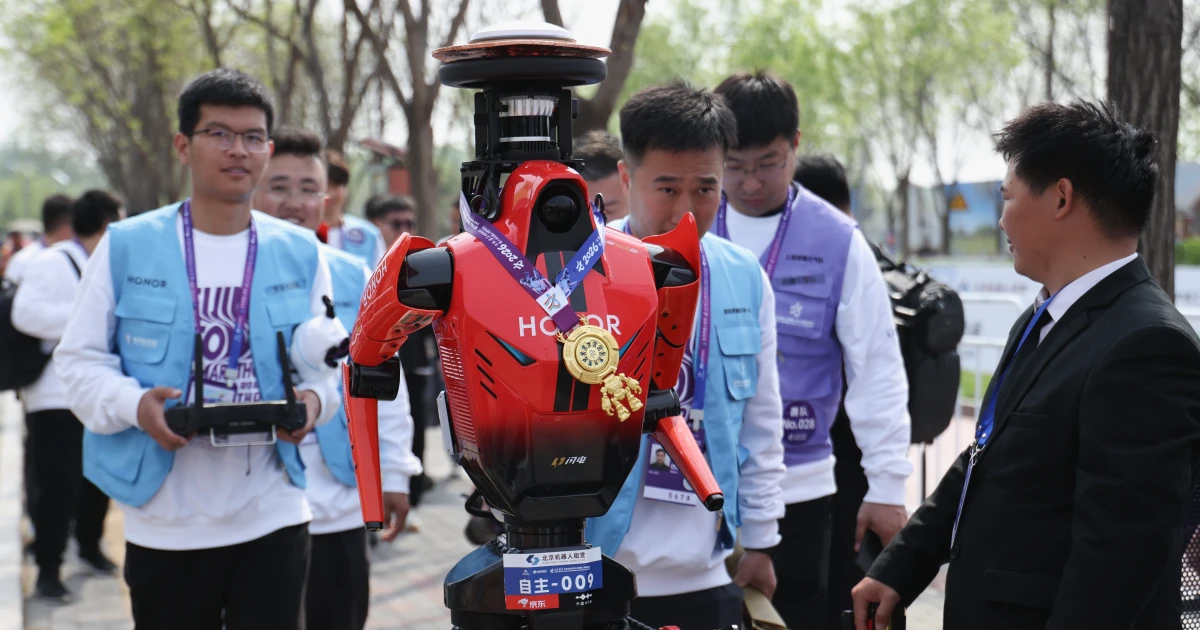
The standout robot, developed by the Chinese smartphone brand Honor, completed the half-marathon in a remarkable 50 minutes and 26 seconds, outpacing even the recent half-marathon world record set by Ugandan runner Jacob Kiplimo in Lisbon.
The Honor team’s performance was stellar, with all three podium finishers setting world record times on autopilot. Du Xiaodi, an honorary engineer for the team, highlighted that the robot was developed over a year with legs designed to mimic elite human runners and advanced liquid cooling technology typically used in smartphones. Du expressed optimism that, despite the nascent state of the technology, humanoid robots could significantly reshape various industries including manufacturing.
Showcasing Remarkable Robotics Progress
Spectators observed a range of humanoid robots of varying designs and capabilities, recognizing them as a testament to China’s strides in robotics innovation. Engineering student Chu Tianqi remarked on the impressive running posture of the robots, noting the remarkable advancements made in artificial intelligence within a relatively short period.
Many young attendees shared a newfound interest in robotics and artificial intelligence, fueled by their experiences watching the race. Eleven-year-old Guo Yukun expressed his aspiration to pursue a degree in robotics, having already immersed himself in robotics theory and programming through his elite school’s curriculum.
Exploring Economic Application Potential
While practical applications for humanoid robots remain predominantly in the trial phase, events like the half-marathon underscore their potential to transform industries, ranging from hazardous occupations to military applications. However, challenges linger for Chinese robotics firms, particularly in developing AI that allows humanoid robots to perform efficiently in industrial settings.
Experts caution that while the skills demonstrated at the half-marathon are entertaining, they won’t directly lead to the mass commercialization of humanoid robots in industrial environments. Key areas like manual dexterity, situational awareness, and the ability to tackle complex, non-repetitive tasks continue to pose significant hurdles.
China is determined to become a global leader in robotics, supported by policies that encourage local innovation through subsidies and infrastructure development. The country even showcased its ambition during the popular CCTV Spring Festival Celebration, featuring humanoid robots in a martial arts demonstration, illustrating China’s vision for the future of manufacturing.
The display included a captivating martial arts performance with several Unitree robots executing complex routines alongside child performers, further emphasizing the nation’s commitment to integrating advanced robotics into diverse applications.
