


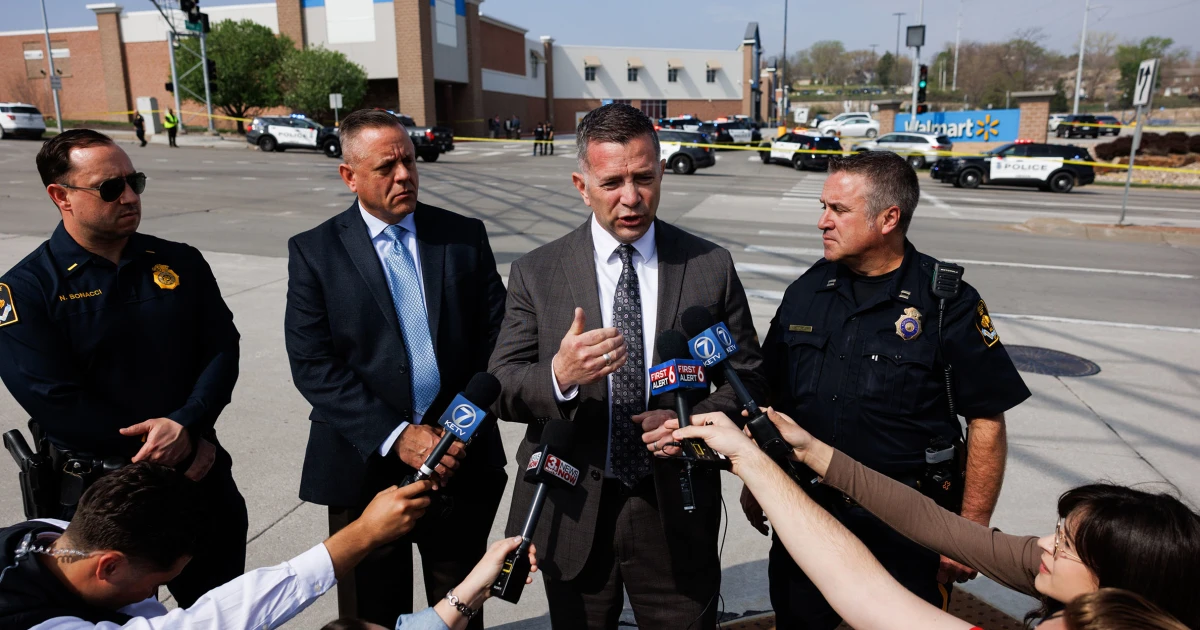
Incident at Walmart Highlights Mental Health Crisis
Noemi Guzman, a 31-year-old woman with a history of mental illness, tragically took her toddler to the brink of violence in front of a Walmart in Nebraska. Guzman, who had struggled with her mental health for years, was involved in an alarming incident that set off a series of events resulting in her death at the hands of police.
Earlier that same day, Guzman had appeared in court for charges related to attempting to set her father’s home on fire and ransacking a priest’s residence. She pleaded not guilty by reason of insanity. Court records reveal a troubling pattern in her behavior; in prior incidents, a judge had ordered her to keep her distance from a neighbor who allegedly attacked her with a knife.
According to Omaha police, Guzman attacked a 3-year-old boy with a kitchen knife stolen from Walmart, injuring the child’s face and hand. When she refused to put down the knife, police intervened, resulting in Guzman’s death. The tragic incident underscores the complexities surrounding individuals with severe mental health issues.
Escalating Concerns Leading to Violence
Guzman had been diagnosed with schizophrenia, a condition that often leads to individuals being more vulnerable to victimization than to inflicting harm. However, her history included violent acts, prompting local prosecutors to label her a danger to herself and others. Despite their objections, a county judge released her in 2024, following an incident involving her father and a priest that raised severe concerns about her mental state.
Community members familiar with Guzman’s challenges emphasize that her experiences reflect a justice system ill-equipped to handle mental health crises. Douglas County Public Defender Thomas Riley noted that effective treatment for mental illness often requires financial resources that many government agencies are reluctant to allocate.
Multiple Warning Signs Ignored
Affidavits indicate a disturbing history of violence, including a 2018 incident where Guzman lured a neighbor to her backyard and attacked her with a knife. In 2024, she faced felony charges after harming her father and threatening to burn down their home. Despite these incidents, Guzman was deemed not responsible due to insanity and placed into mental health care.
Following earlier confrontations, Guzman was ordered to attend an outpatient program supervised by a psychiatrist who was tasked with monitoring her medication compliance. County Attorney Brenda Beadle expressed concern over Guzman’s release, describing the charges she faced as serious and alarming.
Guzman’s Troubled History with Law Enforcement
Court records spanning several years paint a picture of Guzman’s mountaineering struggles, ranging from minor drug offenses to serious violent altercations. Following an altercation with a neighbor, she received a suspended sentence and was ordered to maintain distance from those involved.
In March 2024, a confrontation with her family led to an order of protection being issued against her, restricting her access to her stepmother and father. Days later, Guzman entered a church wielding a knife, making threats while vandalizing the property, which further highlighted her instability.
A Call for Systemic Reforms
In the aftermath of her death, Nebraska Governor Jim Pillen responded to the incident, acknowledging the alarming details surrounding Guzman’s history of violence and questioning her release into the community. Estimates suggest that a significant portion of pretrial detainees in Douglas County Jail suffers from mental health disorders, yet there is only one public mental health center accessible to the population.
Pillen has urged state officials to pinpoint weaknesses in the criminal justice, detention, and mental health systems, stressing the need for improved oversight of individuals known to exhibit dangerous behaviors.
As investigations continue into the circumstances surrounding Guzman’s tragic death, her story serves as a stark reminder of the pressing need for reforms in how mental health crisis cases are managed within the justice system. The intersection of mental health and public safety emerges as a critical area for concerted action and policy change.
