


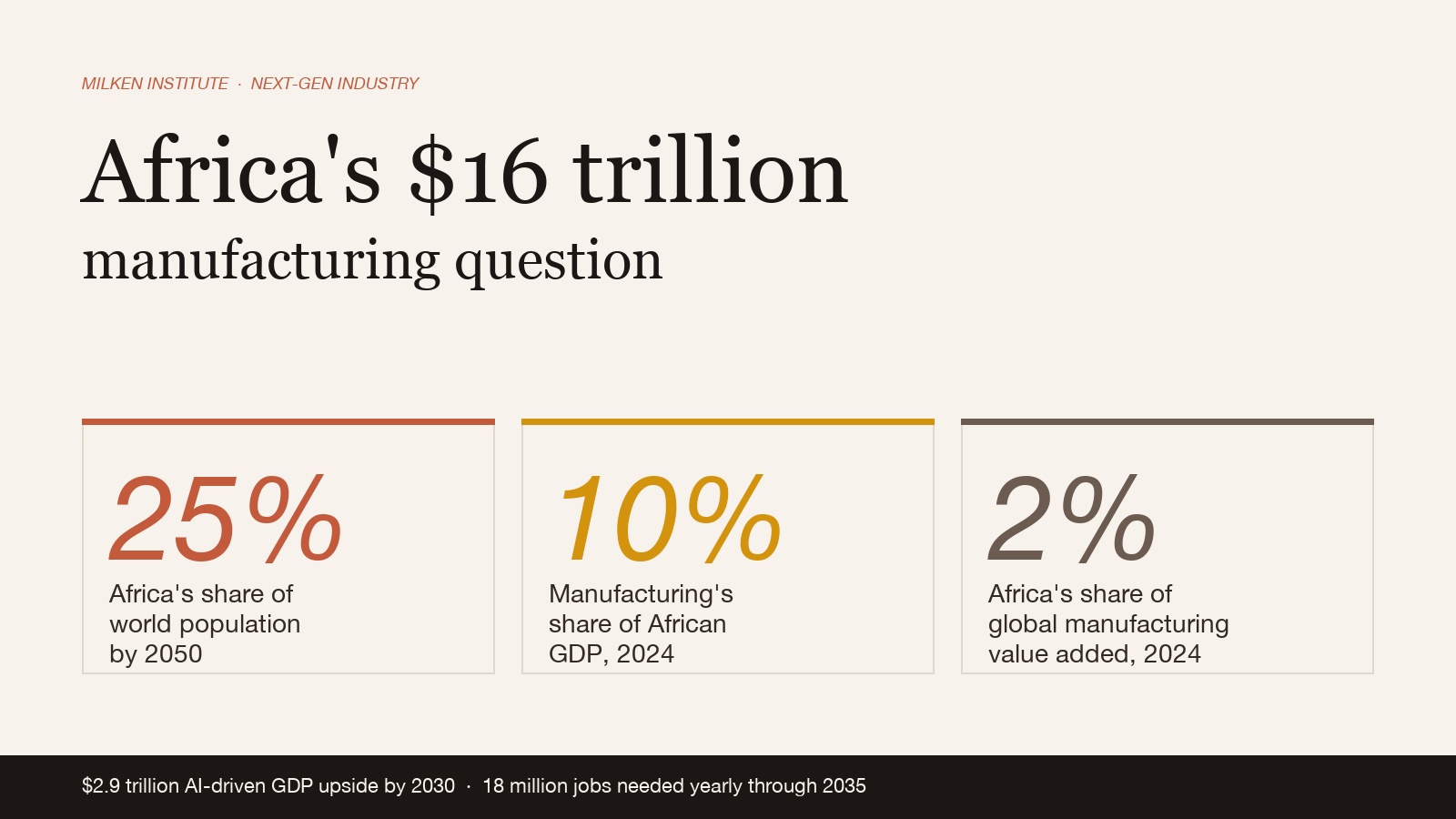
On April 24, the Milken Institute unveiled the Next Generation Industry: Scalable AI and Manufacturing Innovation Award. This report emphasizes the critical need to integrate artificial intelligence within African manufacturing to capitalize on the continent’s anticipated $16 trillion in business and consumer spending by 2050.
Authored by Terry Mulligan, Emily Musil, and Adoma Addo, the report envisions AI-driven manufacturing as a means to bridge the gap between Africa’s burgeoning population and sustained economic growth. By 2050, Africa is expected to represent about a quarter of the global population. Yet, in 2024, manufacturing is projected to contribute only 10 percent to the continent’s GDP and a mere 2 percent of the global manufacturing value added. To accommodate this expansion, approximately 18 million new jobs will need to be created annually until 2035.
Addressing the Productivity Gap
Currently, African factories generate an average of $7,608 in added value per worker, starkly lower than the $30,292 produced by factories in East Asia and the Pacific in 2023. The Milken Institute attributes much of this disparity to unreliable infrastructure and operational inefficiencies. A 2025 World Bank study highlighted in the report reveals that manufacturers in sub-Saharan Africa endure approximately 14 hours of power outages each month, leading to a loss of about 5% of annual revenue due to these disruptions.
While Africa’s manufacturing output has surged by 40%, increasing from around $170 billion in 2015 to nearly $235 billion in 2023, the report cautions that this progress remains precarious. For instance, Ethiopia’s textile parks faced a significant drop in exports from $175 million in 2021 to $120 million in 2023 following the withdrawal of African Growth and Opportunity Act privileges, illustrating how policy changes can swiftly impact sourcing decisions.
Exploring AI’s Current Potential
The report delineates specific instances where AI is effectively curbing costs for African operations. For example, predictive maintenance can diminish scheduled repairs by up to 12% and reduce overall maintenance expenses by 30%. Similarly, computer vision for quality inspection can achieve defect detection accuracy of 99% at line speed, a stark contrast to the 85% accuracy found with manual checks. The light industry sector could expect energy savings of around 8% by 2035.
One notable case is Kenya’s Twiga Foods, which has successfully utilized AI-powered demand forecasting to enhance the alignment of supply with retailer orders, decreasing post-harvest losses from 30% to just 4%. The Milken Institute highlights such implementations as evidence that affordable, edge-based systems tailored to local infrastructural conditions can yield significant productivity improvements, thereby supporting the ongoing discourse on how edge computing is reshaping Industry 4.0.
Launching a $2 Million Prize for Innovative Solutions
The report coincides with the announcement of the Milken Motsepe Innovation Prize in AI and Manufacturing, marking the fourth annual collaboration between the Milken Institute and the Motsepe Foundation. This cycle offers a total of $2 million in non-dilutive capital. In September 2025, ten semifinalists each received $50,000, followed by five finalists awarded an additional $30,000 in December 2025. The grand prize of $1 million, a runner-up award of $250,000, and a special prize of $100,000 for innovative Fourth Industrial Revolution technology will be disclosed in May 2026.
Submissions will be evaluated based on four key factors: commercial feasibility, operational economics, technology integration, and scalability within African markets. Previous iterations of the award have prioritized innovations in agritech, green energy, and fintech. To date, the Milken Institute has reported a remarkable 31-fold return on prize investments and boasts an engaged online community of over 12,000 participants from 136 nations.
Strengthening Policy Support for AI
The report highlights the growing support for AI initiatives across Africa. The number of African nations with established AI or digital industrial strategies has increased from none in 2018 to 17 today, with additional countries in the process of formulating similar frameworks. The African Continental Free Trade Area’s digital trade protocols are setting robust standards for data flows, electronic signatures, and cybersecurity, complemented by over 220 Special Economic Industrial Parks functioning across 47 of Africa’s 54 nations.
According to the World Bank, over 230 million jobs in sub-Saharan Africa will demand digital skills by 2030, particularly in areas such as data analysis and cybersecurity. Notably, manufacturing currently contributes to around 13 percent of Africa’s carbon emissions, primarily due to outdated and energy-inefficient machinery. The report suggests that AI-driven tools that minimize waste and optimize energy consumption can also play a critical role in achieving climate objectives.
The complete report is accessible on the Milken Institute’s website. The announcement of the grand prize winner is slated for the Milken Institute’s Middle East and Africa Summit in May.
