


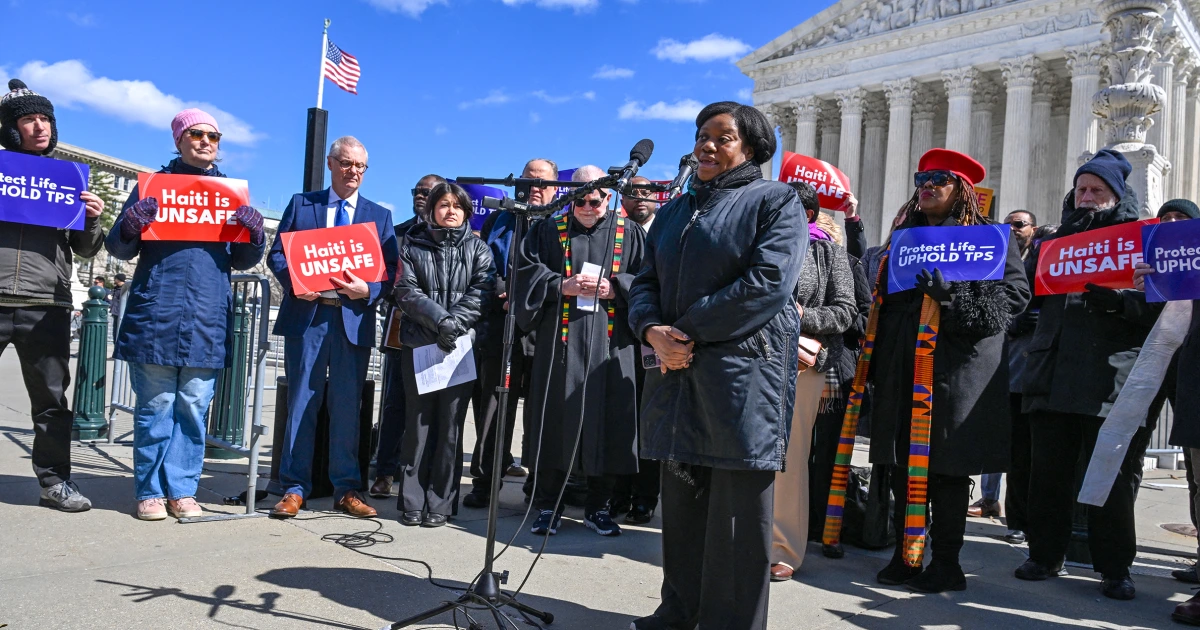
Supreme Court to Review Legal Protections for Haitian and Syrian Immigrants
WASHINGTON – The Supreme Court is set to hear a case on Wednesday that seeks to revoke legal protections for thousands of Haitian and Syrian immigrants residing in the United States. This move addresses a key aspect of the Trump administration’s stringent immigration policies.
If the administration prevails, it could proceed with plans to eliminate Temporary Protected Status (TPS) for approximately 350,000 Haitians and 6,000 Syrians. Currently, those protections remain in place as the legal battle unfolds.
In addition to Haitians and Syrians, the Trump administration is also pursuing TPS revocation for citizens of other nations, including El Salvador, Honduras, Nepal, and Afghanistan. The forthcoming Supreme Court ruling may have broad implications for pending cases in lower courts involving nationals from Somalia, Myanmar, and Ethiopia.
Last year, the Supreme Court allowed the revocation of legal status for 600,000 Venezuelans living in the U.S. The Trump administration contends that this precedent should apply to Haitian and Syrian immigrants as well, a point emphasized in their court filings.
The government argues that the former Homeland Security Secretary Kristi Noem’s decision to rescind the TPS designation should not be subject to judicial review. The court will deliberate on this matter alongside questions regarding whether Noem consulted with the State Department to assess improvements in conditions in Haiti and Syria. Plaintiffs are claiming that the decision to revoke status was rooted in unlawful and discriminatory motives.
The TPS program, established in 1990, provides humanitarian relief to individuals from countries affected by conflict, natural disasters, and other calamities. Beneficiaries of the program enjoy legal status in the U.S. and the option to apply for work authorization for a duration of up to 18 months, with the possibility of extensions.
TPS has been available to Haitians since a catastrophic earthquake struck the country in 2010, while Syrians have qualified since 2012 amid the ongoing civil war. Both nations have faced severe crises, resulting in continued advisory warnings from the State Department not to travel there.
The current conditions in Haiti have led to a state of emergency since March 2024, with the government citing rampant gun violence, kidnappings, and other violent crimes. Meanwhile, the situation in Syria remains perilous, with the Department of State reporting that no area is safe from conflict.
Without TPS, affected immigrants risk deportation through standard legal processes, though many may pursue alternative avenues to remain in the U.S., such as applying for asylum. A prior ruling by a Washington-based judge highlighted procedural errors in Noem’s decision regarding Haiti, referencing evidence of “anti-Black and anti-Haitian hostility” in her statements.
In a separate instance, a federal judge in New York ruled in favor of seven Syrians who had already secured or applied for legal status under TPS. In both cases, appellate courts upheld lower court decisions, emphasizing the difficulty and danger facing these immigrant populations if returned to their home countries.
The Trump administration seeks immediate revocation of TPS for the Haitian and Syrian plaintiffs, but the justices opted for a more deliberative approach, allowing for oral arguments and a thorough consideration of the legal issues before issuing a ruling.
According to the National Immigration Forum, as of March 2025, approximately 1.3 million individuals across 17 countries are affected by TPS. Earlier this month, the House of Representatives diverged from the Trump administration’s stance by passing a measure to reinstate TPS for Haitians, with bipartisan support. The Senate, however, has yet to take action, and the White House has pledged to veto any legislation that emerges.
