


Federal Judge Orders Release of Floyd Diesel Mechanic
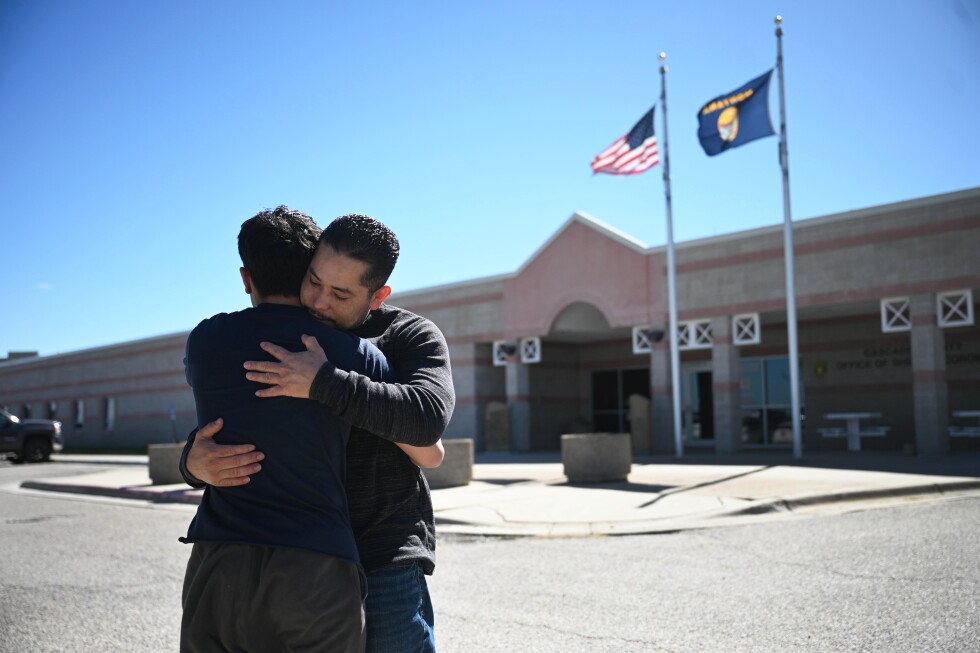
A federal judge in Great Falls ruled on Wednesday night to release Roberto Orozco-Ramirez, a diesel mechanic from Floyd. The decision came after his legal team argued that his ongoing detention was unlawful. Orozco-Ramirez exited the Cascade County Detention Center around 10:50 a.m. Thursday, reuniting with his eldest son in an emotional embrace after more than 100 days in custody.
With tears in their eyes, both father and son made their way to their vehicles to return home, where a celebration awaited them. “I have to go home,” Orozco-Ramirez stated. “It took a long time, but we made it.” His attorney, Laura Christoffersen, emphasized the importance of justice: “Let’s get them out of here once and for all,” she declared.
In a court filing on Wednesday, Chief Judge Brian Morris of the U.S. District Court for the District of Montana condemned the previous interpretation of immigration law by the Trump administration, declaring it “wrong.” He affirmed that individuals accused of unauthorized entry have a fundamental right to due process and expressed concern over the executive branch’s disregard for constitutional protections against arbitrary detention.
Orozco-Ramirez’s 19-year-old son, Roberto Orozco-Lazcano, shared his excitement while waiting outside the detention center. “This is the news I’ve been waiting for,” he said, recalling how he learned of the judge’s decision while preparing mole at home. “I just couldn’t believe it.”
Christoffersen celebrated the ruling and acknowledged the strong community support that made it possible. “No one, alien or not, can be deprived of their freedom without the right to a hearing,” she remarked from the waiting area of the detention center. Floyd residents had rallied to raise tens of thousands of dollars for Orozco-Ramirez’s legal fund, enabling them to secure representation from immigration attorney Johnny Sinodis.
Local community member Marvin Qualley expressed joy over the release, stating, “I met his other three sons this morning, and they were just overjoyed. It was so cool.” This ruling marks a significant win for Orozco-Ramirez, following an earlier case in April when the government dropped felony charges against him for illegal reentry. Subsequently, his legal team initiated a civil lawsuit against multiple federal agencies, including the Cascade County Detention Center and U.S. Customs and Immigration Enforcement (ICE), for wrongful detention.
Background of Roberto Orozco-Ramirez’s Case
Orozco-Ramirez, a skilled diesel mechanic and father of four, was arrested by Border Patrol on January 25th. His arrest sent shockwaves through Floyd, a conservative town with a population of just 195, drawing attention far beyond Montana. Initially charged with illegal reentry, the 37-year-old Mexican national has lived in the U.S. for a decade after arriving as a minor. Although the illegal reentry charge was dropped, he remained in custody amid widespread concern about the implications for immigrants nationwide.
Following the dismissal of charges in April, Orozco-Ramirez was subjected to a series of deportation attempts by federal immigration enforcement officials. He was moved multiple times between detention facilities, demonstrating the complexity and uncertainty surrounding his legal situation. Since May 4, he had been held in the Cascade County Detention Center.
Community Support During Legal Battles
On Tuesday, a crowd of approximately 50 supporters, many of whom drove over seven hours from Floyd, filled the federal courtroom in Great Falls to witness the hearing. Orozco-Ramirez’s four sons, aged 8 to 19, were there, proudly wearing Orozco Diesel sweatshirts. Their classmates, community members, and even individuals like Jill Joyce, who had never met Orozco-Ramirez, attended to show their support. Local students posed for photos wearing Orozco Diesel gear to demonstrate solidarity.
The hearing focused on the Trump administration’s controversial changes to immigration policy issued last July. The new directives expanded the criteria under which immigrants could be detained, leading to increased scrutiny and uncertainty for long-term residents. While federal courts in New York, Georgia, and Ohio have rejected similar policies, no Montana judge had previously ruled on these issues.
Orozco-Ramirez’s attorneys are simultaneously challenging his original 2009 deportation in the Ninth Circuit Court of Appeals, which complicates the situation for federal immigration officials, limiting their ability to detain or deport him absent substantial case changes. Synodis stated, “Roberto is truly an extraordinary person, as evidenced by the outpouring of community support.”
After Orozco-Ramirez’s release, conversations about his situation ignited on social media. While many celebrated his return, others voiced skepticism regarding his immigration status. Comments ranged from criticism towards his entry into the U.S. to calls for him to be granted citizenship due to his demonstrated contributions as a community member.
The unfolding events highlight the ongoing complexities and controversies surrounding immigration enforcement in the United States, particularly in rural areas that historically have not been at the center of such debates. Orozco-Ramirez’s case illustrates the broader implications of national immigration policies and the local responses they inspire.
