


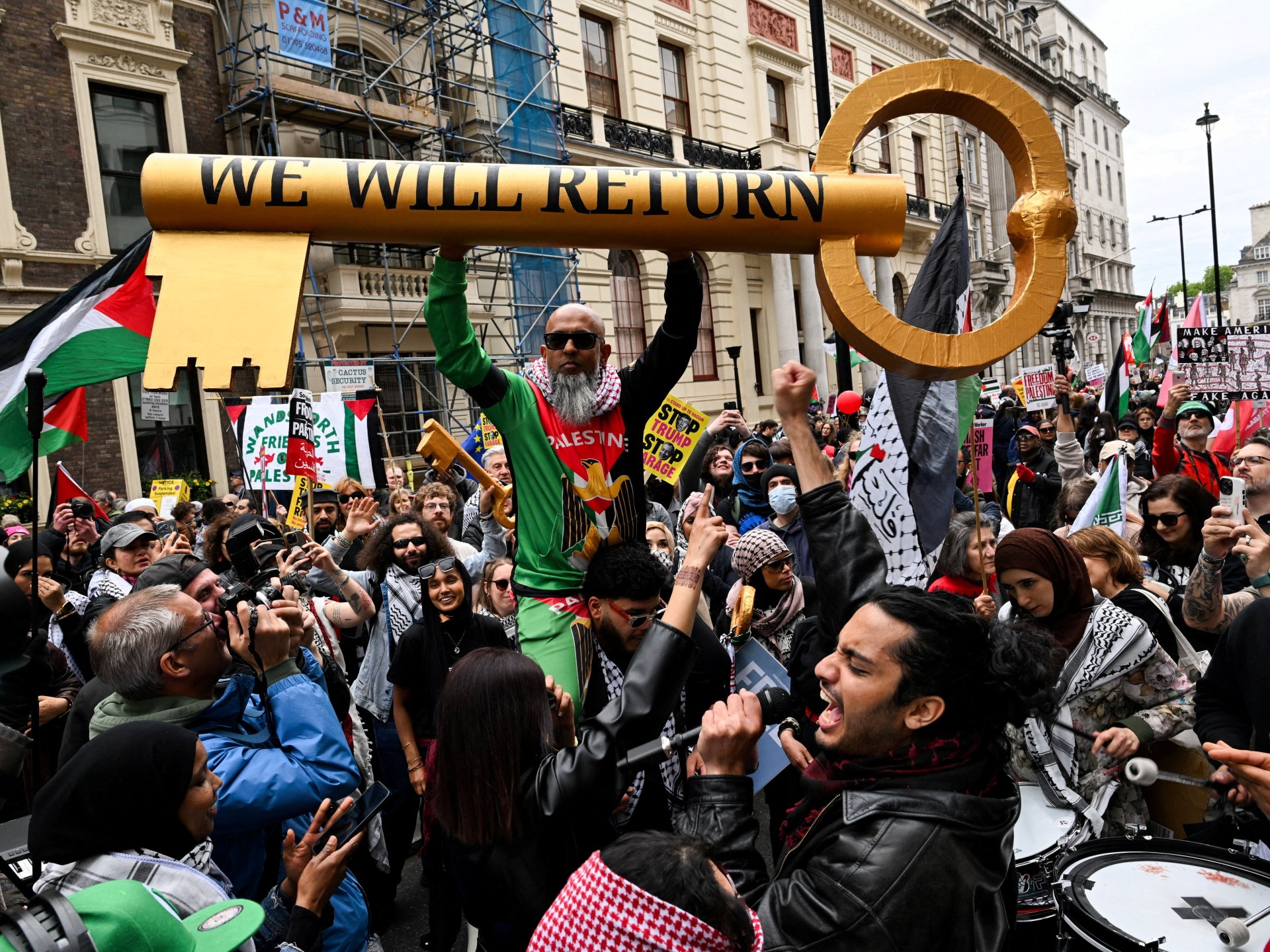
Tens of thousands are currently marching through central London in two pro-Palestinian demonstrations, occurring just one day after Nakba Day. This comes alongside a far-right rally organized by Tommy Robinson.
On Saturday, London’s Metropolitan Police deployed 4,000 officers, reinforced by personnel from surrounding areas. This operation is being described as one of the largest security measures in recent years, with authorities pledging to enforce the law stringently.
Protests in Focus
Authorities had anticipated over 80,000 participants, with approximately 50,000 expected for Robinson’s “Unify the Kingdom” march and around 30,000 for the Nakba Day rally. The police’s strategic response included the use of armored vehicles, horses, dogs, drones, and helicopters to oversee the demonstrations.
By Saturday evening, police reported 43 arrests following the dual protests, which concluded by 6:30 PM local time. Fortunately, despite four police officers sustaining minor injuries during the events, officials noted that there were “very few serious incidents.” Additionally, six officers have been charged with hate crimes amid the protests.
To mitigate tension between opposing groups, authorities established distinct conditions for the two rallies concerning their routes and times. Prosecutors were tasked with evaluating whether certain slogans and placards could incite violence during the gatherings.
The Crown Prosecution Service emphasized that these measures are intended to preserve public safety rather than restrict freedom of speech. Director Stephen Parkinson remarked that the aim is to avert hate crimes, particularly in light of heightened societal tensions.
The financial implications of the operation are significant, with police estimating costs at 4.5 million pounds (approximately $6 million). A “zero tolerance” policy was announced, placing legal obligations on protest organizers to ensure compliance with hate speech regulations. For the first time, live facial recognition technology will be employed to monitor protests.
Immigration Fears Fuel Demonstrations
Aerial footage from major media outlets illustrates the significant turnout at Robinson’s rally, which prominently featured British flags, including the Union Jack and the St. George’s flag. Some attendees expressed unease about immigration policies, with one marcher, Christine Turner, stating that borders need stricter enforcement.
As tensions mount, Prime Minister Keir Starmer cautioned potential troublemakers that they would face legal consequences, emphasizing the importance of maintaining order. Amid this backdrop, internal pressure has intensified on Starmer to step down following disappointing local election results.
Alison Parr, voicing dissatisfaction with immigration levels, argued that excessive immigration disrupts social harmony, stating that it has been a persistent issue. Recent immigration statistics reveal that net immigration approached 900,000 in 2022 before tightening border regulations led to a reduction to about 200,000 in the following year.
Tommy Robinson, whose real name is Stephen Yaxley-Lennon, previously attracted around 110,000 participants to a similar rally focused on “national unity and free speech”. Notably, Elon Musk, addressing attendees via video link, called for the dissolution of parliament and early elections, which resonated strongly with supporters. The earlier rally prompted significant public concern due to the scale of participation and subsequent clashes with law enforcement.
Voices of Unity Amid Division
In stark contrast to the far-right gathering, pro-Palestinian demonstrators can be seen advocating for an end to Israel’s military actions in Gaza. These individuals gathered to honor Nakba Day, which annually commemorates the mass displacement of Palestinians during Israel’s formation in 1948.
Protesters expressed sentiments of justice and compassion. One demonstrator, Sharon DeWitt, highlighted the need for peace between Jews and Palestinians, underscoring the necessity of allowing Palestinians to establish their own state.
Another participant, Ali Haydor, articulated concerns over societal divisions, attributing the fragmentation to decades of flawed political decisions. He emphasized the importance of love and hope in bridging divides, encouraging unity among various groups for a better future.
Anti-racism activists also marked this year’s Nakba Day, combining anti-fascist demonstrations with support for Palestinian rights, illustrating a broader coalition against hate.

