


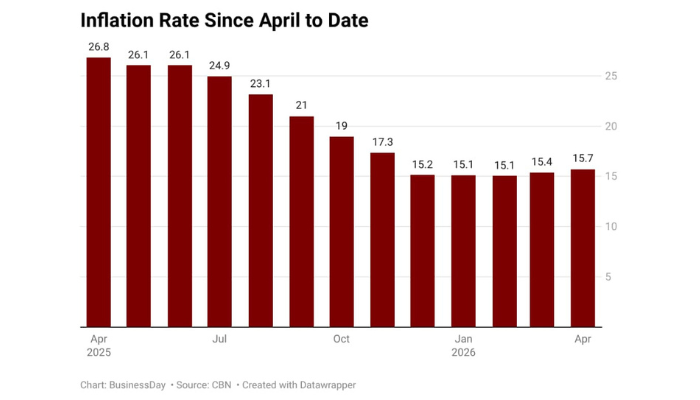
Inflation Rate Climbs for Second Month Amid Geopolitical Tensions
The inflation rate has risen for the second consecutive month, reflecting heightened economic pressures exacerbated by the ongoing conflict between the United States and Iran. This situation has reversed the previous disinflationary trend, prompting the Central Bank of Nigeria (CBN) to navigate a complex macroeconomic landscape.
Pressure Mounts on Central Bank’s Monetary Policy Committee
The Monetary Policy Committee (MPC) of the CBN is under significant pressure to maintain the benchmark interest rate at its upcoming meeting. With global inflation concerns on the rise due to renewed geopolitical instability, policymakers are proceeding with caution. On Tuesday, CBN Governor Olayemi Cardoso will lead the second meeting of the year, where economists and market analysts anticipate a hold on the monetary policy rate (MPR) at 26.5%. This prevailing opinion underscores the necessity to stabilize the exchange rate while closely monitoring inflationary trends before adjusting borrowing costs.
Recent Indicators of Inflationary Pressure
In April, Nigeria’s headline inflation rate increased to 15.69%, up from 15.38% in March. This uptick in inflation has led to heightened expectations that interest rates will remain unchanged. During its last meeting on February 23-24, 2026, the MPC had reduced the base interest rate by 50 basis points to 26.5%, maintaining an asymmetric corridor around the MPR, while also keeping the Cash Reserve Ratio (CRR) steady for deposit money banks at 45% and for non-TSA public sector deposits at 75%.
Global Dynamics Affecting Local Economies
Since the MPC’s last decision, escalating tensions among the US, Israel, and Iran have introduced fresh instability into global energy and logistics markets. The resulting increase in fuel prices poses a significant risk for inflation to permeate the wider economy. Razia Khan, Managing Director and Chief Economist for Africa and the Middle East at Standard Chartered Bank, noted that inflation expectations in Nigeria remain fragile, despite recent foreign exchange market reforms and the elimination of fuel subsidies.
Strategic Considerations Ahead of the 2027 Political Cycle
Muda Yusuf, CEO of the Center for the Promotion of Private Enterprise (CPPE), indicated that the MPC’s deliberations will be influenced not only by geopolitical risks but also by domestic liquidity pressures and anticipated election-related spending ahead of the 2027 elections. Increased political expenditure, coupled with improved revenue disbursements from the Federal Accounting Allocation Committee (FAAC), could intensify liquidity concerns, complicating inflation management.
Expert Insights on Monetary Policy Dynamics
Analysts maintain that tightening monetary policy could hinder economic growth and dampen private sector investment. Ayodele Akinwunmi, Chief Economist at United Capital, emphasized that the MPC’s tools are constrained due to supply-driven inflation. He predicts the committee will maintain the key policy rate while possibly adjusting the CRR for non-TSA deposits to 85% in a bid to control excess liquidity. This cautious approach reflects the ongoing geopolitical context affecting inflation expectations.
Looking Ahead: Economic Forecasts and Recommendations
Several experts agree that the MPC is likely to adopt a wait-and-see approach. As inflation dynamics and global tensions evolve, interest rates are expected to remain stable. Oluwole Crowther, head of research at FMDA, observed that the impending political cycle, marked by increased spending, could further influence monetary policy decisions. The CBN’s strategy will be critical in navigating these intricate challenges while aiming to foster economic stability and growth.
