


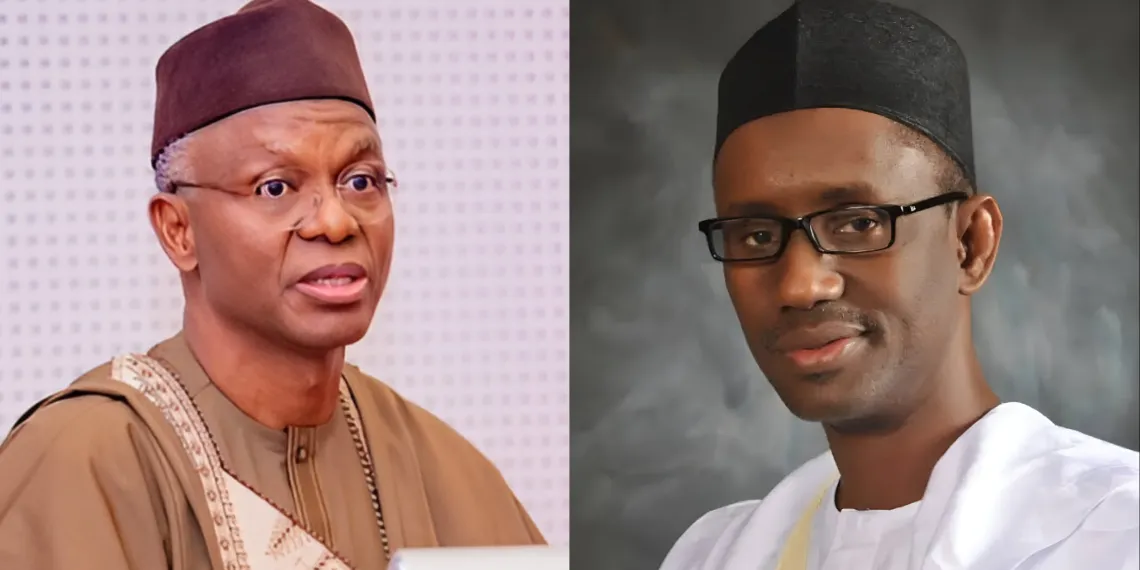
Former Governor Detained Over Wiretapping Charges
Nasir El-Rufai, the former governor of Kaduna State, has been remanded in the custody of the Department of State Services (DSS) despite being granted bail set at NOK 100 million. The charges against him include wiretapping the National Security Adviser (NSA).
Following the bail decision, El-Rufai’s family and legal team made urgent attempts to meet the bail conditions; however, these efforts were unsuccessful. His son, Mohammed Bello, was observed making multiple phone calls while accompanied by his wife as they attended the court proceedings.
The DSS opted to keep El-Rufai in custody until the outlined bail requirements are satisfied. Justice Joyce Abdulmalik issued an order specifying that the former governor must present one surety—an employee at level 17—which must include proof of a three-month salary certified by a bank manager, corresponding to the bail amount.
Additional conditions set by the court stipulate that the proposed surety must be a resident of the Maitama or Asokoro areas of Abuja. Furthermore, the surety is required to deposit the original certificate of occupancy for their property with the court registry.
The conditions extend to the submission of an affidavit of means, the execution of a bail bond, and the provision of a recent passport photograph. El-Rufai is also mandated to submit a valid international passport to the court for consideration.
In a further directive, Judge Abdulmalik requires the former governor to appear at the DSS headquarters by 10 a.m. on the last Friday of each month to sign an attendance register until the case reaches a resolution. Compliance with all bail conditions is crucial, as failure to adhere may result in immediate revocation of bail.
The trial is to proceed expeditiously, following three charges filed by the DSS against El-Rufai, accusing him of infringing upon national security. Prosecutors allege that El-Rufai admitted in an interview to unlawfully intercepting the phone communications of NSA Nuhu Ribadu while Ribadu was a guest on a prime-time show on Arise TV in Abuja on February 13. This act is said to violate Article 12(1) of the Cybercrimes (Prohibition, Prevention, etc.) Amendment Act of 2024.
In a second charge, El-Rufai reportedly acknowledged during another broadcast that he was aware of and had connections to certain individuals who should report to security agencies. This admission forms the basis for further allegations of illegal interception under Section 27(b) of the same Cybercrimes amendment legislation.
The government alleges in a third count that El-Rufai and his associates possess technological equipment and systems that jeopardize public safety and national security, thus instilling fear among Nigerians. He reportedly acknowledged committing a crime related to these actions during a February 13 interview on Arise Television, which the government claims is in violation of Section 131(2) of the Nigerian Communications Act 2003.
