


April 2026 Update on African Technology Policy
This month marks a significant development for the Carnegie Africa Program with the launch of the African Technology Policy Tracker (AfTech) 2.0. This enhanced platform aggregates 1,034 laws, policies, and regulations from all 54 African nations as well as the African Union, offering the most comprehensive and accessible overview of how governments across the continent are fostering their digital economies.
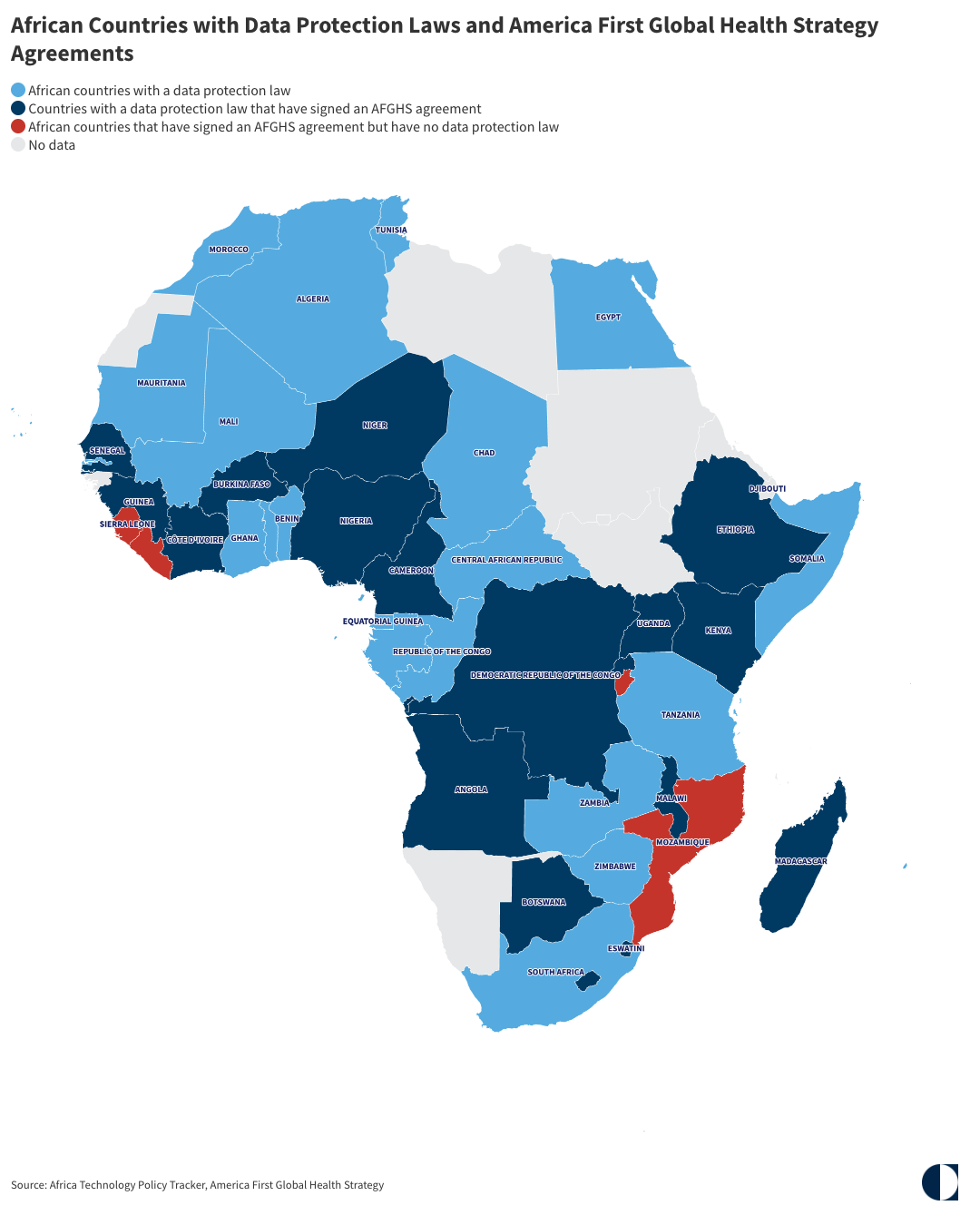
Jane Munga’s recent analysis, informed by the latest data, underscores that digital infrastructure has emerged as a primary focus for policymakers aiming to advance Africa’s digital economy. Alongside this article, AfTech 2.0 supports new research by Munga and Rose Mosello, which delves into the limitations imposed by Africa’s data protection laws on external access to data, particularly within the context of the Trump administration’s America First global health strategy. This month’s featured chart illustrates how data protection regulations correlate with healthcare agreements across various African nations.
In the backdrop of ongoing turmoil in the Middle East that affects global trade and disrupts supply chains, scholars from the Africa Program are actively engaging in discussions related to trade both on the continent and in Washington, DC. During the recent World Trade Organization Ministerial Meeting in Yaoundé, Holofelo Kugler participated in multiple events and shared insights in an interview with Cameroon Radio Television. The lessons gleaned from this meeting have been pivotal to a recent publication co-authored with Georgia Schaefer-Brown, focusing on Africa’s economic strengths and the sectors ripe for investment. Additionally, Henok Asmerash contributed to a preliminary discussion on how the African Continental Free Trade Area is transforming the role of African nations in multilateral trade negotiations.
Issues surrounding energy policy, industrial strategy, and the U.S. relationship with the Democratic Republic of the Congo (DRC) remain central to our agenda. At the Powering Africa Summit, Ramsey Day participated in a panel discussion on energy security and critical mineral supply chains. Meanwhile, Katie Orth moderated a session exploring the importance of investment in achieving universal energy access in Africa. Christian Geraud-Nima has shared his expertise in numerous podcasts, engaging with Chatham House on subjects ranging from the evolving U.S. role in Africa to the critical intersection of minerals and peace in the DRC.
Scholars from Carnegie are also providing valuable insights into Africa’s role in global geopolitical dynamics, particularly in relation to Russia-Africa relations. On Capitol Hill, Francis Z. Brown briefed a bipartisan group of foreign service officials on the findings of Carnegie’s recent Russia in Africa Compendium, produced as part of the ONE Campaign’s Africa Fellows Program. A new article in Foreign Affairs by Frederick Whaley and Andrew S. Weiss indicates that Russia’s influence in the Sahel is on the decline.
This month, we warmly welcome Fonte Akumu as the new Carnegie Africa Program Director and Senior Fellow, along with Leslie Ann Warner as our Visiting Scholar. We look forward to further impactful research on the African continent from our distinguished scholars.
This Month’s Chart
Key Insights
The Critical Need for Digital Infrastructure in Africa
The Africa Technology Policy Tracker reveals that digital infrastructure is a priority for policymakers shaping the continent’s digital future.
Written by Jane Munga
Africa’s Economic Potential: Strategic Sector Investment
By focusing on manufacturing, value addition, and scaling in crucial sectors like critical minerals, specialty agriculture, and fintech, Africa stands poised to emerge as a global economic leader.
Written by Holofelo Kugler and Georgia Schaefer-Brown
The Kenya Health Agreement: A Test for U.S. Global Health Strategy
To effectively function as a durable foreign policy tool, the U.S. health agreement must navigate domestic data protection laws.
Written by Jane Munga and Rose Mosello
Assessing Russia’s Influence in Africa
As Russia seeks to expand its footprint in Africa, West and Southern African nations are exploring new strategies to mitigate associated risks.
Edited by Nate Reynolds, Frances Z. Brown, Frederic Wehrey, and Andrew S. Weiss
Rethinking Moscow’s Presence in the Sahel
Recent miscalculations suggest a waning grip for Moscow, signaling both challenges and opportunities for Washington.
Written by Frederick Whaley and Andrew S. Weiss
Examining the Energy Transition in Maghreb Countries
The European Union-led energy transition poses questions about economic development opportunities for Algeria, Morocco, and Tunisia, raising concerns of potential new extraction practices.
Written by Yasmin Zahlul
New Evidence of Hunger Crimes in Darfur
Written by Tom Dannenbaum and Oona A. Hathaway
Civil Society Constraints in North Africa: Implications for Climate Action
To maximize effectiveness, climate-focused organizations in Morocco, Algeria, and Tunisia must collaborate across borders and share best practices.
Written by Sarah Yerkes
From Our Archives
In August 2022, Rose Mosello published an analysis titled “In Kenya’s 2022 Elections, Technology and Data Protection Must Go Hand-in-Hand,” investigating the interplay between Kenya’s Data Protection Act and the electoral process. In the recent article “Kenya’s Health Deal: A Stress Test for the America First Global Health Strategy,” Mosello and co-author Jane Munga examine how Kenya’s data protection laws can bolster data sovereignty amid bilateral health agreements.
