


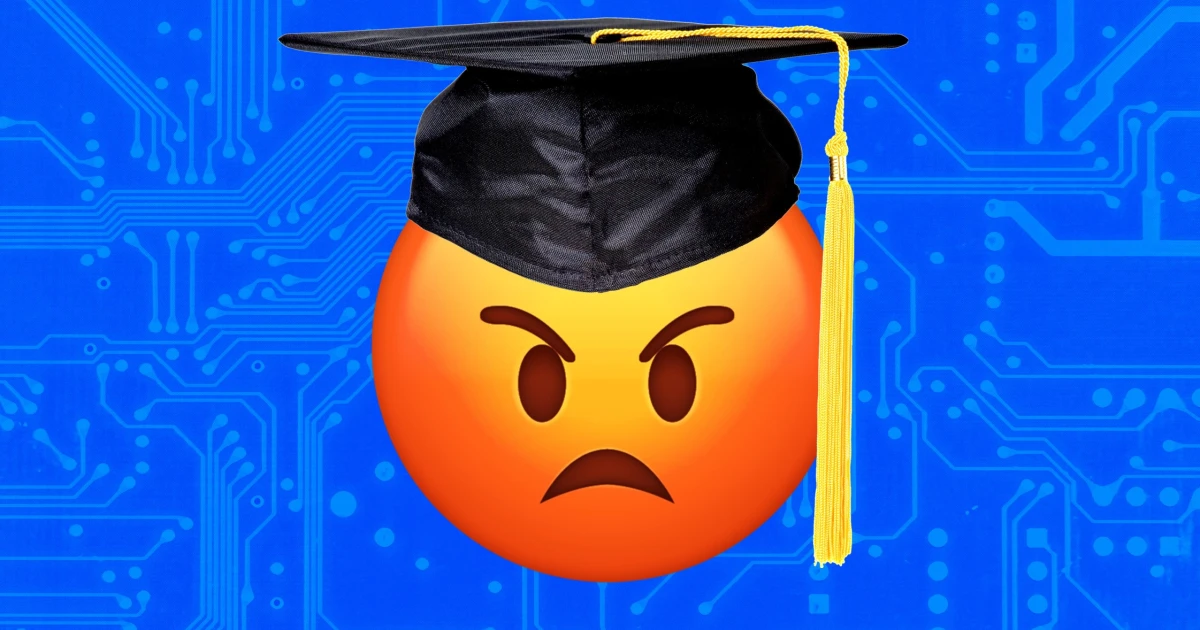
Students Push Back Against AI Integration in Academia
As the demand for AI continues to surge across various sectors, a segment of college students is responding with skepticism and dissent. This month, at multiple graduation ceremonies, graduates vocally expressed their displeasure towards speakers who championed AI advancements. A notable moment occurred when Vice President J.D. Vance addressed this rising wave of anti-AI sentiment during his remarks at the U.S. Air Force Academy.
Emergence of Anti-AI Movements on Campus
On at least five university campuses, students have banded together to form anti-AI organizations. These groups aim to advocate for a more measured approach to the rapid development of AI technologies. The growing backlash serves as a stark contrast to the optimistic outlook on AI held by many business leaders, highlighting a disconnect regarding the potential impact of AI on employment, creativity, and critical thinking skills.
Concerns Over AI’s Impact on Education
Students are increasingly alarmed about how AI technologies may fundamentally change the educational landscape. Paul Webster, a computer science sophomore at the University of California, Berkeley, articulated that the essence of learning lies in grappling with and understanding complex materials. He noted that when educators promote the use of AI as a learning aid, it could undermine students’ ability to attain a deep comprehension of the subjects.
Shifting AI Usage in Academic Settings
A Gallup/Lumina Foundation survey conducted last October revealed that 57% of U.S. college students utilize AI tools in their classes weekly, with 21% employing them daily. Many students report relying on AI primarily for grasping class content and verifying homework answers. This trend has led some to take a stand against what they perceive as a troubling reliance on automation.
Organizing for AI Regulation on Campus
In response to their concerns, students have initiated their own campus organizations, like PauseAI US, which seeks to halt the advancement of AI technologies until they can be deployed more safely. According to Holly Elmore, the group’s executive director, there is a rising consensus among students that existing AI developments pose potential risks and advance too rapidly. Chapter leaders express apprehension about feeling pressured to sacrifice their integrity in academic work due to the proliferation of AI technologies.
Discourse on AI Regulation and its Implications
At campuses across the nation, members of PauseAI US are actively engaging in discussions about the significant implications of AI. Nicholas Spiliotopoulos from the University of California, Santa Barbara, emphasized that many in his chapter are determined to ensure AI does not overshadow vital academic and cognitive processes. He noted that maintaining a regulatory framework around AI is crucial for preserving critical thinking skills among students.
Diverse Perspectives on AI’s Role in Society
While some students aim to slow AI’s development, others recognize its potential to catalyze beneficial societal changes. Jeffrey Kang, a recent graduate now working at Meta, acknowledged the concerns surrounding automation, yet he believes in the importance of leveraging technology effectively. He criticized the fatalistic view that ignores AI’s advantages, asserting that, in major tech organizations, the implementation of AI tools is commonplace and essential.
As debates over AI’s implications continue to unfold, students are finding their voices amidst the evolving landscape of technology in education. With a mix of enthusiasm and trepidation, they seek to shape the future of AI integration in a way that aligns with their values and aspirations.
