


New Insights Challenge Immigrant Blame for Declining Test Scores
Recent findings reveal that the United States has been grappling with a “learning recession” for over a decade. A prominent psychologist is pushing back against claims that immigrants are the primary cause, asserting instead that technology in classrooms bears more responsibility.
Stephen Miller, the White House Deputy Chief of Staff for Policy and Homeland Security Adviser, suggested last year that immigrants are a key driver of America’s societal challenges. He stated that if immigrant contributions to test scores were removed from the equation, the scores would dramatically improve. According to Miller, educational failures and spikes in crime and budget deficits have all been exacerbated by immigration policies.
Jean Twenge, a psychology professor at San Diego State University and the author of 10 Rules for Raising Kids in a High-Tech World, indicated that a recent surge in negative test scores has fueled this divisive narrative. The latest data from Harvard University’s Center for Educational Policy Research and Stanford University’s Educational Opportunity Project indicates significant declines in reading and math scores since 2013, with a nearly one-grade level drop in reading scores among U.S. students from 2015 to 2025, affecting nearly every state. Social media responses to Twenge’s posts revealed a trend of attributing these declines to rising immigration levels.
However, Twenge counters this viewpoint by referencing U.S. census data, which shows that the percentage of foreign-born children under 18 rose slightly from 3.37% in 2015 to 4.36% in 2024. She argues that even if foreign-born children perform worse on reading tests, this increase is too marginal to account for the substantial drop in scores.
Similar observations follow among adult immigrants, who constituted 16.47% of the U.S. population in 2015, growing to 17.61% in 2024. This data suggests that the immigrant population’s growth is insufficient to explain the observed declines in educational performance. In fact, research by the National Bureau of Economic Research suggests that increased interaction with immigrant students correlates with improved performance in reading and math among U.S.-born peers. The study proposed that immigrant presence may help reduce classroom disruptions, leading to a better learning environment.
Amid growing concerns about educational outcomes, a research paper from last year highlighted that Spanish test scores for both foreign-born and U.S.-born students in Florida have notably declined due to increased immigration enforcement. The prevailing narrative that immigrants undermine education and economy has gained traction alongside stricter immigration policies under the Trump administration. Contrary to the claim that immigrants take jobs from native-born Americans, studies indicate that aggressive immigration crackdowns have resulted in reduced labor force participation, impacting even native workers.
Technology’s Role in Declining Academic Performance
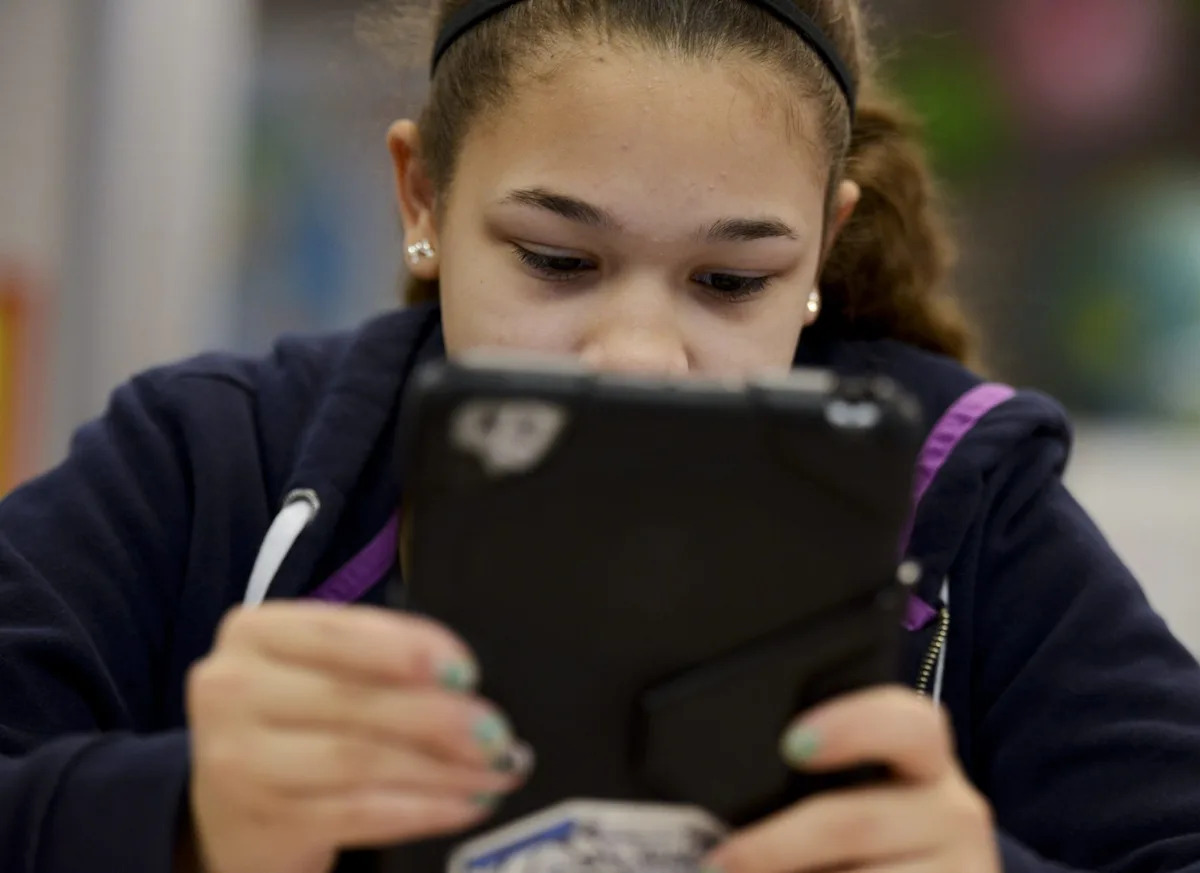
Twenge posits that the more significant culprit behind falling test scores is the pervasive influence of technology in both educational sectors and everyday life. The rise of social media and its addictive nature, particularly since the early 2010s, has coincided with these troubling trends. Twenge emphasizes that digital distractions can easily interfere with students’ learning processes.
This is not a new argument; neuroscientist Jared Cooney Horvath has also made claims linking increased screen time with cognitive decline among younger generations. Earlier analyses pointed to stagnation in test scores in Maine following the introduction of widespread laptop use in schools, with critics labeling the initiative a “colossal failure.” A 2014 survey indicated that college students spend a significant portion of class time engaged in non-class-related activities on their devices.
Despite the challenges presented by technology, some experts, like education consultant Mary Burns, advocate for its educational potential. While acknowledging the risks of cognitive offloading through technology, Burns argues that AI can help tailor education to better serve students’ needs. However, Twenge believes that the benefits of technology must be approached with caution. She advises delaying access to smartphones until high school and suggests that schools set limitations on screen time to minimize distractions.
Twenge underscores the skills essential for college readiness and long-term success: focus, critical thinking, and the ability to grasp complex concepts. She contends that digital devices hinder these skills, while traditional learning methods, such as reading books, promote them effectively.
