


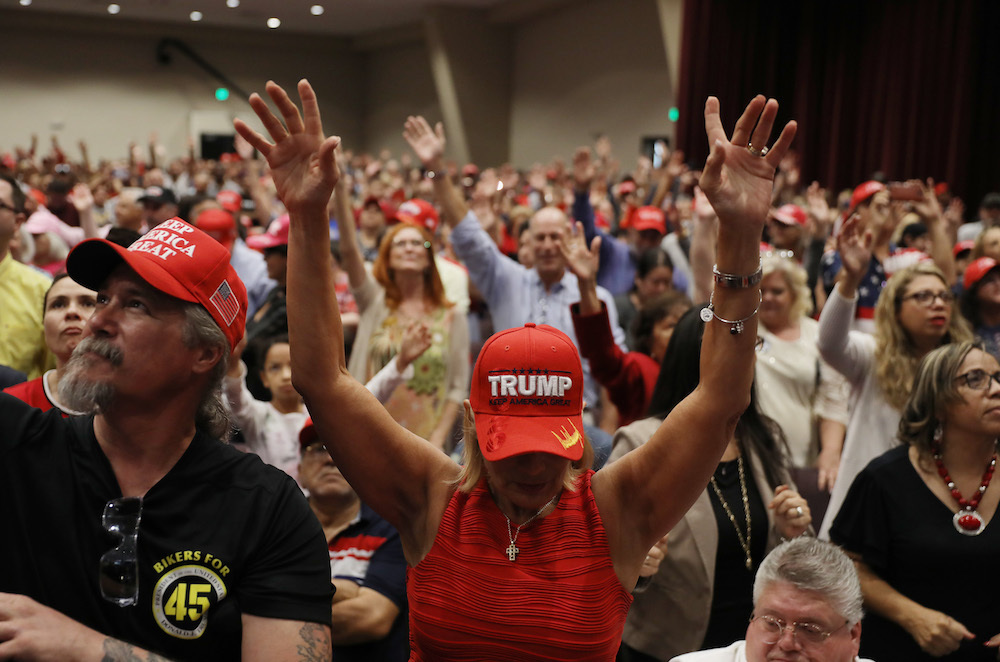
A recent Reuters/Ipsos poll reveals that nearly half of evangelical Christians perceive President Donald Trump’s military and immigration policies as misaligned with their Christian values. As Republican strategists look to harness this influential voter bloc to maintain their congressional majority in the upcoming midterm elections, these sentiments could signal potential shifts in support.
The poll, conducted between June 3 and June 8 among 4,531 American adults, found that 54% of evangelicals believe Trump’s military engagement in Iran conflicts with their understanding of Christianity, while 41% disagreed. Furthermore, 51% of respondents felt that the administration’s immigration policies were inconsistent with Christian values, with only 44% expressing agreement.
Trump’s approval rating among evangelicals has dipped to 52%, down from 61% in August, yet remains significantly higher than the overall 35% approval rating among American adults. According to a Pew Research Center analysis of exit polls, evangelicals support Trump over his challengers by an overwhelming 81% to 16% margin for the 2024 election.
In response to the polling data, White House Press Secretary Taylor Rogers emphasized the administration’s efforts to benefit Christians in the U.S., citing the protection of religious freedom and the pardoning of pro-life activists as examples of Trump’s commitment to this demographic. Rogers characterized Trump as an unprecedented ally for Christian Americans.
Since launching a military campaign against Iran on February 28, with the aim of thwarting its pursuit of nuclear weapons, the conflict has seen significant loss of life. Reports indicate over 3,600 deaths within Iran, alongside fatalities in Lebanon and Iraq that number over 1,900, as documented by both official and non-governmental sources.
Evangelical groups have voiced growing concerns regarding immigration policies under the Trump administration. World Relief, a Christian humanitarian organization, has criticized a recent U.S. Citizenship and Immigration Services memo requiring many legally residing immigrants to leave the country before they can apply for permanent resident status. This shift has largely halted the long-standing practice of adjusting status from within the country.
The president of World Relief, Mial Green, described the policy as having “devastating consequences for families” and urged legislative and judicial action to reverse the changes. In a report titled “United and Torn,” released by the National Association of Evangelicals and World Relief, data suggests that over a million Americans could face separation from family members due to these immigration policies. By the end of Trump’s presidency in early 2029, up to 910,000 U.S. children could lose one or both parents to deportation.
The concerns extend beyond immediate family separation, with earlier reports indicating that the majority of those most at risk of deportation in the U.S. are Christians. Walter Kim, the president of the NAE, highlighted the pivotal role of immigrant communities in combating the rise of religious secularism, noting significant growth in church establishments across the nation, particularly driven by immigrants from Latin America, Africa, and Asia.
