


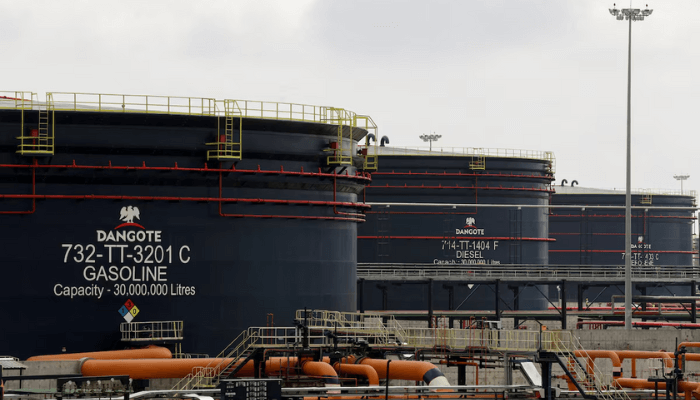
Dangote Refinery Pressures Nigeria’s Diesel Market with Price Cuts
The Dangote refinery has intensified competition in Nigeria’s downstream oil market by reducing diesel gantry rates by 100 naira per liter. This adjustment signals that cheaper crude oil from international sources is beginning to flow into local markets.
Currently, the refinery prices automotive diesel, which fuels trucks, generators, and industrial sites throughout Nigeria, at rates ranging from N1,600 to N1,700 per liter. Additionally, Aviation Turbines Kerosene (ATK), a key component in commercial jet fuel, has also seen a price drop of 100 naira, decreasing from 1,550 naira to 1,450 naira per liter.
Market data from Petroleumprice.ng indicates that this latest price reduction positions Dangote diesel about 60 naira cheaper than the price set by private warehouse operators in Lagos the day before. On June 16, firms like African Terminal, Sahara, Ibeto, and Duport concluded diesel sales at 1,660 naira per liter. Although Rainoil marginally reduced its jet fuel prices to 1,550 naira from 1,553 naira on June 15, this adjustment now appears minimal in light of Dangote’s more substantial cut.
Depot operators are facing a challenging environment, characterized by narrow profit margins. With refineries now offering prices below 60 naira per liter for diesel, competition is likely to lead to further price reductions rather than fragmentation. Traders and marketers holding inventory purchased at higher costs are increasingly pressured to lower their prices or risk losing market share to refineries capable of establishing their own pricing benchmarks.
This price shift is consistent with broader trends in the oil market. As of 1 PM Nigerian time, Brent crude oil was priced at $78.98 per barrel, while West Texas Intermediate experienced a notable drop, down 5.82% to $76.05 per barrel. These declines are largely attributed to diminishing tensions between the United States and Iran, allowing for more stable conditions in the Strait of Hormuz, a vital chokepoint for global oil transportation.
Even prior to the Dangote announcement, private warehouses had begun lowering their prices, anticipating increased supply. This suggests that the recent price cut aligns with the prevailing market trajectory rather than being an isolated development.
Manufacturers are particularly focused on reducing diesel emissions, as many rely heavily on diesel generators due to the unreliability of Nigeria’s national electricity grid. Consequently, the cost of automotive gas oil (AGO) directly impacts production budgets, transportation costs, and ultimately retail prices.
While the 100 naira reduction is not sufficient to entirely offset the higher energy costs experienced over recent months, it does reinforce the correlation between global oil prices and the expenses manufacturers manage to sustain operations. This connection has strengthened since the Dangote refinery began large-scale production, transitioning from being just a buyer of imported fuel to a pivotal domestic price-setter.
Moreover, savings on jet fuel have significant implications for the aviation industry, as ATK often represents a substantial portion of airline operating costs. The recent 6.5% reduction offers airlines the opportunity to either bolster profits impacted by currency fluctuations and high financing expenses, or to reduce ticket prices, enhancing competitiveness and ultimately benefiting passengers. Although a single price adjustment may not lead to immediate fare changes, ongoing declines could influence airlines’ strategic planning regarding routes and schedules throughout the year.
Industry analysts view this development as further proof that the Dangote refinery has shifted the focus of fuel pricing in Nigeria. Previously, domestic pump prices closely followed the costs of imported fuel with a time lag, influenced by not just oil prices, but also currency rates and logistics. Now, with local refineries capable enough to set market direction, fluctuations in international prices are being felt more swiftly by consumers, compelling warehouses that once established their prices independently to respond to Dangote’s competitive rates.
As stricter regulatory measures are implemented, price adjustments are likely to occur in both directions. Should oil prices decline further, we may see rapid reductions at the pump, while an economic rebound could also result in swift price increases as companies seek to recover their costs.
