


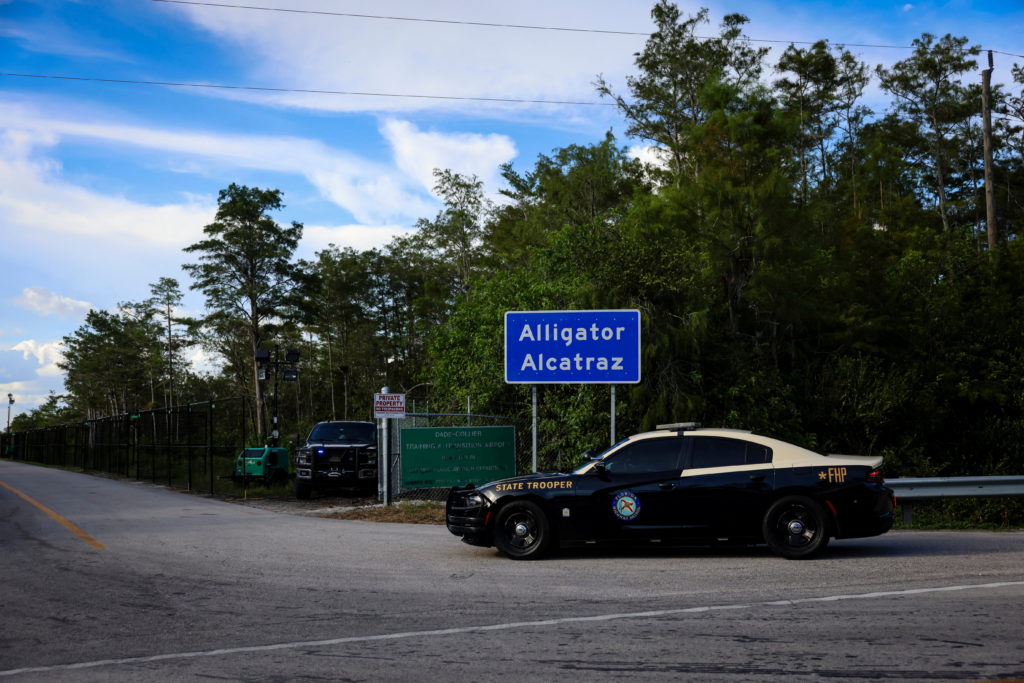
Transfers at Florida’s Immigration Detention Center Amid Hurricane Concerns
MIAMI (AP) – The U.S. Department of Homeland Security has announced the transfer of all detainees from a controversial immigration detention center located on an isolated airstrip in the Florida Everglades, often referred to as “Alligator Alcatraz.” This decision comes in response to concerns regarding the approaching hurricane season.
The South Florida Detention Center garnered attention from President Donald Trump, who praised its establishment. However, it has faced ongoing criticism from lawyers, families, and human rights advocates who have raised serious concerns about the treatment of detainees since the facility began operations 11 months ago, during the Atlantic hurricane season.
While DHS confirmed the transfer of detainees from Florida facilities, it did not disclose the number of individuals moved or their new locations. The agency also refrained from indicating whether the Alligator Alcatraz facility would close on a permanent or temporary basis. “For the safety of detainees, we have transferred them to other facilities,” department spokeswoman Lauren Biss stated in an email.
The Atlantic hurricane season spans six months, from June to November. The detention center officially opened on July 3, 2025, just a month after the season’s onset, which ultimately concluded without major storms affecting Florida. Reports from the National Hurricane Center indicate that the first tropical storm of the 2026 hurricane season has already formed offshore Texas.
Conditions at Alligator Alcatraz have raised alarms, with detainees reporting inadequate access to legal counsel and substandard living conditions marked by contaminated food, malfunctioning toilets, and pervasive insects. Located amidst alligator-infested swamps, the complex was constructed rapidly under the orders of Florida Governor Ron DeSantis, with President Trump visiting just two days before its inaugural opening.
Despite federal and state assurances regarding the facility’s preparedness for hurricanes, immigrant advocates argue that such environments are inherently unsafe and inhumane. The Florida Department of Emergency Management has not provided any updates on the situation or the facility’s future.
Criticism of Hurricane Season as Justification for Transfers
Advocates and legal representatives for detainees contend that citing hurricane season as the rationale for transfers is merely a pretext. Arianne Betancourt, a community advocate with the non-profit organization Workers Circle, remarked that the facility opened during the peak of last year’s hurricane season, challenging the credibility of the stated reasons for the transfers.
Over the past two weeks, there has been a noticeable uptick in detainee transfers, according to advocates who have lost contact with many individuals. Immigration attorney Katie Blankenship reported that all of the 50 clients they have consulted over the past three weeks were transferred from Alligator Alcatraz to various facilities in South Florida, California, Arizona, Louisiana, and Texas. “They are moved into the system and disappear, making it difficult for family members and lawyers to locate them for up to a week,” she explained.
Families Facing Ongoing Challenges
Renata Bozzetto, deputy director of the Florida Immigration Coalition, emphasized that the challenges faced by families of detainees continue even after the facility’s closure. “While many detainees may be moved, their families remain in a state of uncertainty and distress,” she stated. “When the detention center ceases operations, it will be the contractors and companies that profit, while immigrant families struggle to cope with the fallout.”
