


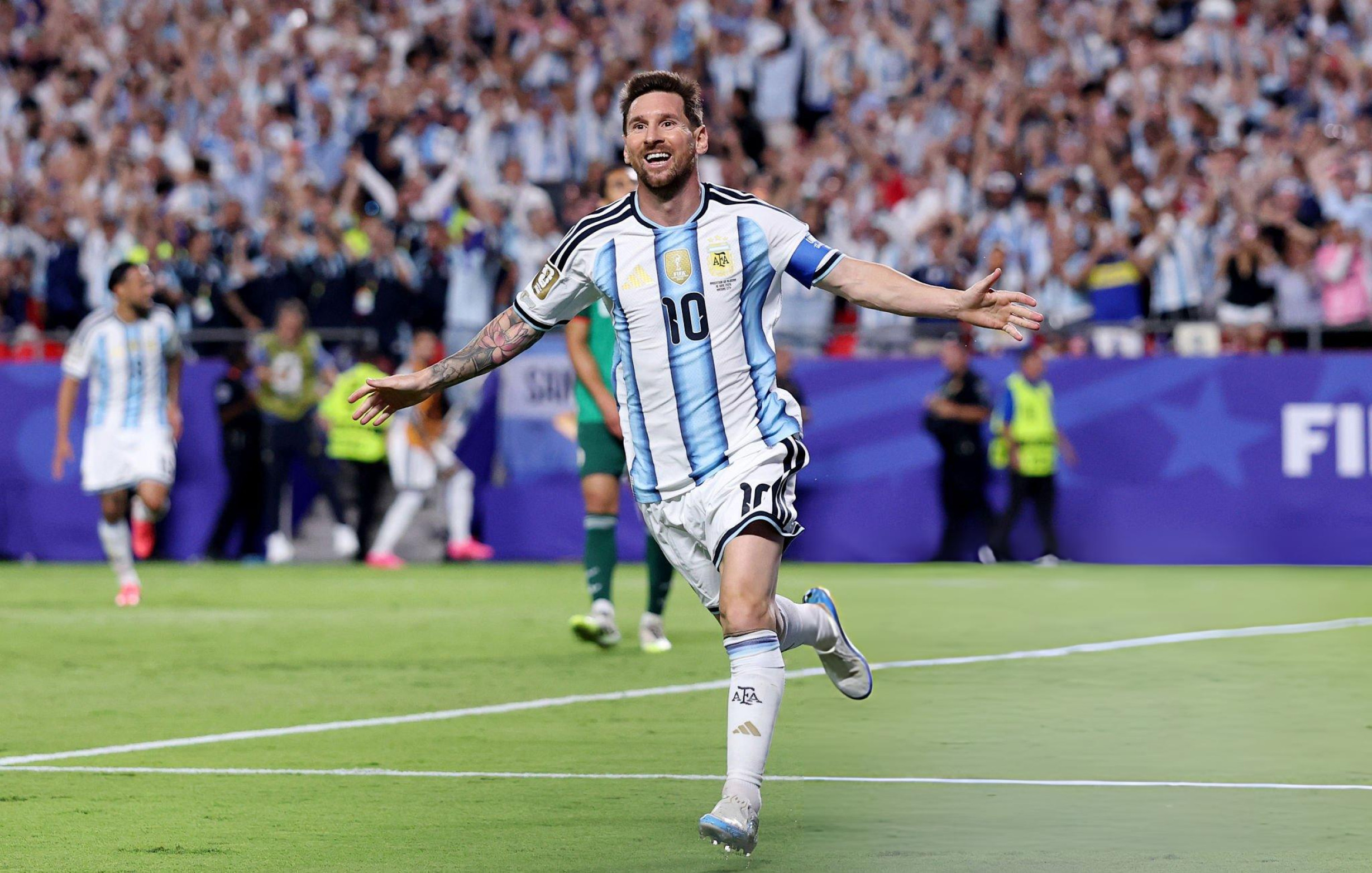
In a remarkable display of resilience, Lionel Messi turned what could have been a disappointing night into a historic milestone in his illustrious career. After missing an early penalty and displaying visible frustration, the Argentine captain triumphed, becoming the highest scorer in FIFA World Cup history.
Messi’s stunning two-goal performance propelled reigning champions Argentina to a 2-0 victory over Austria in Dallas. This victory not only showcased his talent but also allowed him to surpass German icon Miroslav Klose, netting his 17th and 18th goals in World Cup play and securing Argentina’s progression to the knockout stage of the 2026 FIFA World Cup.
The win marked Argentina’s second consecutive victory in Group J, officially ensuring their place in the Round of 32. With this triumph, Lionel Scaloni’s side demonstrated their determination and skill as they aim to defend their title on football’s grandest stage.
Messi’s Early Miss Sets the Stage
The first ten minutes of the match hinted at a significant moment in history. In the 9th minute, an infringement in the penalty area saw Argentina awarded a penalty kick after Stefan Posch fouled Lautaro Martinez. This was Messi’s chance to strike, earning him the opportunity to become the all-time leading scorer in Men’s World Cup history.
However, in a surprising turn of events, the eight-time Ballon d’Or winner squandered the chance, sending a poorly executed shot wide of the right post and leaving the Dallas crowd stunned. This moment of missed opportunity briefly denied one of the sport’s greatest record-breakers. In reflection, Messi acknowledged the psychological impact of his early miss.
A Moment of Glory Arrives
Responding with characteristic brilliance, Messi soon found his footing. After a relentless 30 minutes of Argentine pressure, the breakthrough came in the 38th minute. Facundo Medina’s dangerous cutback found Thiago Almada, who skillfully slid the ball to Messi. Without hesitation, the superstar unleashed a powerful shot past Austrian goalkeeper Alexander Schlager, igniting a frenzy in the stands.
This goal not only gave Argentina the lead but also etched Messi’s name into football folklore, marking his 17th World Cup goal and breaking Klose’s long-standing record. Just four days earlier, Messi had equaled Klose’s tally with a hat-trick in a 3-0 victory over Algeria.
Austrian Resistance Meets Argentine Precision
Despite trailing, Austria, managed by former Manchester United head coach Ralf Rangnick, refused to back down. They posed a continued threat, nearly equalizing in the second half. A powerful free kick from Marcel Sabitzer seemed destined for the net until Argentine goalkeeper Emiliano Martinez made a sensational diving save, preserving Argentina’s lead.
This save proved pivotal, as immediately after, Messi seized the opportunity to strike again.
Messi’s Late Strike Seals the Match
As the game approached stoppage time, Argentina launched one final offensive. Julian Alvarez’s shot was parried by Schlager, but the ball fell perfectly for Messi. Surrounded by defenders and from a tight angle, he cleverly maneuvered through the crowded penalty area to find the net once more, sealing a 2-0 victory and extending his World Cup scoring record to 18 goals.
This goal not only solidified his place in history by surpassing Brazilian legend Marta’s 17 goals in women’s World Cup history but also highlighted Messi’s continued dominance on the pitch.
Argentina Solidifies Their Position
With this victory, Argentina now leads Group J with six points from two matches, confirming their advancement to the Round of 32. The defending champions have joined Mexico, the United States, and Germany as teams that have already secured their place in the finals. Their next group stage match against Jordan will be crucial, especially if Jordan fails to defeat Algeria later today.
Austria, who secured three points from their previous victory over Jordan, will look to maintain their hopes for qualification in their final group match against Algeria.
Messi’s Remarkable Legacy Continues
Approaching 39 years old, Messi defies age as he continues to set records. With a tally of 18 goals in World Cup history, he stands alone atop the leaderboards, surpassing the legendary Miroslav Klose. Furthermore, he has scored in six consecutive World Cup matches, a feat only accomplished by a select few.
Since turning 35, Messi has netted an astonishing 12 goals in World Cup play, and he has played an impressive 201 matches for Argentina, contributing 122 international goals. His journey has grown from scoring his first World Cup goal as an 18-year-old in 2006 against Serbia and Montenegro to now ruling the sport’s biggest stage almost two decades later.
Team Success Takes Precedence
Despite once again shattering records, Messi emphasized that team success transcends individual glory. He expressed his satisfaction with the crucial win, acknowledging its importance for the upcoming challenges in the tournament. “I’m enjoying the moment and want to share it with my teammates,” he stated, highlighting the unity of his team as they strive for their common goal.
World Cup All-Time Top Scorer
Lionel Messi (Argentina, 2006-2026) – 18 goals
Miroslav Klose (Germany, 2002-2014) – 16 goals
Ronaldo (Brazil, 1994-2006) – 15 goals
Gerd Müller (West Germany, 1970-1974) – 14 goals
Kylian Mbappé (France, 2018-2026) – 14 goals
Just Fontaine (France, 1958) – 13 goals
Pelé (Brazil, 1958-1970) – 12 goals
Sándor Kocsis (Hungary, 1954) – 11 goals
Jürgen Klinsmann (West Germany and Germany, 1990-1998) – 11 goals
Helmut Rahn (West Germany, 1954-1958) – 10 goals
Gary Lineker (England, 1986-1990) – 10 goals
Gabriel Batistuta (Argentina, 1994-2002) – 10 goals
Harry Kane (England, 2018-2026) – 10 goals
Teófilo Cubillas (Peru, 1970-1982) – 10 goals
Thomas Müller (Germany, 2010-2022) – 10 goals
Grzegorz Lato (Poland, 1974-1982) – 10 goals
On a night that began with frustration and missed opportunities, Lionel Messi reaffirmed why he is a legendary figure in football, transforming historical expectations into reality.
