


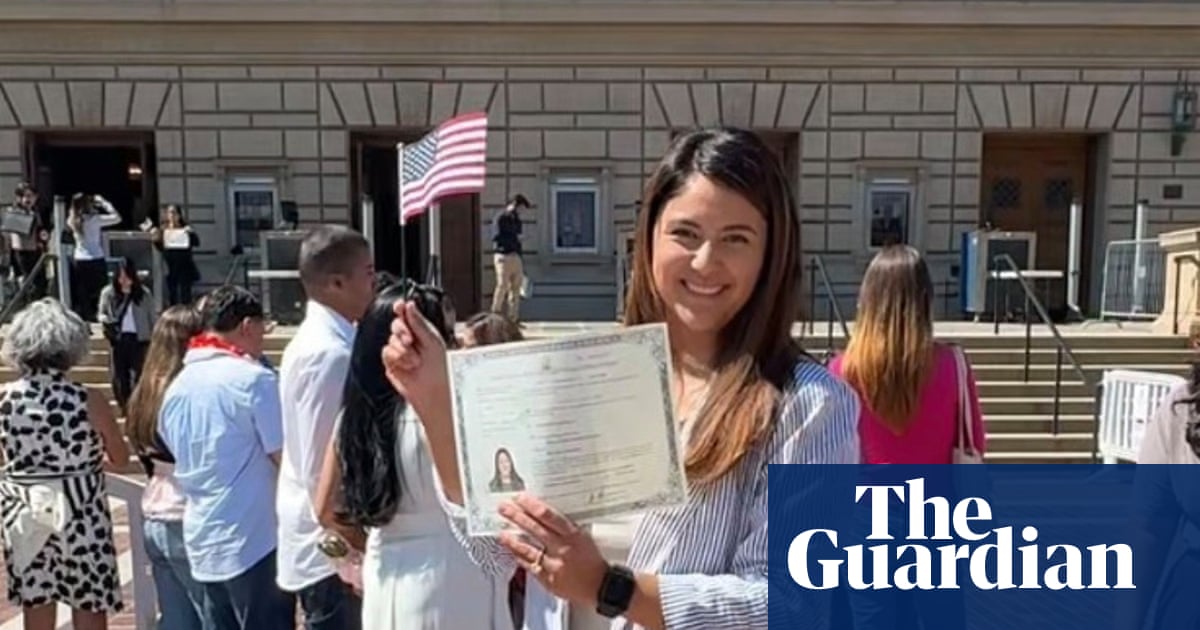
In June, Yessica McKean proudly achieved her lifelong dream of becoming a U.S. citizen. During the naturalization ceremony, she joined thousands of others in reciting an oath of allegiance, marking a significant moment as the nation approaches its 250th anniversary. For many, this occasion was deeply emotional, with some individuals quietly shedding tears of joy.
Reflecting on her journey, the 32-year-old McKean shared, “We’re finally here.” Her family emigrated from Michoacán, Mexico, when she was just two years old, settling in California as permanent residents. Currently, they reside in the picturesque town of Solvang, nestled in California’s central coast.
As a mother of two young children, McKean’s naturalization signifies the end of a prolonged and uncertain journey. Yet, amidst her pride, she is conscious of the surrounding challenges, including the memory of federal immigration arrests that have left a mark on her experience.
While she now enjoys legal protections as a citizen, McKean grapples with feelings of conflict. In a landscape where routes to immigration and citizenship are increasingly limited, her sense of true belonging remains elusive. “You see people being pushed around all the time,” she lamented. “These are just strange times,” she added, echoing sentiments shared by many new citizens as they balance pride with apprehension.
As the United States approaches this historic milestone, newly naturalized Americans express simultaneous feelings of pride and anxiety regarding their status. The naturalization process has become notably more complicated, involving longer wait times, more stringent testing requirements, and increased application fees. The current political climate has led to significant restrictions on who can immigrate and, ultimately, who can call themselves American. This raises a critical question: are they truly welcome in this country?
Despite these challenges, many new citizens find solace in the act of taking the oath. The role of community organizations, such as Asian Americans Advancing Southern California (AJSocal), plays an essential part in supporting citizenship application workshops and advocacy, as noted by CEO Dhani Tsuboi, who stated, “It’s survival” for many immigrants seeking to navigate the complexities of the naturalization process.
Financial Implications of Naturalization
Naturalization ceremonies scheduled for July 4th at historic sites, including Mount Vernon—the former home of George Washington—will serve as a poignant reminder of the country’s founding principles. Tsuboi emphasized that with each new citizen, the nation relives that founding moment. It underlines the inherent contradictions in America’s longstanding debates surrounding citizenship.
The first naturalization act, enacted in 1790, explicitly limited citizenship to “free white people.” Presidential hopeful Abraham Lincoln expanded the definition in 1858, asserting that anyone who believes in the principle that “all men are created equal” is an American. Meanwhile, the restrictive quota immigration system established in the 1920s hindered entry for most immigrants until the Hart-Celler Act of 1965 opened doors to a more diverse range of newcomers.
Despite the challenges, Eileen Bloemrad, a political science and sociology professor at the University of British Columbia, asserts that the U.S. maintains a relatively accessible naturalization process compared to nations like Qatar and Kuwait, where citizenship for immigrants is nearly unattainable. “It’s remarkable that the United States says, ‘Come here. Spend some time here. Learn a little about us, and you can be one of us,'” she noted.
However, as the nation celebrates its 250th anniversary, it must confront a resurgence of old challenges in immigration policy. The Trump administration’s aggressive stance on immigration enforcement and denaturalization has created a landscape of fear for many eligible immigrants. Tsuboi remarked on the growing hesitance among certain individuals to pursue citizenship due to fear, expense, and ongoing immigration crackdowns.
Navigating Belonging in a Changing Landscape
Despite the uncertainties surrounding immigration policy, some individuals find the benefits of citizenship outweigh the associated challenges. Kwan “Dawn” Tan, who became a citizen in June after nearly a decade of living in the U.S., illustrates this journey. As a permanent resident, Tan faced daily struggles, including the anxiety of additional screening when returning home to San Francisco.
For Tan, becoming a U.S. citizen represented liberation from the anxiety that accompanied their previous status. Yet, this newfound freedom is tempered with the understanding that their journey occurs in a climate of diminishing confidence in the U.S. as a refuge for immigrants. “At some point, I just wanted to end it all and leave,” Tan confessed about the stress of the naturalization process.
Experts, including Rogers M. Smith, a political science professor emeritus at the University of Pennsylvania, suggest that the current climate is reminiscent of the restrictive immigration policies of the 1920s. Smith points out that many of these limitations have emerged through executive action rather than legislative consensus, leading to an atmosphere that is less welcoming than it曾 was historically.
As the nation approaches its 250th anniversary, a growing segment of Americans believes that the original ideals held by the country’s founders are slipping away. Despite the surrounding apprehension, the enduring belief that the path to naturalization is a valuable pursuit remains alive at citizenship ceremonies. Ahead of Independence Day celebrations, both McKean and Tan are preparing to honor their milestones in their own unique ways, illustrating the complex emotional tapestry that defines the modern American identity.
