


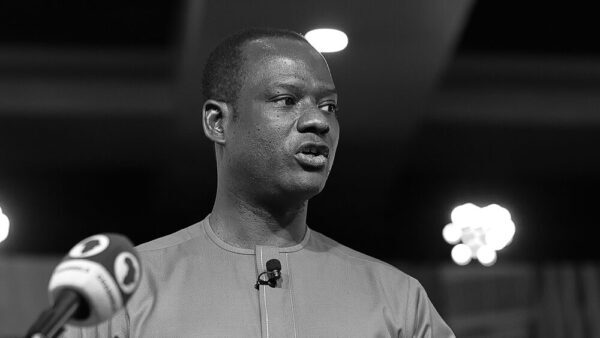
Federal Government Denies Spending Beyond Approved Budget
The Nigerian federal government has firmly rebutted allegations that it has exceeded its approved budget by more than ₦8 trillion. Officials have emphasized that all public spending is conducted within the bounds of the constitution and relevant legislation, dismissing claims of a “shadow budget.”
In a statement released on Sunday, Taiwo Oyedele, the Minister of Finance and Coordinating Minister for the Economy, labeled recent assertions—suggesting that about 2 percent of Nigeria’s GDP was expended without legislative authority—as erroneous and misleading.
These accusations reportedly stem from references made in the International Monetary Fund’s (IMF) 2026 Article IV Consultation Report, which the Minister argues misrepresents the federal government’s financial management practices.
Oyedele reiterated, “For clarity, the Federal Government does not engage in a ‘shadow budget’ or spend public funds outside the constitutional and statutory framework established for public finances.” He clarified that according to Articles 80 to 83 and 162 of the 1999 Constitution, amended, withdrawals from public funds must align with the stipulations laid out by the National Assembly.
The Minister further detailed that federal spending is governed by enacted appropriations and supplemental appropriations laws, along with other legislative approvals. He highlighted that multi-year capital projects extending beyond a single fiscal year would adhere to existing legal mandates, including necessary capital rollovers.
In response to the allegations, Oyedele challenged critics to present concrete evidence regarding the purported misallocation of funds and to specify which projects were allegedly undertaken without legal authorization. He pointed out that credible allegations should include detailed evidence of misappropriated funds.
Oyedele also underscored that Nigeria’s fiscal framework incorporates various statutory provisions, including contributions and intervention mechanisms established by Acts of Parliament. These encompass statutory allocations to development boards and agencies, levies for revenue-generating bodies, and capital expenditures sanctioned through distinct budgets.
He emphasized that these expenditures are legal, public, and subject to rigorous oversight and accountability systems. Differences between how such expenditures are documented in accounting records and their representation in annual budget laws are often a result of international reporting standards, rather than evidence of illegal spending.
The Minister dismissed any notions that the figures reported indicated a growing fiscal deficit. He explained that the budget deficit is derived from the balance between total government revenues and expenditures, clarifying that funding for sanctioned projects does not automatically lead to an increased deficit.
Additionally, Oyedele maintained that the IMF’s commentary does not question the legality of the government’s spending but instead emphasizes the need for enhancements in fiscal reporting, particularly regarding comprehensiveness and presentation. He recalled President Bola Tinubu’s advocacy for unifying overlapping budgets into a comprehensive framework during the presentation of the 2026 Appropriation Bill to the National Assembly in December 2025.
Reaffirming the Federal Government’s commitment to transparency and responsible fiscal management, Oyedele noted that ongoing reforms have bolstered budget integrity, revenue management, and the digitalization of financial processes. He acknowledged that these reforms have been recognized by the IMF, multilateral institutions, international credit agencies, investors, and major global media.
While encouraging public scrutiny of government financial practices, Oyedele urged commentators to base their discussions on verified information and a solid understanding of Nigeria’s constitutional and fiscal framework. He concluded by affirming the government’s dedication to upholding the rule of law and collaborating with various stakeholders to enhance fiscal governance in alignment with international best practices.
